


Lake Mead Dead Pool Would Force Lake Mohave to Drain
Lake Mohave works as a hydraulic buffer immediately below Hoover Dam. Water released from Lake Mead travels into the 67-mile-long reach impounded by Davis Dam, where it can be stored, regulated and released farther down the Colorado River. If Lake Mead fell too low for Hoover Dam to pass water by gravity, that buffer would keep downstream water moving temporarily but every release from Lake Mohave would then reduce its own reserves.
This is a worst-case scenario, not an imminent forecast. Lake Mead stood at roughly 1,040 feet in 2026, more than 140 feet above the stated dead-pool elevation of 895 feet. The scenario nevertheless demonstrates why a loss of outflow at Hoover Dam would not remain confined to Lake Mead: it would move progressively through a connected chain of reservoirs, dams, power plants and aqueduct intakes.
Power generation would stop before water releases
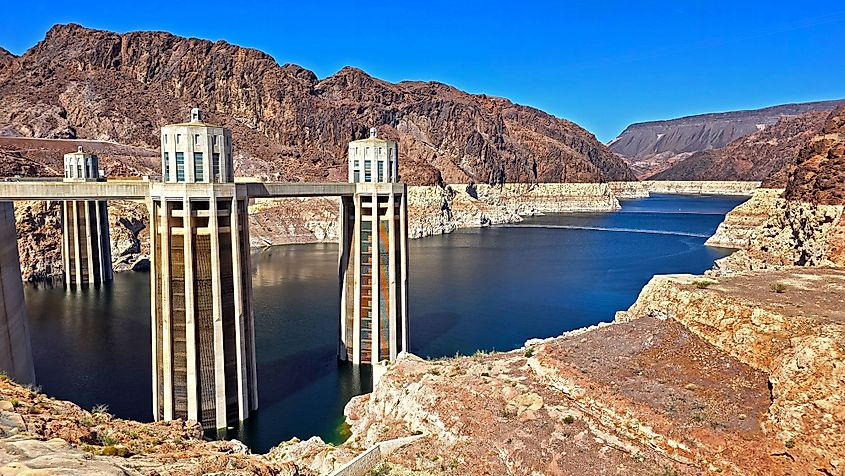
Hoover Dam has two relevant operating thresholds. At approximately 950 feet, Lake Mead would reach minimum power pool, where the reservoir would no longer provide the hydraulic head needed for normal hydroelectric generation. Water could still move downstream through other outlets.
Dead pool is lower, at 895 feet the stated bottom elevation of Hoover Dam’s intake towers. Below that point, the remaining water in Lake Mead could no longer pass through Hoover’s outlets by gravity. The dam would cease functioning as the normal upstream supply point for Lake Mohave, even though water would remain trapped in Lake Mead.
Lake Mohave holds about 1.8 million acre-feet behind Davis Dam and receives almost all its inflow from Hoover releases. That storage could be used to preserve downstream deliveries after Hoover stopped passing water. But Davis Dam would still be releasing water while little or no replacement supply arrived from above. Lake Mohave would therefore become a finite reserve rather than a continuing link in the river.
How long that reserve lasted would depend on operating decisions, delivery demands and any other inflows. The available information does not establish a specific depletion timeline. The system-level result is clearer: Lake Mohave can postpone the downstream consequences of dead pool, but it cannot eliminate them.
The shortage would move toward Lake Havasu
Continued releases from Davis Dam would send Lake Mohave’s stored water toward Lake Havasu, the next major regulating reservoir, which is held by Parker Dam. Havasu is much more than another lake in the chain. It provides intake points for the Central Arizona Project serving Phoenix and Tucson and for the Colorado River Aqueduct supplying Southern California.
The Bureau of Reclamation’s Parker Dam profile identifies the Colorado River Aqueduct intake on Lake Havasu and notes that the aqueduct extends 242 miles toward Lake Mathews near Riverside, California. Parker Dam hydropower also supports part of the energy demand associated with pumping that water.
If upstream releases remained unavailable, Lake Havasu would face the same underlying imbalance as Mohave: withdrawals and downstream releases without sufficient replenishment. Hydropower generation at Davis and Parker dams would also decline as their reservoirs lost the water levels and flow needed to operate. Reliability concerns would extend to Lower Colorado River deliveries, including treaty water for Mexico.
Las Vegas has an important but limited exception to this sequence. Its deep Lake Mead intake can pump water from below the dead-pool elevation. That gives the city access to water that gravity could no longer move through Hoover Dam, but it would not restore the missing flow into Lake Mohave or keep the downstream reservoir chain full.
Storage loss would reach beyond water deliveries
A major drawdown at Lake Mohave would reduce recreational access and shrink aquatic habitat. The reservoir supports the largest remaining wild population of the endangered razorback sucker and also provides habitat for the endangered bonytail chub. Each spring, biologists collect tens of thousands of razorback sucker larvae along Mohave’s shoreline and raise them under protected conditions. A substantially smaller reservoir would alter the habitat supporting that recovery work.
The dead-pool scenario therefore exposes a basic constraint in the Lower Colorado River’s design. Hoover, Davis and Parker dams form a gravity-dependent storage and delivery sequence, not three independent supplies. Lake Mohave’s 1.8 million acre-feet could buy time after Hoover releases stopped, but maintaining downstream flow would consume the very buffer keeping that part of the system operating.
| More aerospace and engineering stories, right in your MSN feed. Follow AMI on MSN |
By Thomas Caldwell — AMI’s senior editor for mechanical and mobility engineering, covering vehicle electronics, systems integration, electrification, chassis systems, propulsion, and safety policy.



