


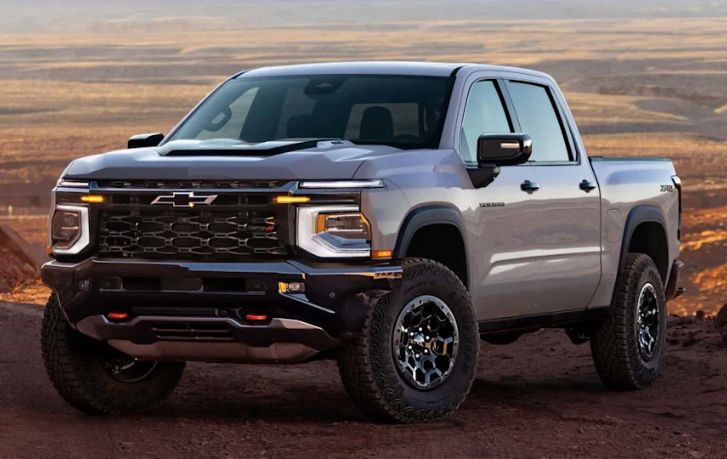
2027 Chevrolet Silverado Diesel Undercuts Optional V8 by Up to $830
Chevrolet’s 2027 Silverado 1500 configurator presents an unusual upfront-price comparison: The 3.0-liter Duramax diesel costs $50 to $830 less than the optional 5.7-liter V8 on every listed trim offering both engines. On the High Country, where the 5.7-liter V8 is standard, choosing the Duramax does not change the listed price.
The figures were displayed in Chevrolet’s U.S. Build and Price tool for Crew Cab Short Bed configurations on October 19, 2026. They include a $2,795 destination charge but exclude taxes, title costs, dealer fees and additional options. Dealers set final prices, and changing the cab, bed, drivetrain or equipment package can alter the available combinations.
The largest diesel advantage is on the Work Truck
On the Silverado WT, the Duramax adds $3,035 over the standard 2.7-liter TurboMax engine. The 5.7-liter V8 adds $3,865, making the diesel $830 less expensive than the V8. Those premiums are the same for the listed two-wheel-drive and four-wheel-drive versions.
The gap becomes much narrower on three other trims. The Duramax carries a $2,640 premium on the LT, Custom Trail Boss and Trail Boss, while the 5.7-liter V8 adds $2,690. The diesel is therefore $50 cheaper than the V8 on each of those trucks.
On the Z71, the Duramax again adds $2,640 over the TurboMax but costs $545 less than the optional 5.7-liter V8. Across these shared configurations, Chevrolet’s pricing makes the diesel the smaller step up from the base engine even though the exact advantage varies substantially by trim.
High Country prices the diesel and standard V8 equally
The High Country uses a different pricing structure because its standard engine is the 5.7-liter V8 rather than the TurboMax. Chevrolet lists the two-wheel-drive High Country at $74,495 with either the V8 or Duramax. The four-wheel-drive version is $77,595 with either engine.
That makes the diesel a no-cost alternative to the standard V8 on this trim, rather than a discounted option. Buyers can also select the larger 6.6-liter V8 on the four-wheel-drive High Country, raising its listed price by $2,800 to $80,395.
The 6.6-liter V8 has a much narrower role in the lineup. It is listed only for the four-wheel-drive High Country and ZR2 and requires 91-octane fuel. The four-wheel-drive ZR2 starts at $79,995 with its standard Duramax; selecting the 6.6-liter V8 raises that figure by $2,505 to $82,500.
Availability limits the apparent range of choices
Chevrolet lists four Silverado engines for 2027: the 2.7-liter TurboMax, 3.0-liter Duramax diesel, 5.7-liter V8 and 6.6-liter V8. They are not interchangeable across the range. The Custom is TurboMax-only in the configurations shown, while the ZR2 starts with the Duramax and offers only the 6.6-liter V8 as an alternative.
The configurator also presents the LT Crew Cab Short Bed as two-wheel-drive only. The Z71, Custom Trail Boss, Trail Boss and ZR2 configurations are four-wheel-drive only. Chevrolet’s order information further indicates that engine availability can depend on cab, bed, drivetrain and package selections, so the comparison applies specifically to the listed Crew Cab Short Bed trucks.
Upfront pricing alone cannot establish which engine will cost less to own. The federal fuel-economy database did not yet list 2027 pickups at the time these prices were checked, leaving no verified model-year figures for comparing fuel consumption. Fuel prices, maintenance requirements and operating patterns would also be needed for a defensible lifetime-cost calculation.
The immediate constraint is availability rather than long-term economics. Chevrolet marks the lowest-priced TurboMax engine as “Late availability” on every trim that offers it. If that engine is not available when a truck is ordered, the Duramax represents the smaller listed upgrade wherever it competes directly with the 5.7-liter V8 and on the High Country, it costs no more than the standard V8 at all.
| More aerospace and engineering stories, right in your MSN feed. Follow AMI on MSN |
By Thomas Caldwell — AMI’s senior editor for mechanical and mobility engineering, covering vehicle electronics, systems integration, electrification, chassis systems, propulsion, and safety policy.



