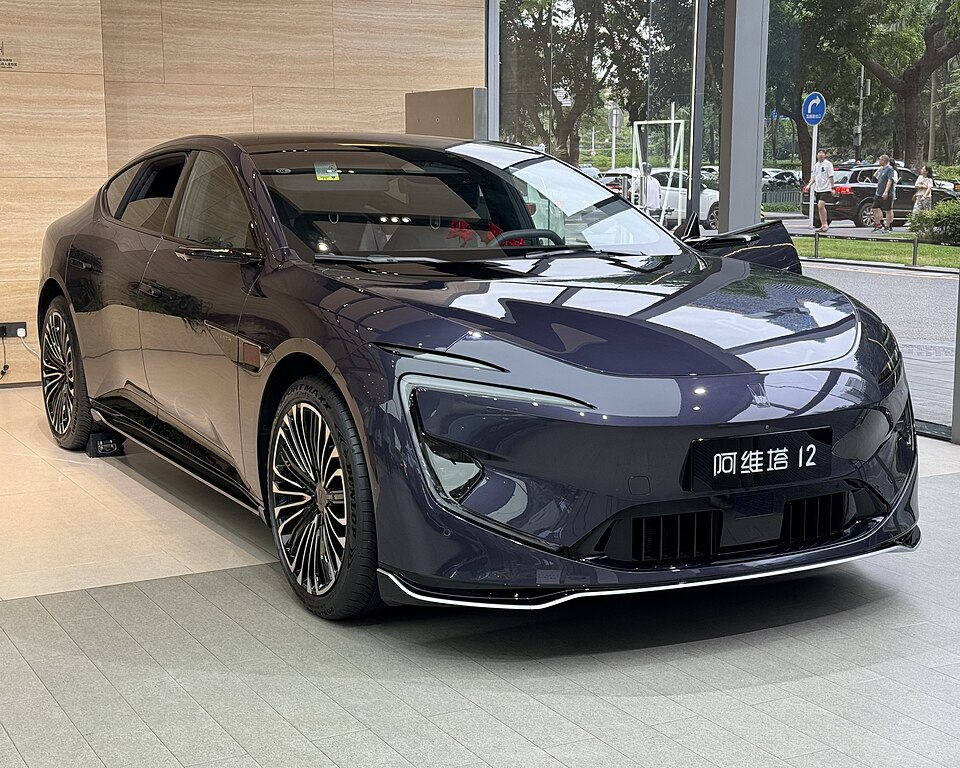
Avatr 12 Replaces Mirrors and Rear Glass, Making Visibility Electronic
The Avatr 12 removes two familiar sources of rearward vision: conventional exterior mirrors and the rear window. High-definition cameras send the side views to dedicated dashboard screens, while another camera supplies the view behind the car. The arrangement gives the Chinese electric grand coupe a cleaner exterior, but it also turns an ordinarily passive function into one dependent on cameras, displays, software and electrical power.

That trade is central to a recent hands-on design overview of the all-wheel-drive Avatr 12. The car also integrates three lidar units, electrically extending door handles, sensor-controlled power doors and an active rear spoiler. Together, these features show how aerodynamic design and automation can remove protruding or manually operated hardware while adding more electronic dependencies.
What the camera system buys
Exterior mirrors interrupt airflow and generate wind noise. Compact camera housings can reduce those effects while giving designers more freedom over body shape. Camera systems can also offer a wider field of view and electronically adjust brightness, contrast or image presentation under conditions where a fixed mirror may be less useful.
The Avatr places separate side-camera displays inside the cabin and uses a 35.4-inch panoramic screen across the base of the windshield for other vehicle information. That screen-heavy layout is consistent with the broader design: sensing and image processing replace direct optical paths wherever the body would otherwise need mirrors or rear glass.
Removing the rear window also allows the roof and rear bodywork to be shaped without preserving a driver’s sightline through the cabin. A camera view is not blocked by rear passengers, head restraints or luggage. Human-centered development of another production camera mirror found that drivers valued this unobstructed, wider perspective, although their experience varied with lighting, distance perception and visual accommodation.
The view now has failure modes
A glass mirror continues working without software or vehicle power. A camera-based view requires the complete chain lens, sensor, wiring, processor, display and power supply to remain available. A fault in the Avatr’s rear-camera chain could remove the camera-provided center rear view because there is no rear window to support a conventional optical mirror.
Environmental performance is another systems issue. Water droplets, dirt, ice, condensation and direct sunlight can degrade a camera image. Displays must also remain readable in bright daylight without becoming distracting at night. Latency, image compression, lens flare and blooming around bright lights can alter what the driver sees or how quickly an approaching object is recognized.
Display placement affects driver behavior as well. A 2024 systematic review of camera-monitor layouts found that the existing human-factors results were not fully consistent across designs and driving tasks. Several studies favored screens near traditional mirror locations, while another found advantages from displays positioned closer to the steering wheel. The implication is that a technically clear image is only part of the requirement; drivers must also find it quickly and interpret distance and motion correctly.
Regulation follows the complete visibility system
These questions have direct consequences for where a mirrorless vehicle can be certified. In a 2019 federal notice on camera-monitor systems, the National Highway Traffic Safety Administration said the U.S. rear-visibility standard required mirrors and sought information on allowing cameras as an alternative. The agency identified unresolved issues including glare, image distortion, weather exposure, display location, driver acclimation, component life, replacement cost and how drivers should be warned when a system is unavailable.
Other markets have already developed a certification path. The United Nations regulation used across numerous European and Asian countries permits camera-monitor systems and includes requirements covering field of view, contrast, image artifacts, frame rate, latency, activation and system-availability indications.
The Avatr 12 extends the same electronic-first philosophy beyond visibility. Its handles deploy electrically, its doors open under power with sensors intended to detect nearby obstacles, and its rear spoiler rises at highway speeds. The reviewed version also combines three lidar units with cameras and radar for Huawei’s driver-assistance system.
Underneath those systems is a 94.5-kilowatt-hour CATL battery and an 800-volt electrical architecture. The reviewed dual-motor version is rated at a combined 578 horsepower and 650 newton-meters, with a claimed 0-to-60-mph time of 3.9 seconds. Its roughly 430-mile range figure comes from a Chinese test cycle, not an official U.S. rating.
The car’s most consequential innovation is therefore not its acceleration or display size. It is the transfer of everyday functions from passive hardware to interconnected electronics. Cleaner airflow and greater design freedom are the gains; reliable vision, clear failure warnings and safe human interaction become the engineering and certification price.
| More aerospace and engineering stories, right in your MSN feed. Follow AMI on MSN |
By Thomas Caldwell — AMI’s senior editor for mechanical and mobility engineering, covering vehicle electronics, systems integration, electrification, chassis systems, propulsion, and safety policy.