


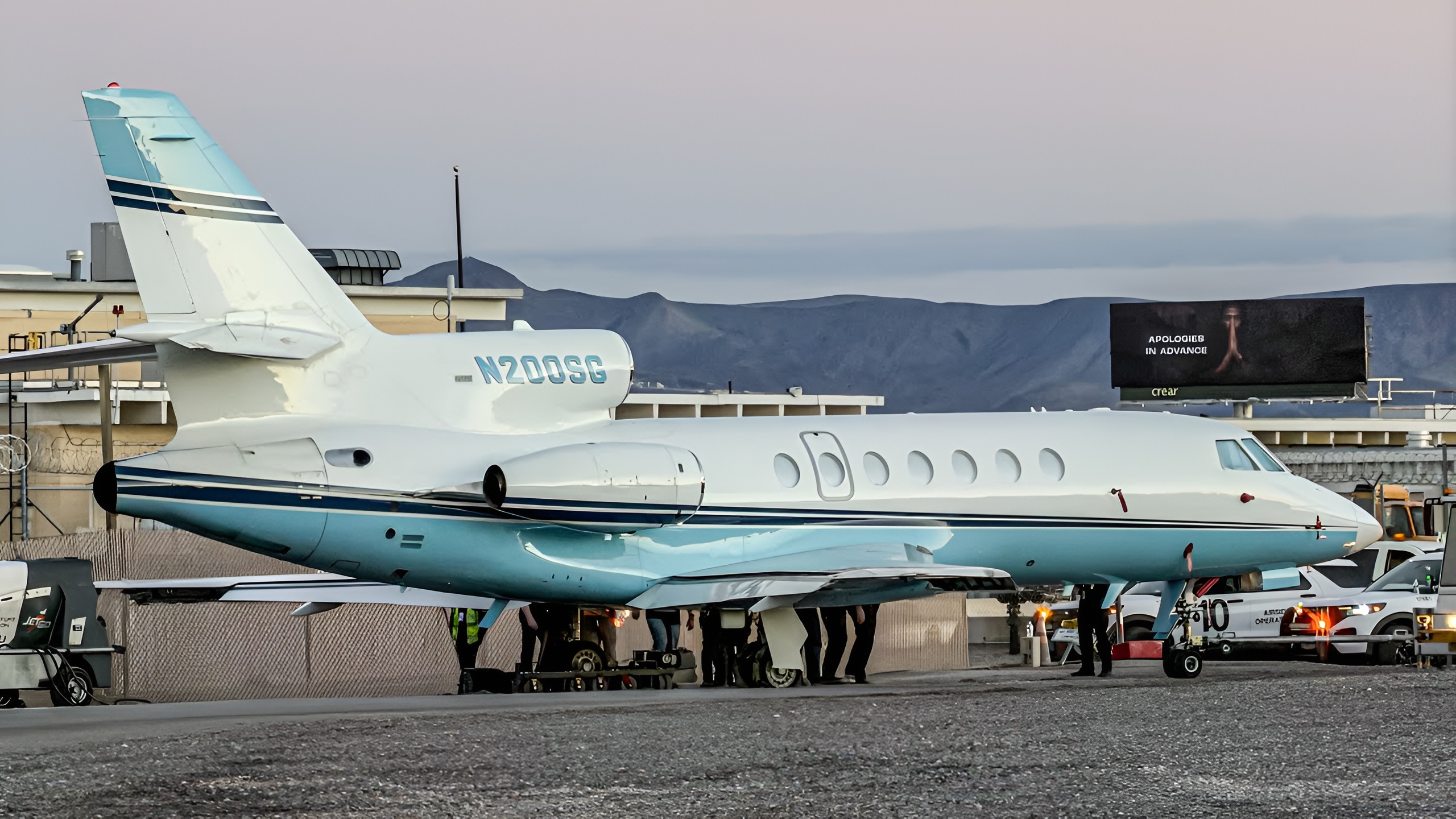
FAA Investigates Falcon 50 Overrun at Harry Reid; Eight Aboard Uninjured
The Federal Aviation Administration is investigating why a Dassault Falcon 50 carrying actor Donnie Wahlberg and seven other people rejected takeoff at Harry Reid International Airport on Sunday morning, ran beyond the runway and struck the airport’s perimeter fence. No injuries were reported.
The excursion also affected traffic beyond the private jet. An arriving passenger aircraft was directed to discontinue its landing, and the airport imposed a ground stop. The available information does not establish how long that interruption lasted.
The abort is confirmed, but its trigger is not
Air traffic control audio establishes the essential operational sequence without explaining its cause. The Falcon 50 received takeoff clearance, and a controller later asked whether the aircraft was okay. A crew member responded, “Aborting, aborting.” Emergency vehicles were dispatched after the jet left the runway.
The FAA has not identified what prompted the rejected takeoff. No mechanical malfunction, crew action or environmental condition has been announced as the cause. The aircraft remained beyond the perimeter fence behind yellow tape after the event, while the damaged fence had been repaired.
Pilot and aviation expert Reed Yadon estimated that the Falcon 50 could have been traveling close to 150 mph, but that figure is an outside estimate rather than a measured speed released by investigators. Its value is therefore contextual: it illustrates the substantial energy that may be involved in a late takeoff rejection, not the jet’s confirmed speed or the point at which the crew made its decision.
Investigators need to reconstruct two linked decisions
The investigation must determine both what prompted the crew to reject the takeoff and why the aircraft could not stop on the available paved surface. Those questions are connected, but they are not interchangeable. A valid reason to abort can still lead to an overrun if little runway remains, while stopping performance can also be affected by aircraft condition and the operating environment.
Yadon said investigators could examine mechanical and human factors, training records and aircraft maintenance records. He also identified the cockpit voice recorder and airport security cameras as potential sources of information. Those are his expectations about likely investigative avenues; the FAA has not published a formal evidence list or preliminary finding.
Recorded cockpit information could help establish what the crew detected, when the rejection began and how the pilots coordinated their response. Airport cameras could provide an independent timeline of the ground roll and the aircraft’s path after leaving the pavement. Maintenance documents and physical examination could then be compared with those records rather than treated as stand-alone proof of a failure.
This evidence-led reconstruction is particularly important because a runway excursion describes an outcome, not a cause. SKYbrary’s aviation-safety gui dance defines the category broadly to include an aircraft overrunning or veering off a runway during takeoff or landing. Possible contributing conditions vary widely, so the physical fact that the Falcon 50 crossed the runway end does not identify what initiated the event.
The airport response contained a wider traffic risk
Once the Falcon 50 was no longer contained on the runway, air traffic control had to protect the surrounding operation. Waving off an arriving passenger jet removed an immediate traffic conflict, while the ground stop limited additional aircraft movement as emergency crews responded and the airport assessed the affected area.
The intact outcome for all eight occupants does not erase the operational consequence. A runway-end event can obstruct movement areas, interrupt arrivals and departures, damage airport infrastructure and require rapid coordination among controllers, rescue personnel and airport operators. International guidance reflects that system-wide exposure: the Global Action Plan for the Prevention of Runway Excursions directs recommendations to aircraft operators, airports, air-navigation providers, manufacturers and regulators rather than assigning prevention to a single participant.
Runway-end protections can also include cleared safety areas or, where appropriate, crushable engineered material intended to absorb an aircraft’s energy. FAA data examined by InvestigateTV showed such arresting systems had helped stop aircraft in 26 overruns at the time of its analysis. Their effectiveness depends on aircraft weight, speed and installation design, and the available information does not identify whether such a system was installed or engaged on the runway used by the Falcon 50.
The FAA investigation now has to replace estimates with a verified timeline: the condition that prompted the abort, the point and speed at which it began, the aircraft’s stopping response and the path that carried it through the perimeter. Until those elements are established, the strongest confirmed result remains unusually narrow but consequential eight people escaped injury after a rejected takeoff ended beyond the airport fence, while controllers stopped other traffic from entering the event.
| More aerospace and engineering stories, right in your MSN feed. Follow AMI on MSN |
By Thomas Caldwell — AMI’s senior editor for mechanical and mobility engineering, covering vehicle electronics, systems integration, electrification, chassis systems, propulsion, and safety policy.



