


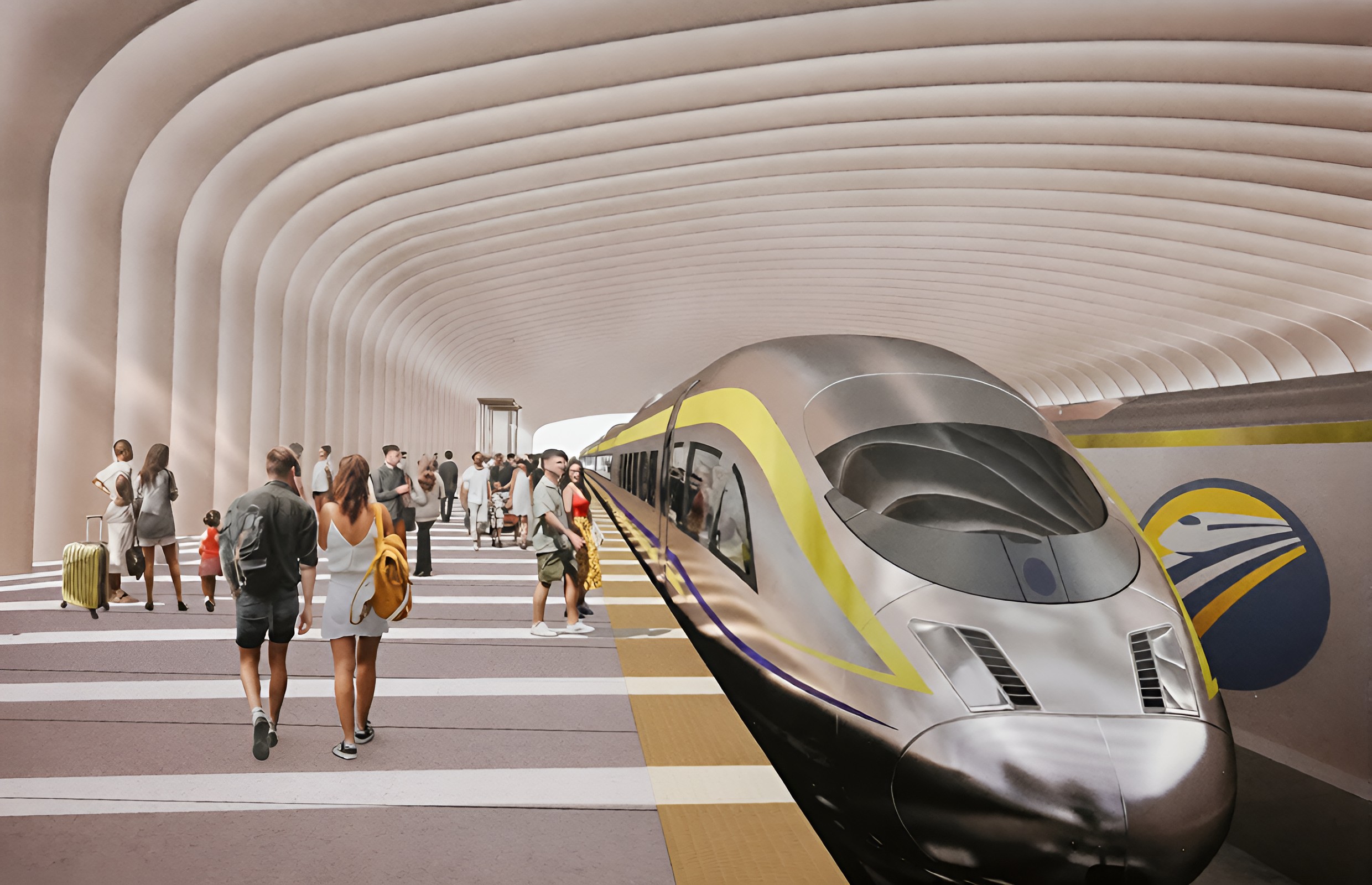
Federal Government Pulls $4 Billion From California High-Speed Rail, Redirects It Nationwide
The federal government has withdrawn $4 billion from the California High-Speed Rail project and begun redirecting the money to other rail investments around the country. The action converts California’s cost and schedule problems into a broader public-funding decision: money once reserved for one major system will now be divided among competing projects, while California must pursue its initial operating line with fewer federal resources.
The U.S. Department of Transportation acted after a Federal Railroad Administration compliance review of more than 300 pages. Federal officials said the California High-Speed Rail Authority had a major funding gap, lacked a credible path to timely completion and overstated projected ridership. The department said the authority received two opportunities to respond but did not satisfy the grant terms. California challenged the withdrawal in court before dropping its lawsuit.
The immediate engineering consequence is not a construction shutdown. Federal money accounts for 18% of the project’s funding, so California can continue work using other sources. The loss instead reduces financial flexibility on a program already described as substantially behind schedule and facing an estimated total cost of $231 billion an 83% increase, according to a California Legislative Analyst’s Office estimate cited in accounts of the project.
Construction progress does not close the funding gap
California’s response rests on tangible progress. Gov. Gavin Newsom’s office says 171 miles between Bakersfield and Merced are under construction, 94% of the planned path is environmentally cleared and construction-ready, and the program has created more than 19,000 jobs. Those figures show that the project is more than a proposal, but they address different delivery stages and cannot be treated as interchangeable measures of completion.
Environmental clearance is a legal and planning prerequisite, not a funded construction package. It establishes where infrastructure may proceed after required review, but it does not by itself provide the contracts, labor, materials, utility relocation, land access or systems integration needed to open passenger service. The distinction becomes especially important on a network intended to connect distant metropolitan areas: completed structures in one region do not create a usable railway until track, power, signaling, stations, rolling stock and operating procedures function as an integrated system.
The project’s financing problem therefore has two layers. California needs enough money to finish a serviceable section, and it needs a credible plan for extending that section into a network that attracts the ridership used to justify the investment. High-speed rail generally works best on densely traveled corridors where passenger demand can support comparatively high construction and operating costs. An OECD assessment of high-speed-rail economics notes that long cost-recovery periods usually require government involvement and can expose governments to substantial debt when demand develops more slowly than expected.
Reallocation creates winners as well as a California shortfall
Redirecting the $4 billion does not remove it from rail policy. It changes which communities and projects receive the federal benefit. Other applicants may gain money for projects with shorter delivery horizons, narrower scopes or more mature financing plans. California residents, prospective passengers and workers face the opposite tradeoff: construction may continue, but the state has less outside funding available to absorb cost growth or complete additional segments.
That shift also changes how taxpayers’ exposure is distributed. Concentrating billions in one high-cost intercity system can produce a transformative network if the complete operating corridor is delivered. Distributing the money among multiple projects may support more locations and reduce dependence on one program, but it may also divide funding into improvements that lack the scale of a new statewide high-speed line. The reallocation alone does not establish which approach will produce greater transportation value; that depends on the replacement grants’ scopes, costs and completed benefits.
The dispute over motivation remains separate from the documented compliance findings. Transportation Secretary Sean Duffy called the project mismanaged and said federal funding comes with an obligation to deliver results. Newsom’s office characterized the withdrawal as politically motivated. Reason Foundation representatives questioned whether the existing California plan was feasible while also arguing that political considerations appeared to influence the decision. Because the grants were discretionary, the federal government retained authority over them.
California’s remaining challenge is measurable rather than rhetorical: it must match construction already underway with enough committed funding to open a useful passenger route, while supporting its schedule and ridership assumptions. Meanwhile, the withdrawn $4 billion will be judged by what the replacement rail projects actually deliver not merely by where the money is sent.
| More aerospace and engineering stories, right in your MSN feed. Follow AMI on MSN |
By Thomas Caldwell — AMI’s senior editor for mechanical and mobility engineering, covering vehicle electronics, systems integration, electrification, chassis systems, propulsion, and safety policy.



