


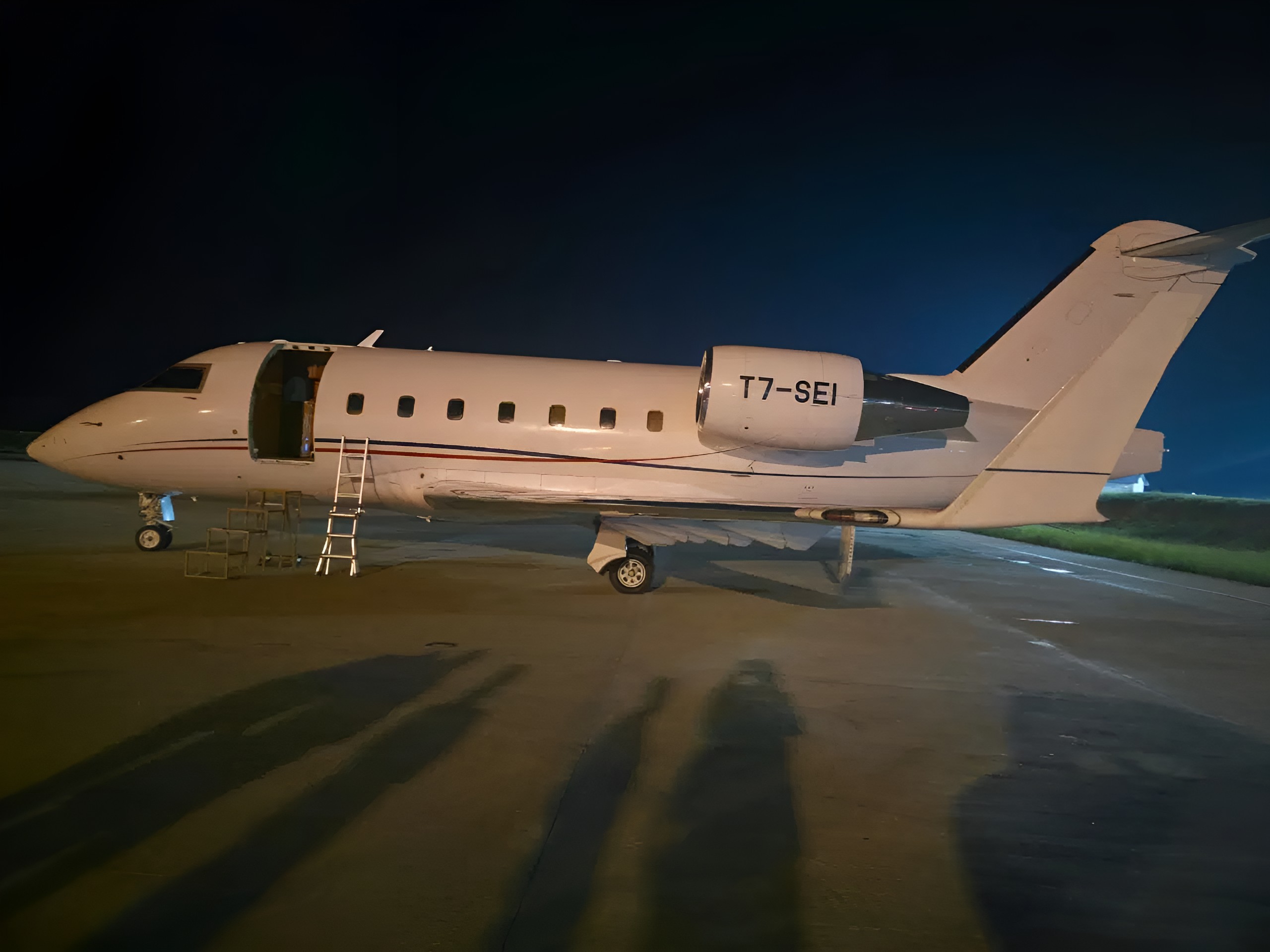
Nigeria Investigates Challenger 604 Door Separation After Nine Return Safely
Nigeria’s Safety Investigation Bureau has opened an investigation after a Triton Aviation Challenger 604 lost a door during its climb from Abuja with nine people aboard. The crew declared an emergency and returned safely to Nnamdi Azikiwe International Airport, but investigators have not identified a mechanical, maintenance or operational cause.
The aircraft, registered T7-SEI and operating as flight DWC052, departed for Lagos at 1612 UTC on October 15, 2026. The bureau said the door separated three nautical miles from the airport as the business jet passed 3,500 feet. The Challenger landed on Runway 22 at 1634 UTC with six passengers and three crew members.
An incident report cited by Punch placed the aircraft at approximately 3,000 feet when the distress call was made, a modest difference from the bureau’s initial account. Establishing the precise altitude, aircraft configuration and sequence of events will be part of reconstructing the occurrence from flight information, crew accounts, air-traffic-control records and physical evidence.
The recovered door is a central piece of evidence
The separated door has been recovered and secured at the bureau’s wreckage hangar, according to NSIB chief executive Alex Badeh. That gives investigators an important physical counterpart to the aircraft itself: they can examine both the recovered component and the area from which it separated rather than relying only on crew observations or controller communications.
The examination can document the condition of the door, its attachment and locking system, and corresponding structures on the fuselage. Investigators can also compare physical marks and damaged interfaces to determine how components moved during the separation. Maintenance records, inspections and previous work can then be checked against the hardware’s observed condition. Those are investigative avenues, not findings; the bureau has not linked the occurrence to any particular part, procedure or maintenance action.
The exact type and function of the separated door have not been specified in the available official account. That detail will affect which components, indications and operating requirements become central to the technical examination. Until investigators identify the door and publish findings, conclusions based on other aircraft designs would be premature.
A safe return does not answer the cause question
The crew asked Abuja tower controllers whether they could determine if the door was open. A controller attempted to inspect the aircraft using binoculars but could not confirm its condition because of the jet’s position. Airport fire, rescue and medical personnel were placed on standby, and a controller reportedly observed the missing door after the landing. The aircraft was then marshalled to the international apron extension.
That sequence illustrates a human-factors constraint during an abnormal return: crews and controllers may have incomplete visual information while still needing to stabilize the situation, coordinate airport support and land the aircraft. The emergency response put specialist personnel in position without requiring the crew to wait for a definitive external assessment that the tower could not provide.
The landing ended the immediate emergency without reported injuries, but it did not reduce the importance of determining why a major aircraft component separated during climb. The investigation must distinguish among the component’s physical condition, its installation and locking arrangement, maintenance history and the aircraft’s operational state. None has been identified as causal.
Another door separation shows why physical recovery matters
A different in-flight separation in January 2024 demonstrates the level of component by component work such investigations can require. After a door plug separated from an Alaska Airlines Boeing 737-9, the US National Transportation Safety Board recovered the plug and examined surrounding fittings, assemblies and missing securing components. The NTSB investigation page documents that physical evidence.
The Boeing event involved a different aircraft, door arrangement and set of circumstances, so it offers no explanation for the Challenger occurrence. Its relevance is methodological: recovering a separated component allows damage patterns and attachment hardware to be assessed alongside records and data rather than inferred from the opening left in the fuselage alone.
NSIB says further updates will follow as it works to establish the circumstances. For the Challenger 604 investigation, the strongest evidence now includes the returned aircraft, the recovered door and records covering a 22-minute flight that began as a routine departure and ended back on Runway 22.
| More aerospace and engineering stories, right in your MSN feed. Follow AMI on MSN |
By Thomas Caldwell — AMI’s senior editor for mechanical and mobility engineering, covering vehicle electronics, systems integration, electrification, chassis systems, propulsion, and safety policy.



