


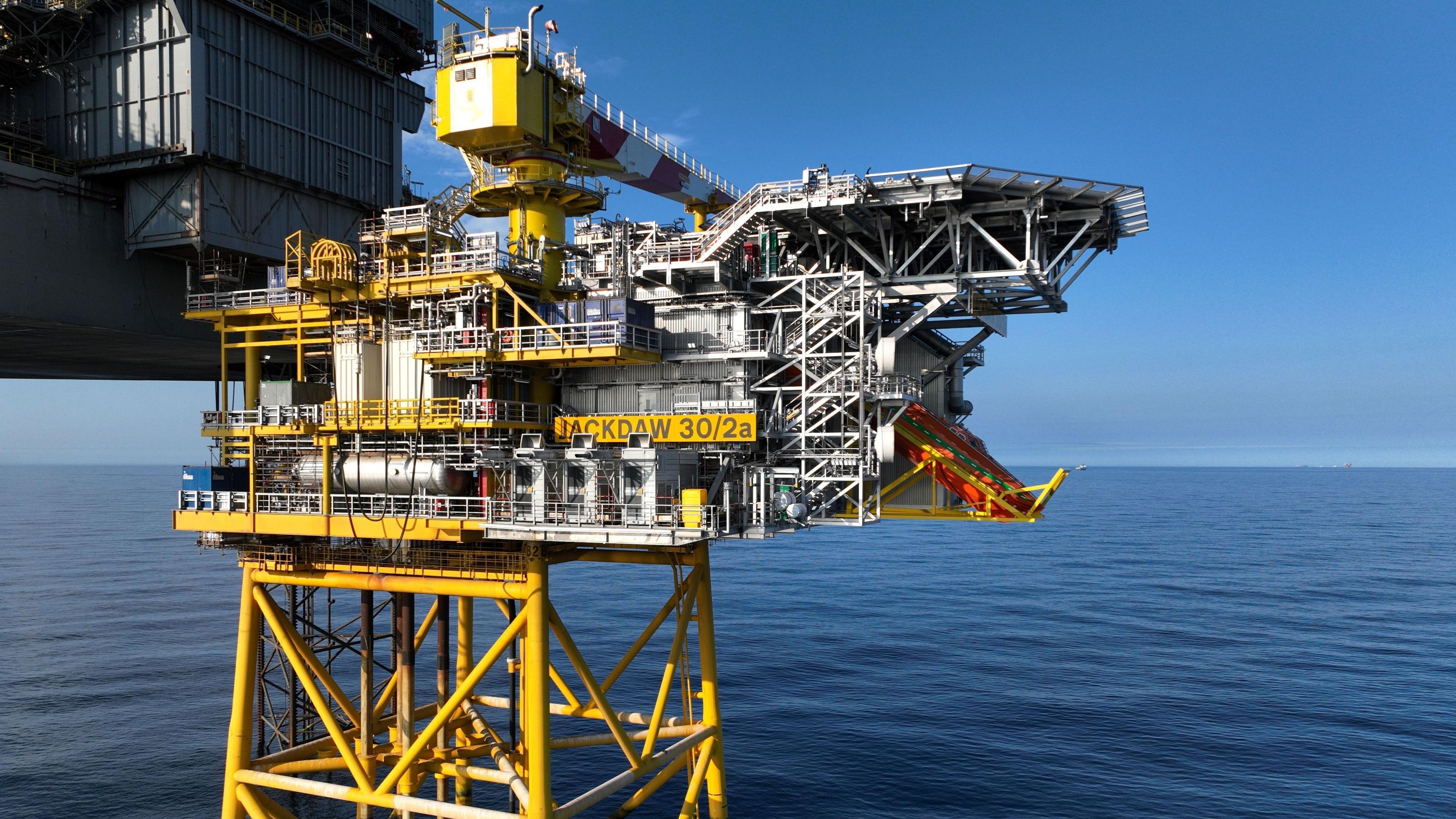
Jackdaw Gas Approval Projects 6% Domestic Output Boost as Aberdeen Turbine Fight Returns
The UK has approved development of the Jackdaw gas field, which the government projects could raise domestic gas production by about 6% at peak. The decision arrived as Donald Trump renewed his unsuccessful campaign against the separate 11-turbine Aberdeen Bay Wind Farm, bringing two technically distinct energy systems into the same public dispute.
Jackdaw lies about 150 miles east of Aberdeen and will produce natural gas, while the wind farm generates electricity offshore from Aberdeenshire. Trump welcomed the gas-field decision, called for North Sea production at “FULL BLAST” and again urged the removal of turbines visible from his golf resort. His earlier legal challenge reached the UK Supreme Court but failed to stop the wind project. No removal has been approved, and its operating status has not changed.
Gas supply and wind generation serve different needs
The comparison is politically potent but technically imperfect. Gas from Jackdaw would enter a fuel market supplying homes, businesses, industrial users and power generation. Aberdeen Bay feeds electricity into the grid. One cannot directly replace the other without changes to heating equipment, industrial processes, power plants, transmission capacity and consumer demand.
Jackdaw’s projected 6% contribution refers to UK domestic gas output at peak, not to 6% of the country’s total energy consumption or a guaranteed reduction in imports. It is still a material addition from one field, particularly in an ageing North Sea basin, but the production figure does not translate directly into lower household bills. British wholesale gas prices respond to wider international markets, where supply disruptions can outweigh the output of an individual domestic project.
The approval therefore addresses supply origin more clearly than affordability. Producing more gas domestically may reduce reliance on imported volumes at the margin and preserve work for North Sea contractors, but consumers remain exposed to market pricing. The government says Jackdaw could support hundreds of jobs, contribute an estimated £2.9 billion to the economy and begin supplying customers as early as the end of the month. Those are projected benefits rather than completed results.
Eleven turbines carry a different engineering value
Completed in 2018, Aberdeen Bay was built as a test and demonstration center for newer offshore-wind technology. Operator Vattenfall lists an installed capacity of 93.2 megawatts and expected annual production of 312 gigawatt-hours, enough electricity for approximately 80,000 British households. Its published project specifications identify nine 8.4-megawatt turbines and two 8.8-megawatt machines.
The site also tested suction-bucket foundations rather than conventional monopiles and was used to study marine effects. Its value consequently extends beyond the electricity generated by 11 machines: it served as a deployment platform for technology and installation methods intended to inform later offshore projects.
That function does not erase local objections over landscape and tourism. Trump bought the Menie estate roughly eight miles north of Aberdeen in 2006 and argued that the visible turbines would damage both. But removing an operating wind farm would require decisions by the relevant owners and authorities, not a demand from a neighboring property owner or foreign officeholder.
The policy conflict is about transition timing
The affected groups also encounter different tradeoffs. North Sea workers and suppliers see Jackdaw as a source of employment and continuity for offshore expertise. Energy users gain another domestic source of gas but no assured bill reduction. Communities near renewable developments bear visual and local environmental effects, while the wider grid receives low-carbon electricity. Environmental groups oppose Jackdaw because burning additional gas produces emissions and, in their view, strains the UK’s commitment to reach net-zero greenhouse-gas emissions by 2050.
The emissions calculation is more complex than labeling domestic gas either secure or incompatible with transition policy. Extraction and transport create emissions, and the much larger carbon impact occurs when customers burn the gas. Domestic production could displace some imported fuel, but climate performance ultimately depends on consumption: replacing gas boilers, industrial combustion and fossil-fueled generation with low-carbon alternatives requires equipment, grid capacity and investment that cannot be changed instantly.
Jackdaw and Aberdeen Bay therefore represent parallel components of the UK energy system, not opposing versions of the same machine. The immediate decision authorizes a new domestic gas supply, while the renewed turbine demand has produced no comparable change. The enduring constraint is that Britain is trying to maintain fuel security and offshore employment while building the electrical infrastructure needed to reduce gas use over time.
| More aerospace and engineering stories, right in your MSN feed. Follow AMI on MSN |
By Thomas Caldwell — AMI’s senior editor for mechanical and mobility engineering, covering vehicle electronics, systems integration, electrification, chassis systems, propulsion, and safety policy.



