


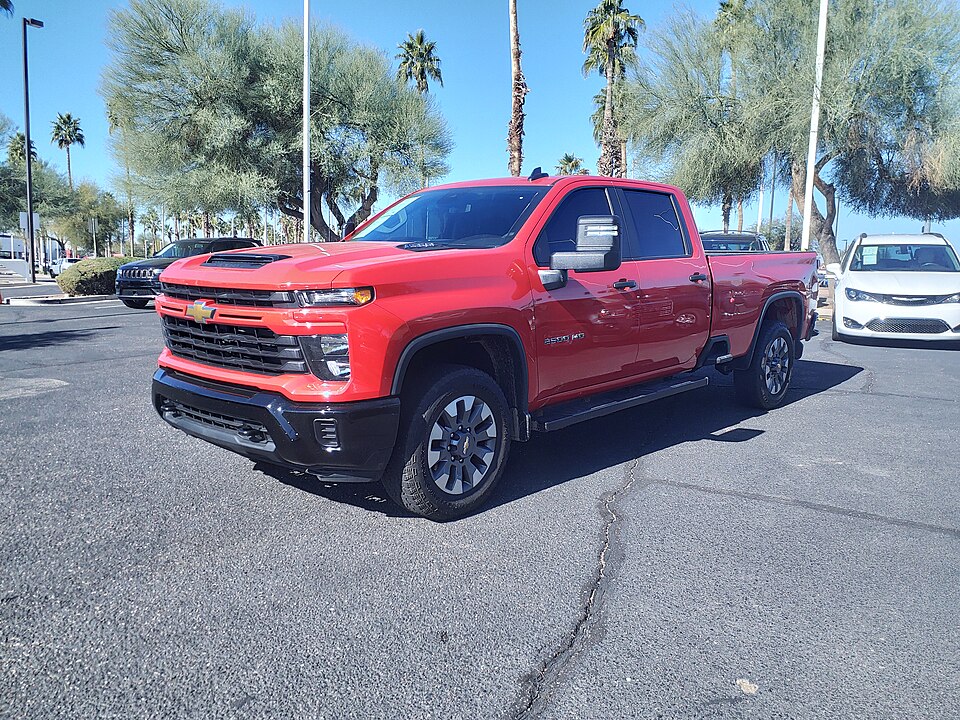
Silverado Owner Sues GM Over $41,319 Repair After Alleged Cooler Failure
A 2024 Chevrolet Silverado 2500 HD with about 16,453 miles is at the center of a dispute over how one alleged component failure became a $41,319.79 repair estimate. Owner Robert Hubof claims an oil-cooler breach contaminated the truck’s cooling and lubrication systems, damaged its engine and left him responsible for the bill after General Motors did not provide full warranty coverage.

Hubof filed a proposed class-action lawsuit against GM in federal court in Michigan on September 24, 2026. He alleges that GM concealed an oil-cooler defect affecting certain heavy-duty trucks and attributed resulting engine damage to poor maintenance. The claims have not been adjudicated, and the lawsuit does not establish a fleetwide defect. GM said it generally does not comment on pending litigation.
Why a cooler problem could become an engine problem
An engine-oil cooler is a heat exchanger with two separate fluid paths. Engine oil circulates through one path while coolant passes through another, carrying heat toward the radiator without mixing with the lubricant. The internal barrier separating those circuits is therefore a small component boundary with system-level consequences if it fails.
The lawsuit alleges that a crack can allow pressurized oil to enter the cooling system or escape from the truck. Oil diverted into the coolant reservoir is also oil no longer circulating through the engine’s lubrication system. If the loss becomes large enough, bearings and other loaded surfaces can operate without adequate lubrication, potentially producing extensive damage and metal debris.
Contamination also expands the repair boundary. Replacing the cooler alone may stop the original leak, but it does not necessarily remove oil already distributed through the reservoir, hoses and other cooling-system passages. GM issued an August 2024 service update for certain 2024 Silverado and Sierra 2500 HD and 3500 HD diesel trucks that directed dealers to inspect for possible coolant contamination. The listed response included coolant-system cleaning and replacement of multiple contaminated parts, requiring substantially more work than exchanging one cooler.
A March 2025 GM repair bulletin covering a broad range of the company’s vehicles said oil in coolant may be caused by a leaking engine-oil cooler. Because that bulletin was a general diagnostic and repair document, it did not identify every Silverado HD as defective. A service bulletin or update gives technicians instructions; it is not, by itself, a safety recall or an official defect determination.
The sequence is central to the warranty dispute
Hubof says he heard a loud bang in June 2025 and then found oil in the coolant reservoir and fluid leaking underneath the Silverado. According to the complaint, a GM technician found engine oil in the cooling system and metal debris in the oil system.
Those findings describe damage in two connected circuits, but the lawsuit asks the court to determine responsibility for it. Hubof alleges that GM treated the low-oil condition as a maintenance problem and sometimes covers only cooler replacement even when an engine also requires replacement. GM has not provided its substantive court response to those allegations.
The engineering and contractual questions overlap: Did inadequate maintenance cause the engine to run low on oil, or did an internal leak remove oil from a properly maintained engine first? Service records, the location of contamination, component inspection and the technician’s documented findings could all bear on that sequence.
The Federal Trade Commission’s warranty guidance says coverage cannot be denied merely because routine maintenance was performed outside a dealership. It also notes that warranty companies may request maintenance records and that coverage can be denied for damage caused by an improperly installed or defective aftermarket part. Those general rules do not resolve Hubof’s case, but they explain why receipts and written diagnostic findings become important when maintenance is cited in a denial.
One lawsuit is not a defect trend
Hubof is seeking to represent other purchasers and lessees, but the proposed class has not been certified. Establishing a broader defect would require more than one owner’s repair experience: investigators or a court would need evidence about affected configurations, failure frequency, common causation and whether the same condition produced comparable damage across multiple trucks.
This oil-cooler dispute is also separate from the federal investigation involving nearly one million GM pickups and sport utility vehicles with L87 engines. That investigation followed a 2025 recall covering nearly 600,000 vehicles from the 2021 through 2024 model years over supplier quality issues. It should not be used as evidence that the oil-cooler allegations involving Hubof’s heavy-duty Silverado have been substantiated.
NHTSA explains that complaints are reviewed with manufacturer information and other data through a risk-based process; there is no fixed complaint count that automatically opens an investigation. Owners who believe a problem could constitute a safety defect can file a complaint and review the agency’s investigation and recall resources.
The next significant evidence will come from GM’s formal response, the court’s treatment of the proposed class and any additional documented failures involving the same hardware. Until then, the immediate issue remains sharply defined: whether an allegedly failed cooler or owner maintenance came first and who must absorb the $41,319.79 cost of the damage that followed.
| More aerospace and engineering stories, right in your MSN feed. Follow AMI on MSN |
By Thomas Caldwell — AMI’s senior editor for mechanical and mobility engineering, covering vehicle electronics, systems integration, electrification, chassis systems, propulsion, and safety policy.




