


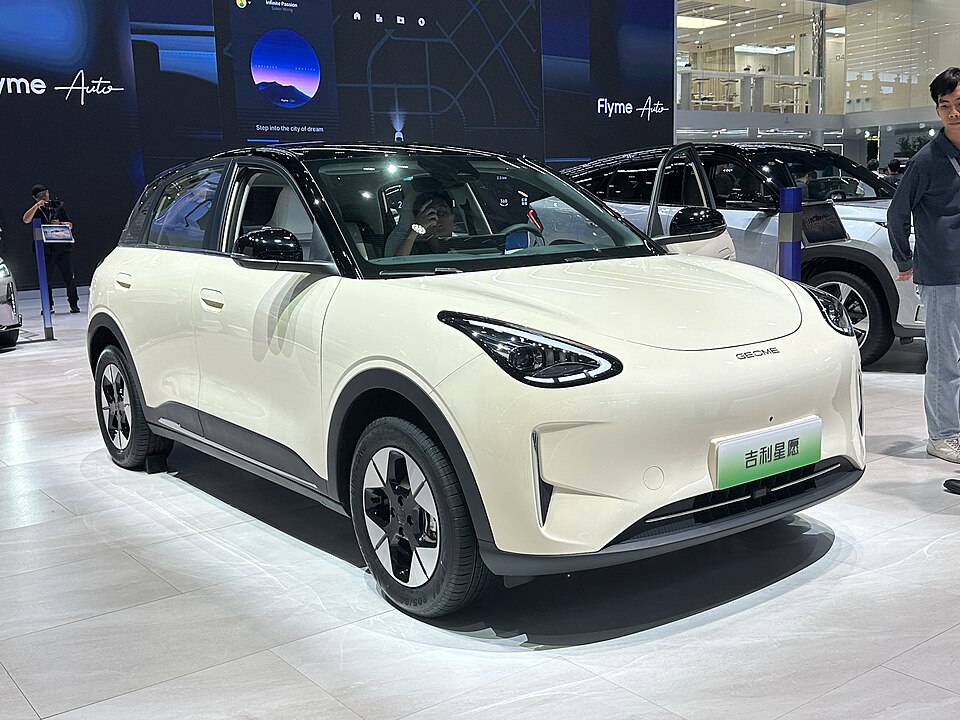
Geely E2 Costs R339,900 in South Africa, Nearly Double China Price
The Geely E2 Aspire costs R339,900 in South Africa, compared with a converted Chinese price of R178,397. That makes the South African version about R161,500 or 91% more expensive, even though the E2 is positioned as one of the country’s more affordable electric vehicles.

The comparison is less extreme for the higher-specification E2 Apex, but the gap remains substantial. Its Chinese price of 94,800 yuan was equivalent to R234,774 at the exchange rate used in TopAuto’s analysis, while the South African price was R389,900. That is a difference of approximately R155,100, or 66%.
China and South Africa prices side by side
In China, the Aspire and Apex are listed at 71,800 yuan and 94,800 yuan, respectively. In South Africa, the same two variants cost R339,900 and R389,900. The comparison therefore shows more than a general difference between two markets: the lower-priced Aspire attracts the larger proportional premium.
Exchange-rate conversions alone cannot reproduce the cost of placing an imported vehicle in a South African showroom. An importer must account for border taxes, transport, insurance, distribution and retail costs. Exchange rates can also move between procurement, customs clearance and final sale.
Cars imported into South Africa from outside the European Union and United Kingdom are subject to a 25% customs duty, regardless of whether they use an electric or combustion powertrain. Value-added tax is then calculated at 15% on 110% of the vehicle’s declared value. An additional ad valorem duty applies on a sliding scale, so its contribution depends on the vehicle’s value rather than being one uniform percentage for every model.
TopAuto estimated that shipping and insurance could add another R30,000. Its comparison also included an estimated 4% dealer margin. These charges explain a meaningful portion of the increase, but the analysis still found a noticeable difference between the resulting cost estimate and the E2’s South African retail prices.
Export margins may account for part of the remainder
The unresolved portion cannot be assigned to a single cost with precision from the published figures. TopAuto attributed part of it to manufacturers earning higher margins outside China, where intense domestic competition places pressure on vehicle prices.
Geely’s chief financial officer previously said the company’s export gross margins were about 10 percentage points higher than its domestic margins. That company-level statement supports the broader export-margin explanation, although it does not disclose the exact margin built into either South African E2 variant.
Figures reported for BYD illustrate a similar market split, but they should be treated as a comparison rather than a direct measure of Geely’s pricing. BYD’s reported foreign-market gross margin was 21.71% in 2026, against 15.67% in China. In 2025, the corresponding figures were 19.46% and 16.66%. Those numbers show how an automaker can accept tighter margins in China while securing more revenue per vehicle abroad.
Pricing also has to support costs that are difficult to isolate in a simple import calculation, including local distribution and the commercial risks of operating in a smaller export market. The available comparison does not provide a complete model-level breakdown of those expenses, so the remaining difference is best understood as a mixture of unitemized market costs and a potentially higher export margin not as a confirmed measure of excess profit on each E2.
Still cheaper than many established alternatives
The premium over China creates an unusual market position. South African buyers pay far more than Chinese buyers for the E2, yet Chinese vehicles can still undercut many established-brand alternatives locally. Some new Chinese models now compete on price with used Volkswagen Polo and Toyota Corolla Cross vehicles, increasing pressure on the second-hand market as well as on incumbent manufacturers.
That competitive pricing does not erase the E2’s country to country gap. Instead, it shows how low the vehicle’s domestic Chinese baseline is and how much cost and margin can accumulate before an exported car reaches a South African showroom. For the Aspire, identifiable taxes, shipping, insurance and an estimated dealer margin narrow the difference, but they do not fully bridge the R161,500 divide between its converted Chinese price and its South African sticker price.
| More aerospace and engineering stories, right in your MSN feed. Follow AMI on MSN |
By Thomas Caldwell — AMI’s senior editor for mechanical and mobility engineering, covering vehicle electronics, systems integration, electrification, chassis systems, propulsion, and safety policy.




