


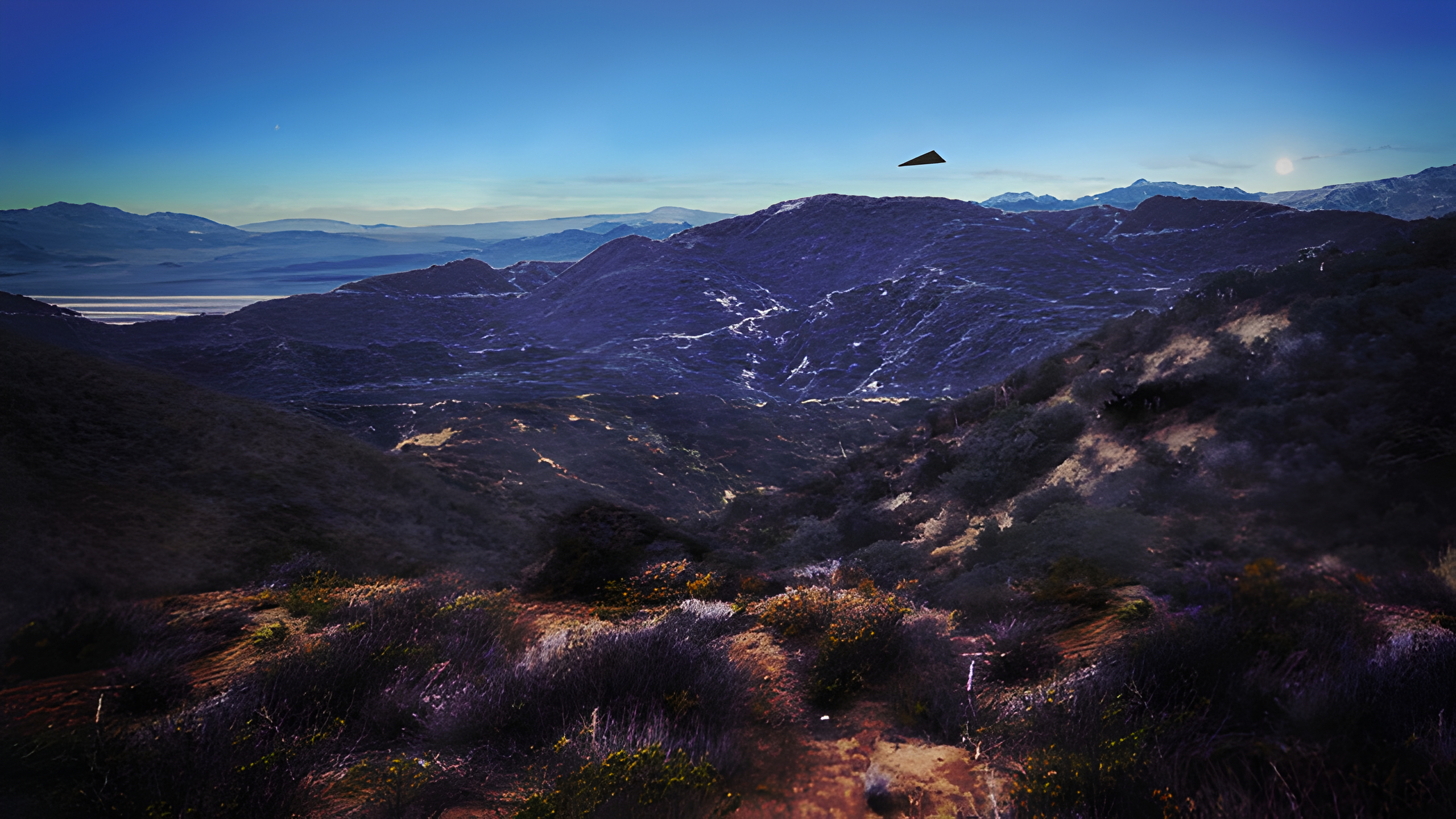
Pentagon Files Document Agents’ Silent Triangle Report, Leave Craft Unidentified
Federal agents officially reported watching a dark triangular craft rise from a standstill, hover and accelerate away without detectable noise or visible exhaust. Pentagon and FBI records preserve that account, but they do not identify the object, establish its origin or independently verify its apparent performance.
The encounter occurred in June near an unspecified national security site in the western United States. Two agents submitted a signed statement to the FBI, while the Pentagon’s All-domain Anomaly Resolution Office compiled a debriefing memo. Those documents appeared in the seventh batch of files released under an executive order concerning unidentified anomalous phenomena. The batch contained 28 PDF files.
This is therefore an official witness statement rather than an online rumor. It is also still a witness account: the released material offers descriptions, estimated dimensions, infrared observations and illustrations including an FBI representation of the craft but no recovered hardware or instrument package capable of identifying it.
What the agents reported
A third agent alerted the two witnesses shortly after sunset. After repositioning, they reported seeing a “substantial, nonreflective, dark black triangular object” above a ridgeline several miles west of their position. They compared its appearance to a delta-wing drone.
The agents estimated a wingspan of nine to 15 feet, a depth of six to nine feet and a thickness of one to two feet. Those figures establish the scale they perceived, not a surveyed set of dimensions. Distance, lighting and viewing geometry can constrain the precision of visual size and motion estimates when an object’s identity and exact range are unknown.
According to the AARO memo, the triangle climbed vertically by roughly 200 to 300 feet while maintaining a static orientation, with no reported tilting, swaying or wobbling. Investigators recorded that the ascent occurred in “absolute acoustic silence.”
An infrared scope added another layer to the account. The agents said the object appeared hotter than its surroundings, with a consistent thermal signature across its visible area and no apparent exhaust gases. It then reportedly stopped and hovered for about 20 seconds before accelerating away at an apparent speed the witnesses compared with a military fighter jet. They lost sight of it within seconds and reported no sound during the departure.
Why the observations do not identify an aircraft
Each reported feature is technically notable, but the records do not supply enough calibrated data to convert the observations into confirmed aircraft specifications. Apparent speed depends on range and trajectory. A thermal image can show contrast with the background without, by itself, yielding a complete temperature map or identifying the heat source. Silence at the observers’ position establishes what they heard under those conditions, not a measured acoustic signature around the craft.
The lack of visible exhaust similarly narrows the description without revealing a propulsion method. Electric aircraft, gliders and some conventionally powered vehicles can present very different visual and acoustic signatures depending on distance, orientation and atmospheric conditions. The files do not provide a basis for assigning the object to any of those categories.
A ground survey of the canyon drainage the following morning found no wreckage, ground scarring or vegetation damage. That result removed an obvious source of physical evidence and left investigators with the agents’ observations, the infrared account and the accompanying drawings.
The Pentagon said AARO considered the incident worthy of further investigation because its reported shape and motion aligned with aspects of other reports from the western United States. Similarity can help investigators group cases and search for recurring explanations, but it does not establish that separate sightings involved one vehicle type or a common origin.
The broader obstacle is data quality. NASA says the limited number of high-quality observations makes it impossible to draw scientific conclusions about the nature of many unidentified anomalous phenomena. Useful resolution generally requires synchronized sensor records, known locations and viewing angles, calibrated imagery, environmental information and data that can be checked against aircraft, satellites and natural phenomena.
None of the released records identifies the triangle, and no physical trace was reported after the search. What remains is unusually formal documentation of an unresolved event: trained federal personnel signed an account of an aircraft-like object near a national security site, while the available files stop short of showing what it was or how it produced the motion, thermal appearance and silence they described.
| More aerospace and engineering stories, right in your MSN feed. Follow AMI on MSN |
By David Whitaker — Associate editor for AMI’s aerospace and drone systems desk, translating flight systems, aircraft programs, spaceflight, and UAV developments into accessible technical stories.



