Volunteers Identify Scentronic’s Five Transmitted Smells With 73 Percent Accuracy
Screens can carry images and sound across the internet, but smell presents a harder problem: it must be detected as chemistry at one end and physically released at the other. Researchers at Ohio State University and Zhejiang Laboratory have now demonstrated a system called Scentronic that does this with a wearable bracelet or necklace. In a 14-person laboratory test described in Science Advances, volunteers correctly identified 73 percent of the individual odors it released.
The result is an unusual but measurable step toward remote scent sharing. It is also tightly bounded. Scentronic reproduced five familiar categories beer, cake, coffee, orange and red wine using scented liquids loaded into separate channels. It did not receive a chemical description and construct an arbitrary smell from basic components.
How the system moves an odor through the internet
At the transmitting end, an electronic nose uses an array of six gas sensors to detect volatile organic compounds, the small airborne molecules associated with odors. Different compounds change the sensors’ electrical resistance in different patterns. Machine-learning algorithms then compare those patterns with categories on which the system has been trained.
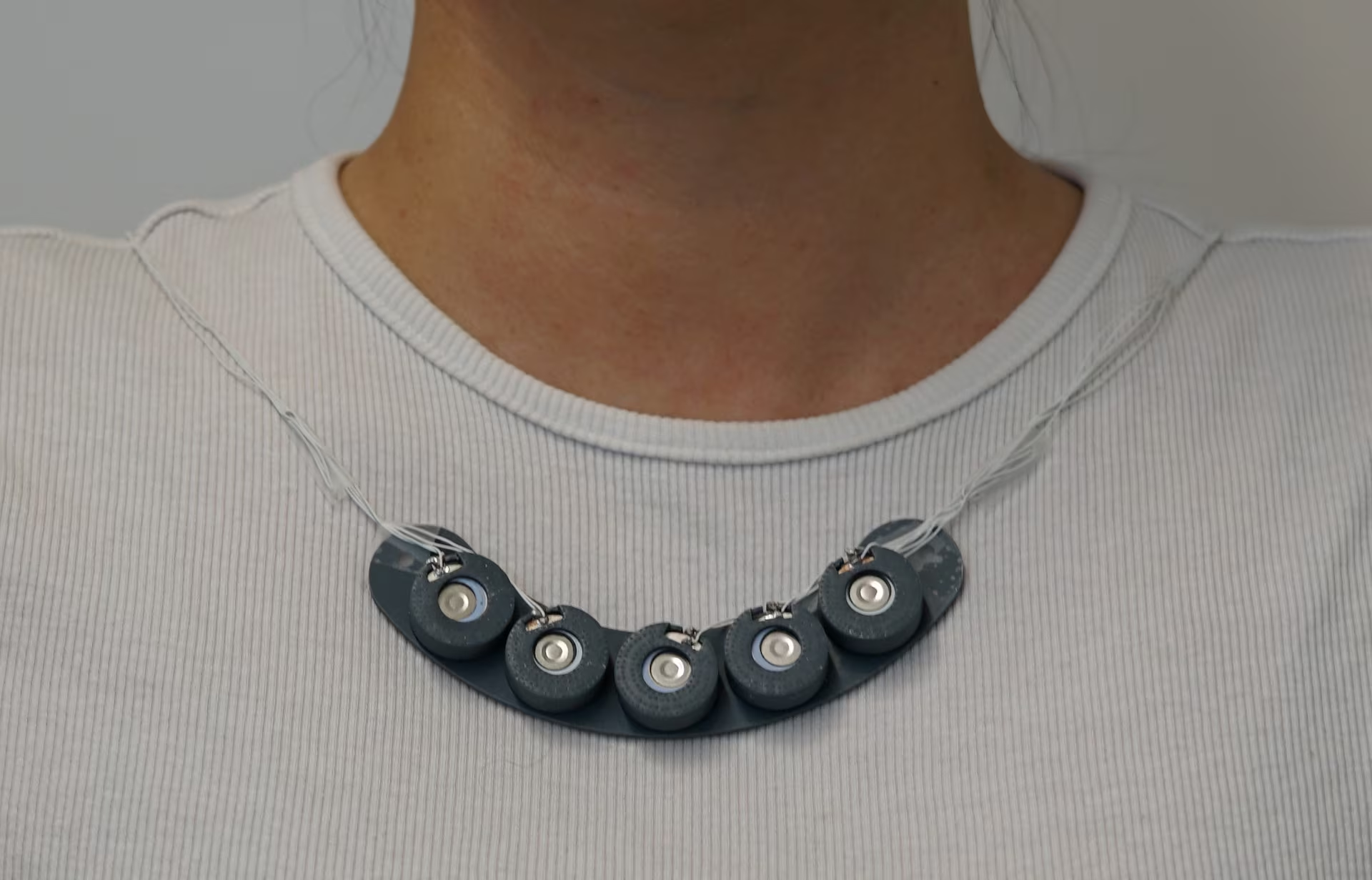
Once the software assigns a category, the internet connection sends data rather than scent molecules. A receiving device activates the corresponding preloaded fragrance and releases it near the user’s nose. The researchers produced several receiver layouts, including wristband, necklace and handheld versions.
The actuation stage uses a piezoelectric atomizer. An alternating electrical signal mechanically vibrates the piezoelectric element, pushing scented liquid through microscopic openings and creating fine droplets. Digital control of the signal allows the system to vary the release intensity and select individual channels or combinations.
This sensing-classification-actuation chain explains both the achievement and the constraint. The electronic nose can decide that an input resembles coffee, but the receiver must already contain a coffee formulation. Adding another category would require suitable recognition data and a corresponding scented liquid at the receiving end.
Recognition was useful, but far from automatic
Before the recognition task, participants were familiarized with the five odor categories. Scentronic then delivered each scent individually in randomized trials, and the volunteers selected an answer from the available categories. Their identification accuracy was 72.86 percent, reported in rounded form as 73 percent.
The researchers also tested five two-odor combinations: coffee and orange, beer and cake, coffee and wine, orange and beer, and cake and wine. Participants identified the components with 71.43 percent accuracy, or approximately 71 percent. Mixtures are especially difficult because human receptors and neural processing can make a combination smell different from either ingredient alone.
Those human results should not be confused with the electronic nose’s classification performance under controlled training and test conditions. The sensing model achieved much higher accuracy when categorizing the five prepared food sources, but recognizing a sensor pattern and making a released fragrance unmistakable to a person are separate engineering tasks. The latter involves atomization, concentration, distance from the nose, adaptation and substantial variation between individuals.
The sensor-to-actuator system responded in 0.6 seconds during a paired test, while internet communication itself averaged about 65 milliseconds. More complex food classification could take several seconds, and a separate real-time flavor experiment required several to tens of seconds for prediction. The network is therefore only one part of the delay; chemical sensing and classification can dominate the response.
Five reservoirs define the present ceiling
The wearable format makes the receiving side more practical than a fixed odor machine, but every additional smell brings mechanical costs. More channels require more reservoirs, atomizers, control outputs and refill capacity. They also add size, weight, power demand and the possibility of residual scents affecting later releases. A five-channel device is enough to demonstrate controlled selection and mixing, but it is not a general-purpose smell display comparable with a screen’s millions of colors.
The team also built an experimental cup with five odor channels and five liquid dispensers, intended to coordinate scent with flavored liquids. That work suggests a route toward reproducing selected aspects of flavor, which depends heavily on smell, but it remains a research demonstration rather than a deployed taste-transmission product.
Possible future uses include remote sensory-loss testing, selected online product experiences and multisensory virtual interaction. Reaching any of those settings will require trials beyond the controlled laboratory, more diverse participants and odors, stronger management of expectation bias, and reliable operation amid real-world odor mixtures. For now, Scentronic’s striking accomplishment is also its clearest boundary: a bracelet can release an internet-selected smell near the nose, provided that smell is already waiting inside it.
| More aerospace and engineering stories, right in your MSN feed. Follow AMI on MSN |
By Jonathan Barrett — Editor for AMI’s future mobility and autonomous systems section, with two decades covering robotics, e-mobility, drone-vehicle convergence, and transport mechanical systems.