


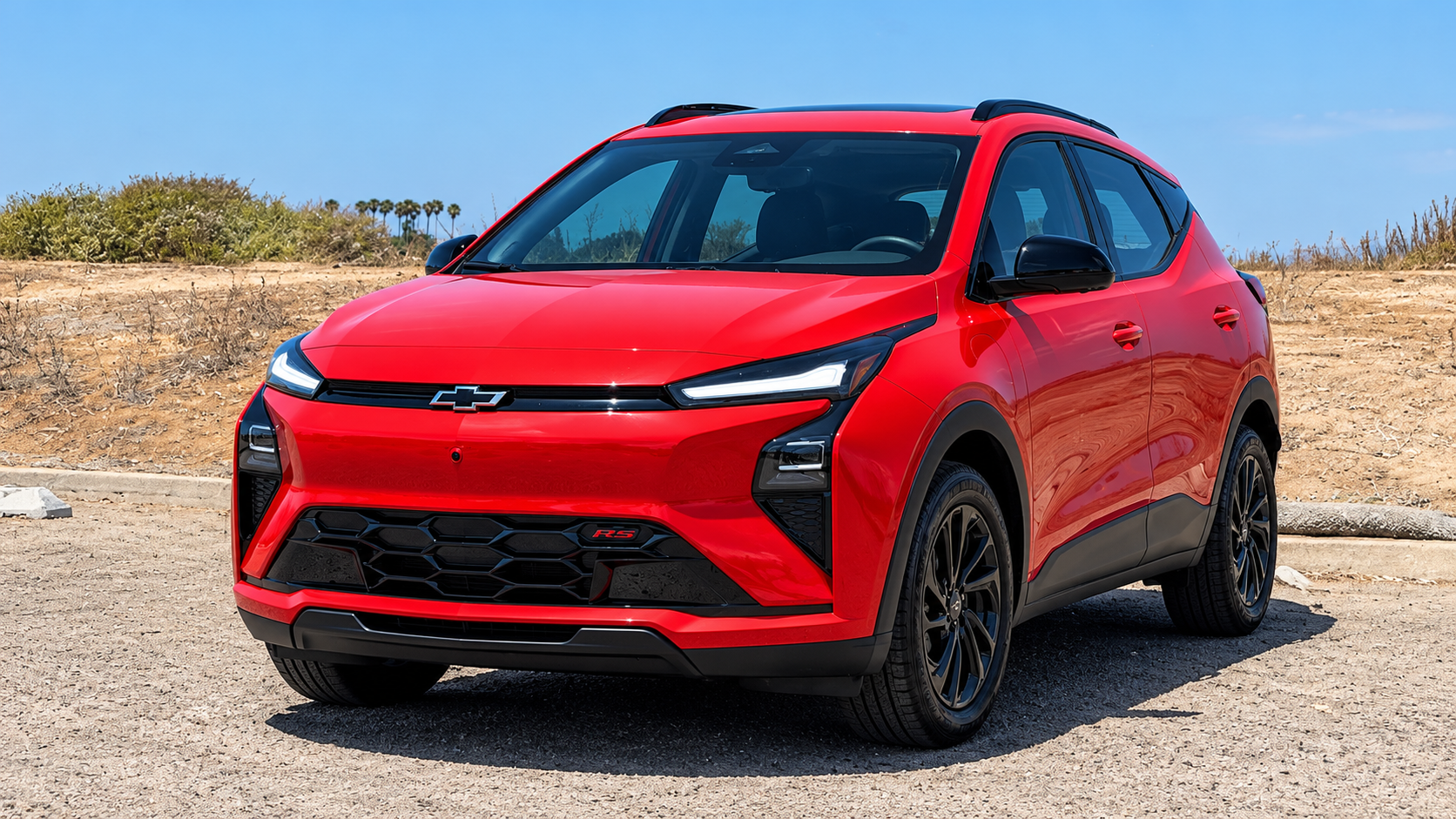
2027 Chevy Bolt Finishes Deep South Trip but 200-Mile Range Forces Detour
The 2027 Chevrolet Bolt completed a demanding drive from Nashville to New Orleans, but it did not follow the intended route. At a sustained 75 mph, the electric crossover delivered roughly 200 miles of observed range about 62 miles below its 262-mile EPA combined rating. That shortfall made a planned charging gap between Arkansas and the next usable stop east of Jackson, Mississippi, unreachable, forcing a detour through Hope, Arkansas, and Shreveport, Louisiana.
The completed trip presents an encouraging but qualified result for Chevrolet’s $28,995 EV. The Bolt, described as America’s most affordable new electric vehicle, crossed an area with some of the country’s sparsest charging coverage and was judged only a little less convenient than making the journey in a gasoline vehicle. Yet normal interstate speed and the locations of available chargers still dictated where it could go.
Why 262 miles became roughly 200
The difference between the official rating and this road result does not represent a direct contradiction. The 262-mile figure is a combined city-and-highway estimate rather than a promise of 262 miles under every condition. The EPA’s range-testing process combines adjusted results from prescribed driving cycles, weighted 55% toward city operation and 45% toward highway operation.
Sustained high-speed driving is a more demanding operating condition for an EV. Aerodynamic drag rises rapidly with speed, increasing the energy required to maintain 75 mph. Electric vehicles also lose one of their urban advantages on an open interstate: there are fewer opportunities to recover energy through regenerative braking. The test therefore illustrates why a combined range label and a high-speed road-trip range can differ substantially.
The practical consequence was larger than the 62-mile numerical gap suggests. Route feasibility depends not only on total range but also on whether chargers fall within that range with enough reserve for traffic, weather or an unavailable station. Google Maps determined that the planned Arkansas-to-Mississippi leg exceeded the Bolt’s available reach, so the navigation system redirected the car toward charging opportunities around Hope and Shreveport.
Software reduced the charging burden
The same vehicle integration that identified the problem also made the revised trip manageable. The Bolt uses an infotainment system based on Google’s Android Automotive operating system, without Apple CarPlay or Android Auto. Its native Google Maps application could use vehicle energy information to select stops rather than treating the car as an ordinary location marker.
As the Bolt approached a selected fast charger, it automatically warmed the battery to prepare it for a higher charging rate. The driver reported that this preconditioning reduced time spent at charging stops by about one-third. That is a meaningful systems benefit: route planning, battery thermal management and charger selection worked together, reducing the amount of manual calculation required from the person behind the wheel.
Most stops used Tesla fast chargers. The Bolt’s Tesla-style connector and General Motors’ network arrangements allowed those sessions to be billed to the payment card already on file, without another app or card swipe. The experience was not completely uniform, however. One station required an adapter, while a Rivian-operated charger required direct credit-card payment. Those differences show that physical connector compatibility is only one layer of charging integration; authentication and payment remain part of the driver’s workload.
A larger network can still have regional gaps
The national fast-charging network now exceeds 80,000 public ports. Paren’s third-quarter 2026 charging report counted 80,964 ports after 4,106 were added during the quarter. National scale, however, does not guarantee that chargers are evenly placed along every useful corridor.
Mississippi and Louisiana were identified as having the fewest EV chargers per person in the country, although Louisiana’s fast chargers were distributed more practically along major highways. That geographic difference helps explain why the Bolt could complete the journey but had to bend its route toward Shreveport rather than continue on the preferred path toward central Mississippi.
This was one vehicle on one trip, so the roughly 200-mile result is an operating example rather than a universal range figure. Speed, temperature, traffic, elevation and cabin climate use can change consumption. The test nevertheless exposes the controlling relationship for long-distance EV travel: a car does not need a charger everywhere, but it needs dependable charging at intervals matched to its real highway range.
For the Bolt, integrated routing and battery preparation made a charger-sparse Deep South journey practical. They could not make an unreachable charging gap disappear. Until corridor coverage becomes more even, the least expensive EVs may be capable of crossing difficult regions while still letting charger geography choose the road.
| More aerospace and engineering stories, right in your MSN feed. Follow AMI on MSN |
By Thomas Caldwell — AMI’s senior editor for mechanical and mobility engineering, covering vehicle electronics, systems integration, electrification, chassis systems, propulsion, and safety policy.



