


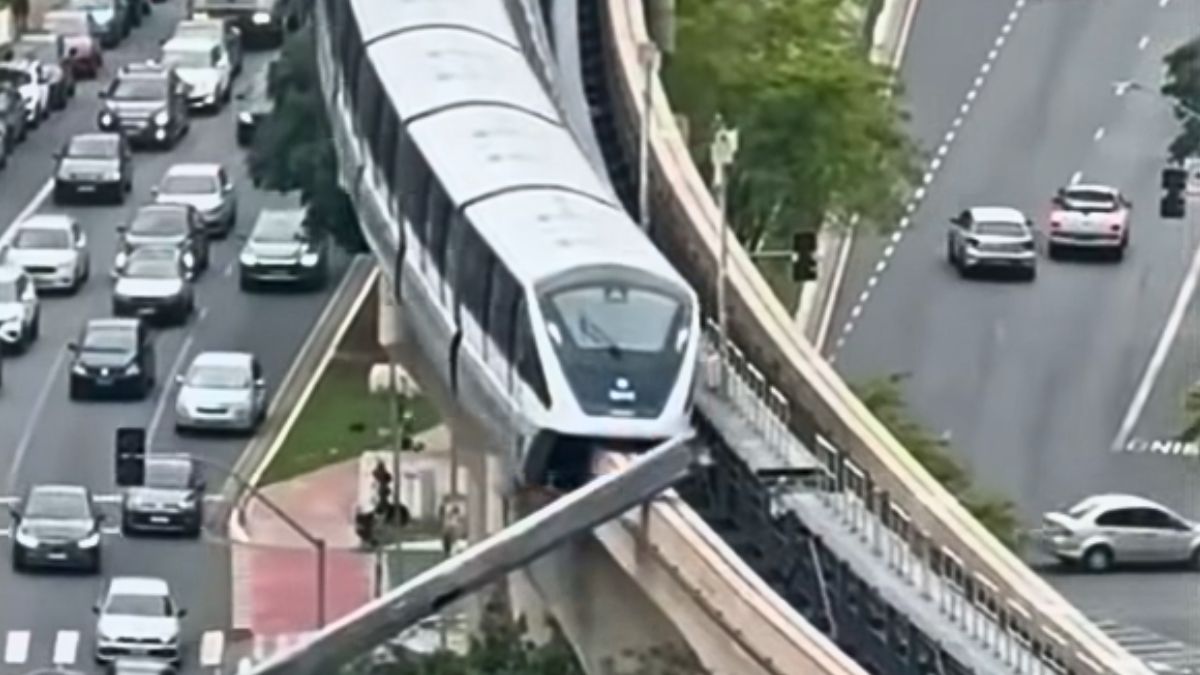
Driverless Line 15 Train Caught on Camera Slamming Into Fallen Industrial Crane
Rapid transit automation across major global metropolises relies heavily on elevated beamways to isolate high-capacity passenger flows from surface traffic congestion. In high-density urban environments, grade-separated rail systems are engineered to optimize transit efficiency while reducing human intervention through centralized telemetry and autonomous operations. Modern driverless monorail transport systems operate on the assumption that dedicated elevated corridors remain entirely free of ground-level hazards and heavy construction interference.
Under standard operational profiles, automated guideway networks utilize Communications-Based Train Control (‘CBTC’) to supervise traction, braking curves, and headway safety. By removing onboard operators, transit authorities rely on trackside signaling, radio frequency positioning, and centralized monitoring hubs to regulate vehicle movement. However, these systems are fundamentally structured to detect internal traffic conflicts rather than unforeseen physical intrusions originating from private job sites beyond the perimeter.
That operational vulnerability became acutely apparent along São Paulo’s elevated transit network on ‘Line 15-Silver’ (‘Linha 15-Prata’). A heavy industrial mobile crane, engaged in private commercial work adjacent to the elevated guideway, tipped over and collapsed across the concrete tracks near Camilo Haddad station. The boom of the crane fell directly into the path of travel between São Lucas and Oratório stations, resting horizontally across the monorail beamway.
Shortly after the structural collapse, an approaching Bombardier ‘Innovia Monorail 300’ train—identified by local transit officials as composition ‘M03’—approached the sector at regular track cruising speed. Because the overhead steel arm did not interrupt the signaling track circuits in time to trip an automated safety halt, the train struck the crane boom at full transit momentum. Eyewitness footage captured the driverless lead car impacting the heavy boom and pushing the machinery along the beamway.
In Brazil, a train traveling at full speed slammed into a crane that had fallen onto the monorail tracks Miraculously, there were no casualties.
— NEXTA (@nexta_tv) October 25, 2026
The force of the kinetic collision snapped portions of the crane assembly and sheared the equipment off the concrete structure. Heavy metal trusses and mechanical components were dragged forward before plunging several meters downward toward the busy lanes of Avenida Professor Luiz Ignácio de Anhaia Mello. The falling wreckage crashed directly into the arterial corridor below, scattering steel debris across the asphalt.
Surveillance feeds and bystander video recorded vehicles, a passing motorcyclist, and a nearby pedestrian narrowly avoiding the collapsing structure by fractions of a second as traffic abruptly halted. Despite the violence of the overhead collision and the volume of heavy debris raining down on the thoroughfare, neither motorists nor passengers suffered fatal injuries. As reported by Poder360, emergency response units confirmed that all passengers aboard the train were evacuated without injury, while the crane operator sustained injuries and received medical treatment.
Transit operator ‘Metrô SP’ immediately triggered safety protocols, de-energizing the electrical supply across the affected sector to isolate the damaged rolling stock. Service was suspended between Vila Prudente and São Lucas stations, prompting the deployment of emergency bus support under the ‘PAESE’ contingency plan. Maintenance crews subsequently towed the damaged monorail train to the Oratório rail yard for structural inspection.
The high-profile collision has reignited debate among transportation analysts and labor representatives regarding the limitations of Grade of Automation 4 (‘GoA4’) driverless train platforms. While automated systems manage vehicle spacing effectively, they currently lack long-range optical obstacle detection or LiDAR sensors capable of spotting aerial hazards falling onto elevated guideways. Brazilian civil authorities have opened an investigation into whether ground subsidence at the private commercial property caused the crane to topple into the public transit corridor.


