


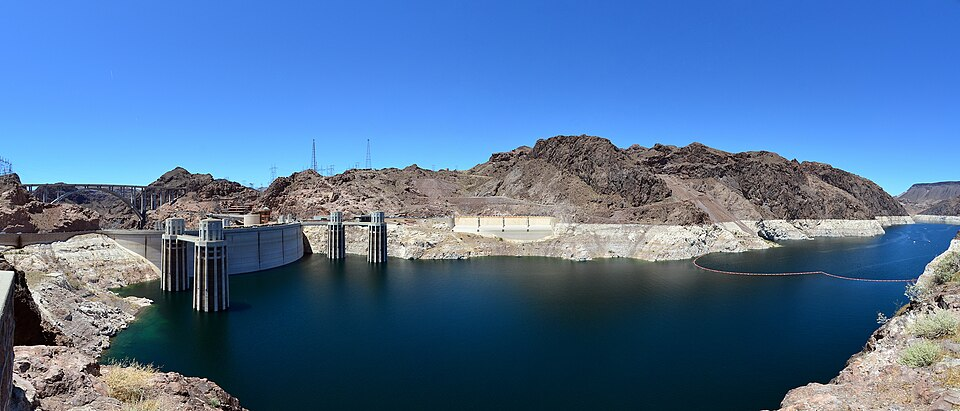
Hoover Dam’s First Extended Spillway Run Carved a 45-Foot-Deep Cavity
Lake Texoma’s first spillway flow removed some sod and caused no major structural damage. Hoover Dam’s first extended spillway operation produced a radically different result: cavitation eventually carved a cavity as much as 45 feet deep into the concrete lining of its Arizona spillway tunnel.

Those outcomes frame a consequential but infrequent engineering milestone. A spillway may sit dry for decades before a flood forces its crest, channel, tunnel, drainage system and downstream ground to function together at substantial flow. Across six U.S. reservoirs, first major operations ranged from routine performance to hidden tunnel damage, undermined concrete, a new bedrock gorge and an evacuation affecting about 188,000 people.
Lake Texoma provided the uneventful comparison
Denison Dam was completed in 1944, but Lake Texoma remained below the spillway crest for more than a decade. Water finally crossed late on May 27, 1957, initially at a depth of about two inches. The flow removed sod from portions of the roughly 2,000-foot concrete-lined channel, which occupies a natural saddle away from the main earthen dam, but it caused no major structural damage.
The spillway subsequently operated in 1990, 2007 and twice in 2015. Its first use illustrates the intended result: a rarely used system can begin carrying water without uncovering a major weakness. The other five cases show why operators cannot assume that decades of apparent readiness guarantee the same outcome.
Hoover and Glen Canyon exposed cavitation inside tunnels
Hoover Dam’s Arizona spillway first began operating on August 6, 1941. An inspection eight days later found the concrete lining intact, but water continued through the system until December 1942 at an average flow of about 13,500 cubic feet per second.
During that extended run, cavitation opened a tunnel cavity approximately 115 feet long, 30 feet wide and up to 45 feet deep. Cavitation occurs when pressure changes in fast-moving water form vapor bubbles that subsequently collapse against a surface. Irregularities can concentrate the resulting impacts and progressively damage concrete. Engineers repaired Hoover’s tunnel and smoothed its interior to reduce the likelihood of renewed cavitation.
Glen Canyon Dam encountered a related mechanism in 1983. Its left spillway opened on June 2, and loud rumbling early on June 6 signaled serious damage. High-speed water passing over a concrete irregularity triggered cavitation, penetrated the lining and began eroding the sandstone behind it. The resulting cavity measured about 134 feet long, 50 feet wide and 35 feet deep.
Engineers installed aeration slots in both Glen Canyon spillway tunnels. By introducing air along vulnerable flow surfaces, such systems can reduce cavitation damage. The modified tunnels handled substantial runoff in 1984 without another major cavitation failure.
Open terrain made geology part of the structure
Canyon Lake waited 38 years for water to reach its spillway crest. After extraordinary rainfall in the upper Guadalupe River watershed, overflow began on July 4, 2002, exceeded 67,000 cubic feet per second and continued for about six weeks.
The water removed vegetation and soil before eroding fractured limestone and creating the roughly 64-acre Canyon Lake Gorge. Researchers Michael Lamb and Mark Fonstad found that much of the erosion occurred during the three days of highest discharge. Unlike the tunnel failures at Hoover and Glen Canyon, this case demonstrated how outlet geology and flow concentration can reshape an unlined landscape even when concrete is not the principal damaged element.
Water beneath concrete created another failure path
Garrison Dam’s 28-gate spillway had not been used for flood releases between the dam’s 1953 completion and June 1, 2011. During that first flood operation, water pressure displaced a manhole cover and opened a route beneath the concrete chute slabs. By June 23, all 28 gates were open and releasing about 150,000 cubic feet per second.
The case shifted attention from visible chute surfaces to drainage and pressure beneath them. Recommended improvements have included drainage modifications and removing manhole covers from inside the chute. In June 2026, the U.S. Army Corps of Engineers conducted a controlled-flow test using 23 gates as part of continuing investigations.
Oroville joined physical weaknesses with system management
At Oroville Dam, a section of the gated main spillway chute failed during a scheduled release on February 7, 2017. Rising reservoir levels then sent water across the previously unused emergency spillway at about 8 a.m. on February 11. The overflow descended an unlined hillside, where rapid erosion near the approximately 1,700-foot emergency weir prompted authorities to evacuate about 188,000 downstream residents the following day.
Operators increased releases through the damaged main spillway to roughly 100,000 cubic feet per second, ending the emergency overflow that evening. An independent forensic investigation later identified interacting physical, human and organizational factors rather than a single root cause. The reconstructed main spillway returned to operation on April 2, 2019.
Together, the six reservoirs show why first flow is more than a ceremonial threshold. It loads surfaces, joints, drains, foundations and outlet terrain simultaneously at a scale that dry inspection cannot reproduce. The useful comparison is not that every unused spillway is dangerous, but that apparent readiness can conceal very different outcomes from minor sod loss at Lake Texoma to a 45-foot-deep cavity inside Hoover Dam’s concrete tunnel.
| More aerospace and engineering stories, right in your MSN feed. Follow AMI on MSN |
By Thomas Caldwell — AMI’s senior editor for mechanical and mobility engineering, covering vehicle electronics, systems integration, electrification, chassis systems, propulsion, and safety policy.



