


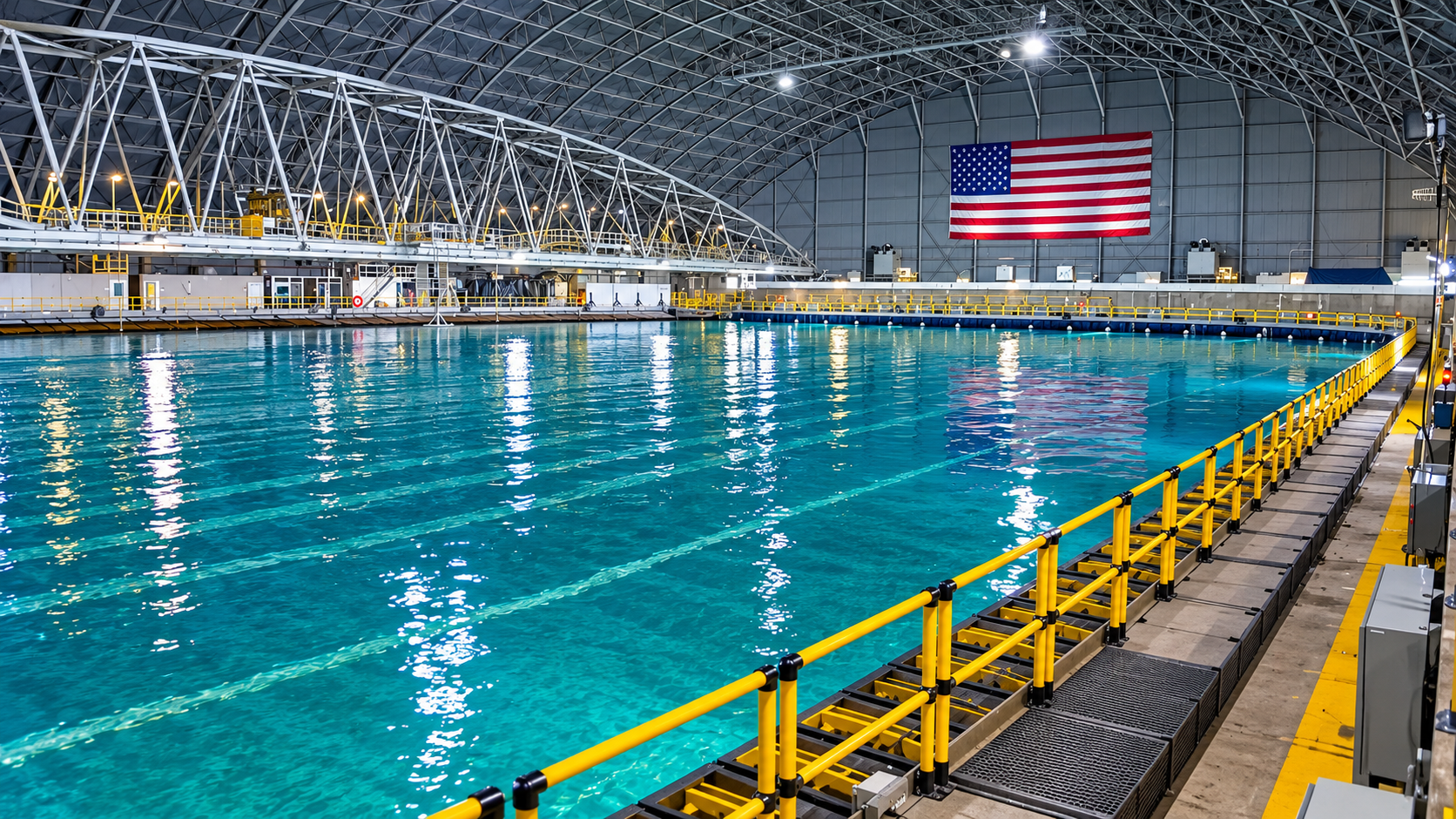
Navy’s Carderock Basin Uses 216 Paddles to Test Ship Designs Indoors
Along two walls of the Navy’s football-field-size indoor ocean, 216 individually controlled paddles turn programmed motion into repeatable waves. This machinery allows the Carderock Maneuvering and Seakeeping Basin in Bethesda, Maryland, to expose scale ship designs to specified sea conditions before engineers rely on full-size vessels and unpredictable open water.
The basin measures 360 feet by 240 feet and is 20 feet deep. Its paddles, positioned along the north and west sides, can generate waves traveling from directions between minus 45 degrees and 135 degrees. Air bellows produce each paddle’s angular motion, while force transducers measure the loads within the wave-making system.

Size is the facility’s most visible attribute, but control is its central engineering advantage. Natural seas continually change as wind speed, wind duration, the distance over which wind crosses the water, and water depth vary. Carderock can instead reproduce selected wave amplitudes, frequencies and directions, then run a model through the same conditions repeatedly.
Repeatability turns waves into comparable data
A controlled basin gives naval architects a stable basis for comparison. Engineers can alter a hull form, loading condition or model setup and rerun the same wave program. Differences in heave, pitch, roll or course behavior can then be evaluated against a consistent input rather than against two ocean trials conducted in different seas.
Ultrasonic sensors provide the measurement side of that control loop. An array over the basin confirms wave height, period and direction, allowing engineers to check whether the water actually matches the programmed condition. Without that verification, precise paddle commands alone would not guarantee a useful experiment.
The system can create regular waves, multidirectional seas and more specialized patterns. Opposing regular waves can form a standing-wave arrangement known as a quilt wave: some locations remain near zero amplitude as the waves cancel, while others reach maximum amplitude as they reinforce one another. Waves sent from several directions can also converge at one location to form a bullseye pattern.
Wave timing creates another capability. In deep water, higher-frequency waves travel more slowly than lower-frequency waves. The basin can send the slower, higher-frequency components first and release lower-frequency components afterward so that they meet at a selected location, producing a breaking wave under controlled conditions.
A smaller hull requires more than smaller waves
Scale-model testing depends on preserving the physics that dominate full-size ship motion. At Carderock, wave and ship dynamics are related through the Froude number, which compares inertial forces with gravitational forces. It is the relevant scaling relationship for free-surface behavior, even though the model cannot simultaneously match the full-size vessel’s Reynolds number, which governs the balance between inertial and viscous effects.
One example used a hull 46 times smaller than its corresponding ship. Its model speed therefore had to be the full-size speed divided by the square root of 46, approximately 6.8. Recorded model motion also had to be slowed by about 6.8 times to resemble the timing of the full-size vessel.
The water itself introduces another adjustment. Carderock’s basin contains fresh water, while ocean ships operate in denser salt water and experience greater buoyancy for the same displaced volume. Engineers must account for that density difference while balancing and loading the model.
In one demonstrated condition, an approximately five-inch significant wave height represented waves of about 20 feet at full scale. Free-running models can follow large circles or figure-eight courses, allowing engineers to correlate model headings with those of the full-size design as it encounters waves from changing directions.
Controlled tests define behavior, not every possible outcome
The basin can distinguish between materially different sea inputs. Long-period ocean swell may make a ship heave, while steeper wind-driven waves are generally more disruptive to its motion. Reproducing those conditions lets engineers study how a design responds across a defined test program rather than treating all waves as equivalent.
These experiments do not reproduce every full-scale environmental and viscous effect at once, nor do they guarantee how a completed ship will perform in every ocean condition. Their value is narrower and practical: 216 paddles, verified by sensors and governed by scale-model physics, let engineers make repeatable comparisons that the changing ocean cannot.
| More aerospace and engineering stories, right in your MSN feed. Follow AMI on MSN |
By Thomas Caldwell — AMI’s senior editor for mechanical and mobility engineering, covering vehicle electronics, systems integration, electrification, chassis systems, propulsion, and safety policy.



