


BYD and Chinese Rivals Reach 15% of Mexico Market, Barred From U.S.
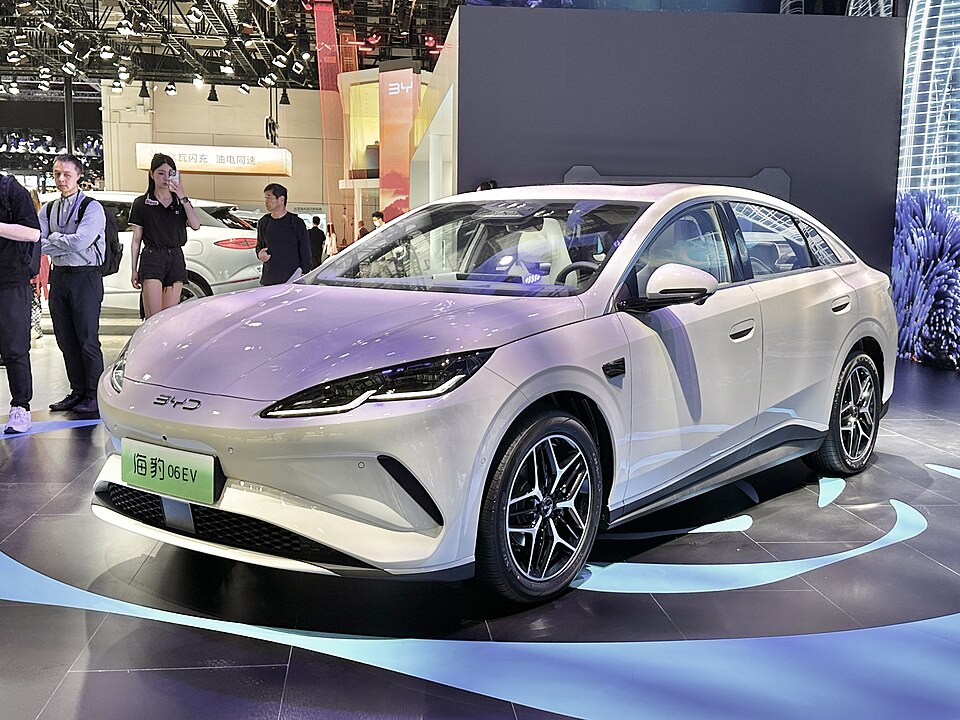
Cross the U.S. border into Mexico and the electric-vehicle market changes sharply. Chinese brands including BYD, Zeekr and JAC have expanded from less than 1 percent to 15 percent of Mexico’s overall vehicle market in five years. They now account for about 90 percent of the country’s electric vehicles, while tariffs, trade barriers and software restrictions effectively keep the same products out of the United States.

The contrast is not just about brand availability. Mexican buyers can choose lower-priced electric cars, a midsize electric SUV with high charging performance and a plug in hybrid pickup a format no U.S. automaker currently offers. Those three classes illustrate how policy boundaries are producing different technology choices in neighboring markets.
An affordable electric car in a shrinking price class
BYD’s five-seat Dolphin Mini starts at $21,400 with a stated range of 130 miles. A $22,300 Mini Plus was modeled at 165 miles under U.S. Environmental Protection Agency testing assumptions. Its 40-kilowatt maximum charging rate can take the battery from 30 percent to 80 percent in about 30 minutes.
Those figures do not make the Dolphin Mini a long-range or exceptionally fast-charging vehicle. Its significance is the combination of price, usable urban range and electric propulsion. Cox Automotive reported that the number of new models available in the United States around the Dolphin Mini’s price fell from 36 six years ago to four. That leaves an increasingly thin U.S. market for buyers seeking basic new transportation rather than premium range and performance.
Operating costs reinforce the comparison, although they depend heavily on local electricity and gasoline prices. A Mexican dealership estimated that supplying enough electricity for 130 miles would cost about $9 at home or $18 at a public charger, versus more than $30 in comparable gasoline cars.
An electric SUV with different engineering priorities
The five-seat Zeekr 7X starts at $45,300 and competes directly with Tesla’s Model Y. Designed in Gothenburg, Sweden, developed through parent company Geely’s shared research network and assembled in China, it also demonstrates that “Chinese vehicle” can describe a multinational engineering structure rather than a wholly domestic development process.
In a comparison of flagship versions, the Zeekr matched the horsepower of the Tesla Model Y Performance, rode more smoothly and charged nearly twice as fast. Tesla retained meaningful system-level advantages: better energy efficiency, more cargo capacity and access to its Supercharger network.
That balance shows why specification sheets alone cannot determine the stronger product. Faster charging can reduce stop duration, but efficiency affects how frequently a vehicle must stop in the first place. Charging-network access also depends on connector compatibility, station reliability, route coverage and payment integration. The Zeekr emphasizes charging speed and cabin value; the Tesla counters with efficiency, packaging and an established charging ecosystem.
A pickup configuration missing from U.S. showrooms
The $48,000 BYD Shark exposes an even clearer product gap. It is a plug in hybrid pickup offering about 43 miles of electric-only operation and an estimated 365 miles of combined range under EPA standards. Its 1.5-liter gasoline engine can generate electricity for the 30-kilowatt-hour battery and help drive the wheels at highway speeds.
This architecture allows shorter daily trips to be completed electrically while preserving gasoline-supported range for longer journeys. It also adds mass, thermal-management demands and control complexity because the vehicle carries both electric and combustion systems. Yet no U.S. automaker currently sells a plug in hybrid pickup at any price, leaving American buyers to choose between gasoline trucks and fully electric alternatives.
Scale helps explain how Chinese manufacturers can offer these combinations. BloombergNEF estimates that BYD sells about seven of every 10 electric and plug in hybrid vehicles in Mexico. BYD also overtook Tesla as the world’s largest electric-vehicle manufacturer last year. High production volume can spread battery development, software and manufacturing investment across more vehicles, although pricing is also shaped by supply chains, competition and government policy.
Other markets show that access is a policy choice rather than a technical inevitability. Chinese electric vehicles face only the standard 10 percent import duty in Britain, while the European Union has imposed additional manufacturer-specific duties and Chinese brands have nevertheless gained market share across Europe.
U.S. restrictions protect domestic manufacturing and limit dependence on Chinese vehicle software and supply chains, but they also reduce immediate price and product competition. Mexico now provides the nearby counterexample: Chinese brands reached 15 percent of its vehicle market in five years, and buyers there can already purchase an affordable BYD electric hatchback, a fast-charging Zeekr SUV and the plug in hybrid pickup that remains absent from every U.S. showroom.
| More aerospace and engineering stories, right in your MSN feed. Follow AMI on MSN |
By Thomas Caldwell — AMI’s senior editor for mechanical and mobility engineering, covering vehicle electronics, systems integration, electrification, chassis systems, propulsion, and safety policy.




