


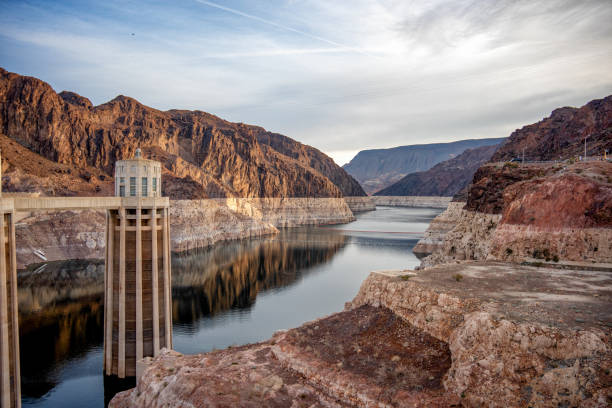
Hoover Dam Losing Lake Mead Outflow Would Begin Draining Lake Mohave
Lake Mohave’s ability to keep the lower Colorado River moving depends on a supply arriving from above. Almost all of that water passes from Lake Mead through Hoover Dam. If Mead fell below the elevation where gravity could carry water through Hoover’s outlets, Mohave could maintain downstream deliveries only by consuming its own stored water.

That would turn Lake Mohave from a regulating reservoir into a temporary buffer. The lake holds about 1.8 million acre-feet behind Davis Dam, roughly 67 miles downstream from Hoover. Operators could continue releasing that stored water through Davis, but without replacement inflow from Mead, each release would lower Mohave and reduce what remained for later deliveries.
This is a worst-case engineering scenario, not an imminent forecast. Lake Mead was roughly 1,040 feet above sea level in 2026, more than 140 feet above the stated dead-pool elevation. Its value as a scenario is that it shows how an operating limit at one dam would propagate through reservoirs, power plants, habitats and aqueduct intakes far downstream.
Hoover would lose power before it lost gravity-fed outflow
Two different elevations define the sequence. At approximately 950 feet, Lake Mead would reach Hoover Dam’s minimum power pool. The reduced hydraulic head would prevent normal hydroelectric generation, although water could still be released through other outlets.
Dead pool is lower, at 895 feet, identified as the bottom elevation of Hoover’s intake towers. Below that level, water would remain in Lake Mead but could no longer flow through the dam’s outlets under gravity. Las Vegas would retain an important exception because its deep intake can pump from below dead pool, but that pumping capability would not restore flow into Lake Mohave.
Davis Dam normally catches and re-regulates Hoover releases, smoothing the movement of water through the Lower Basin. Once Hoover’s contribution disappeared, continued operation at Davis would create a straightforward storage imbalance: outflow without comparable inflow. Available information does not support a specific timeline for exhausting Mohave’s usable reserve because the rate would depend on release decisions, demand and any other inflows. The direction, however, is fixed maintaining downstream flow would draw the reservoir down.
The shortage would move toward Lake Havasu
Water released from a declining Lake Mohave would next move toward Lake Havasu behind Parker Dam. Havasu contains the intake points for the Central Arizona Project, which supplies Phoenix and Tucson, and the Colorado River Aqueduct serving Southern California.
The Bureau of Reclamation’s Parker Dam profile identifies the Southern California intake on Lake Havasu and says the aqueduct extends 242 miles toward Lake Mathews near Riverside. It also notes that about half of Parker Dam’s generated power is reserved to help pump Colorado River water through that aqueduct.
A prolonged loss of upstream replenishment would therefore reach beyond reservoir levels. Lake Havasu would also be drawn down to sustain deliveries, while reduced water levels and flow would affect hydropower generation at Davis and Parker dams. Reliability pressure would extend to deliveries within Arizona and California and to Mexico’s treaty water.
Lake Mohave’s decline would also reduce recreational access and aquatic habitat. The reservoir supports the largest remaining wild population of the endangered razorback sucker as well as the endangered bonytail chub. Biologists collect tens of thousands of razorback sucker larvae along Mohave’s shoreline each spring and raise them in protected conditions, tying the reservoir’s physical state directly to ongoing recovery work.
New rules manage risk but cannot remove the dependency
The federal government’s current operating framework recognizes that the Colorado River must be managed as a connected storage system. A Congressional Research Service review says most of the previous conservation agreements expired in 2026 and that a new 10-year framework covering October 2026 through 2036 is being implemented in two-year increments. Those shorter operating periods allow releases and delivery reductions to be revisited as reservoir conditions change.
Operational rules can slow drawdown and assign shortages, but they cannot change Lake Mohave’s underlying water balance. Hoover, Davis and Parker are successive parts of a gravity-fed storage and delivery chain, rather than independent water sources. If Hoover could no longer pass Lake Mead water, Mohave’s 1.8 million acre-feet would buy time downstream only by steadily consuming the buffer itself.
| More aerospace and engineering stories, right in your MSN feed. Follow AMI on MSN |
By Thomas Caldwell — AMI’s senior editor for mechanical and mobility engineering, covering vehicle electronics, systems integration, electrification, chassis systems, propulsion, and safety policy.



