


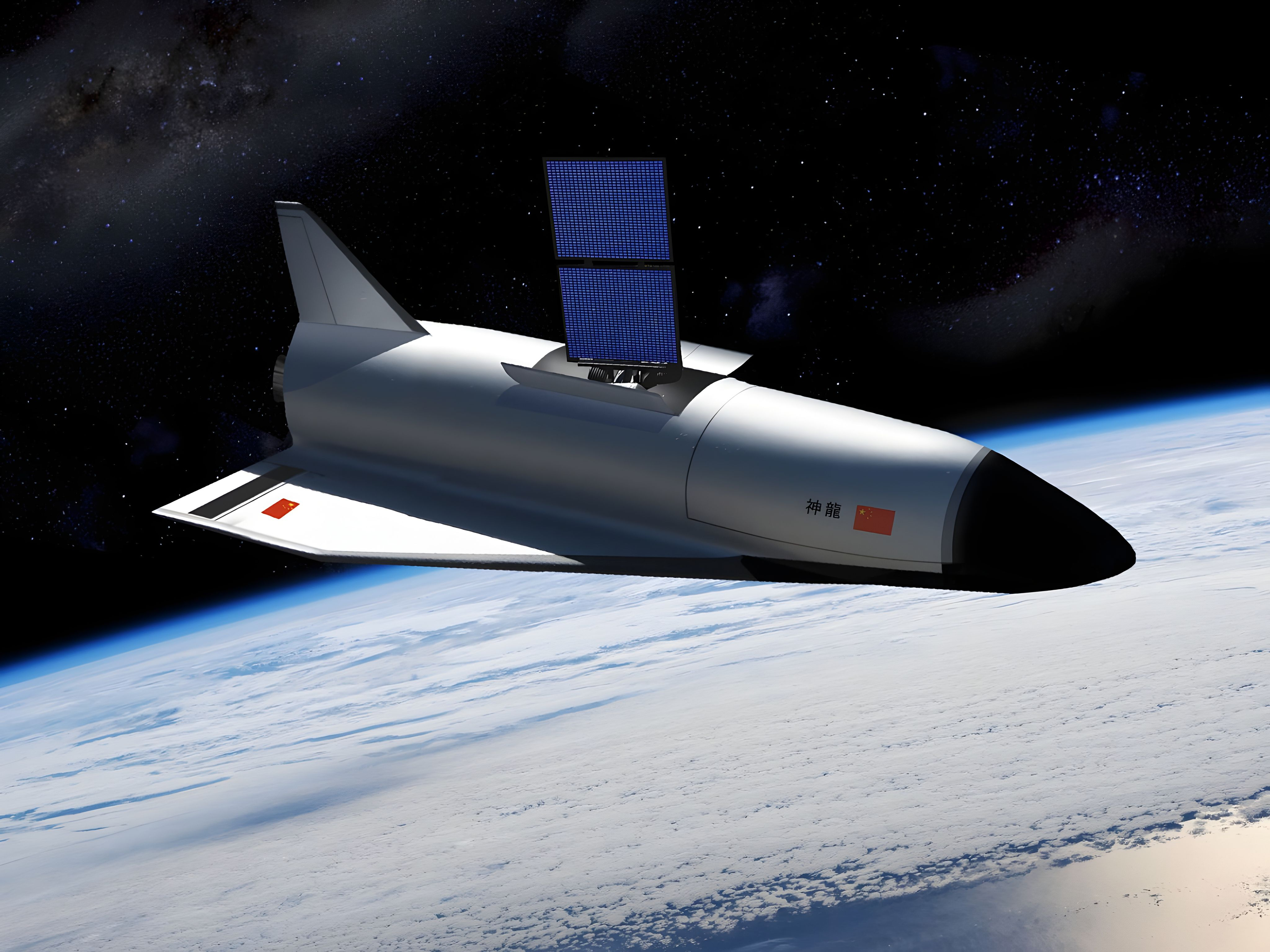
New Shenlong Image Reveals Spaceplane Underside and Rear Solar Arrays
The Defense Intelligence Agency has published the clearest public image yet of the Chinese reusable spaceplane commonly known as Shenlong. Captured from orbit by Maxar Technologies in 2024, the unclassified image exposes the vehicle’s underside and a set of solar arrays extending behind it an unusually detailed view of a spacecraft whose payload and mission remain undisclosed.
The image appears on page 53 of the DIA’s latest 130-page Challenges to Security in Space report. The agency’s caption identifies the craft only as a Chinese “spaceplane,” rather than naming Shenlong. Its appearance and timing, however, strongly associate it with China’s reusable experimental spacecraft, which was conducting its third known orbital mission in 2024.
What the image establishes
The viewing angle supplies more than a recognizable silhouette. It shows a winged vehicle from below, including its dark thermal-protection area and the underside of its main body. The spacecraft appears to have an open central bay, while hardware and deployed solar arrays are visible behind the vehicle.
Those arrays require careful interpretation. Vantor, the company formerly known as Maxar, said a separate satellite was docked to the spaceplane’s aft section when the image was taken. Its structure and solar arrays are visible behind the winged vehicle. The picture therefore documents a rear-mounted arrangement in orbit, but it does not by itself establish that the panels are a permanent part of the spaceplane.
That distinction shapes what engineers can reasonably extract from a single image. The photograph provides direct evidence of the craft’s external configuration during one point in its mission, including an apparently open bay and attached aft hardware. It does not reveal the internal payload, propulsion system, dimensions or precise function of the docked object.
A mission history measured in months
China has disclosed little about the reusable spacecraft even as its flights have become substantially longer. Its first known orbital mission lasted two days in 2020. A second flight in 2022 remained in orbit for 276 days, while the third launched in December 2023 and lasted 268 days.
The Maxar image was captured during that third mission. The DIA says the spacecraft “released and interacted with an object,” but provides few further details. A Secure World Foundation program history describes the vehicle as a platform associated with reusable-flight testing, hardware experimentation and operations involving smaller space objects. Its analysis also separates demonstrated activity from more speculative claims about the vehicle’s purpose.
A fourth known flight reportedly began from the Jiuquan Satellite Launch Center on February 7, 2026. That continuing test cadence is significant because reusable vehicles must prove more than orbital endurance. Each mission also exercises launch processing, thermal protection, guidance, recovery and whatever inspection or refurbishment is required before another flight. Public information does not establish how much hardware is being reused or how extensive that servicing work may be.
What remains outside the frame
The closest public comparison is the Boeing-built X-37B operated by the U.S. Space Force. Both are uncrewed, reusable winged vehicles that spend extended periods in orbit, but the American spacecraft is better documented. The X-37B is more than 29 feet long with a wingspan of nearly 15 feet, and officials have identified selected experiments, including laser communications and quantum measurement work on its eighth mission.
No equivalent public specification set exists for Shenlong. The new image cannot establish its size without a reliable scale reference, and visual similarity to another spaceplane does not demonstrate matching payload capacity, maneuverability or mission equipment.
China’s 2021 space white paper said the country would continue research and flight testing for reusable space-transport technologies. The growing duration of Shenlong’s missions is consistent with a maturing experimental program, but the newly released image remains a snapshot rather than a technical disclosure.
It narrows one part of the mystery: the public can now examine the spacecraft’s underside, open-bay configuration and aft-mounted hardware in unprecedented detail. Its fourth reported mission is the next test of progress, while the payload and purpose behind those months in orbit remain largely hidden.
| More aerospace and engineering stories, right in your MSN feed. Follow AMI on MSN |
By David Whitaker — Associate editor for AMI’s aerospace and drone systems desk, translating flight systems, aircraft programs, spaceflight, and UAV developments into accessible technical stories.



