


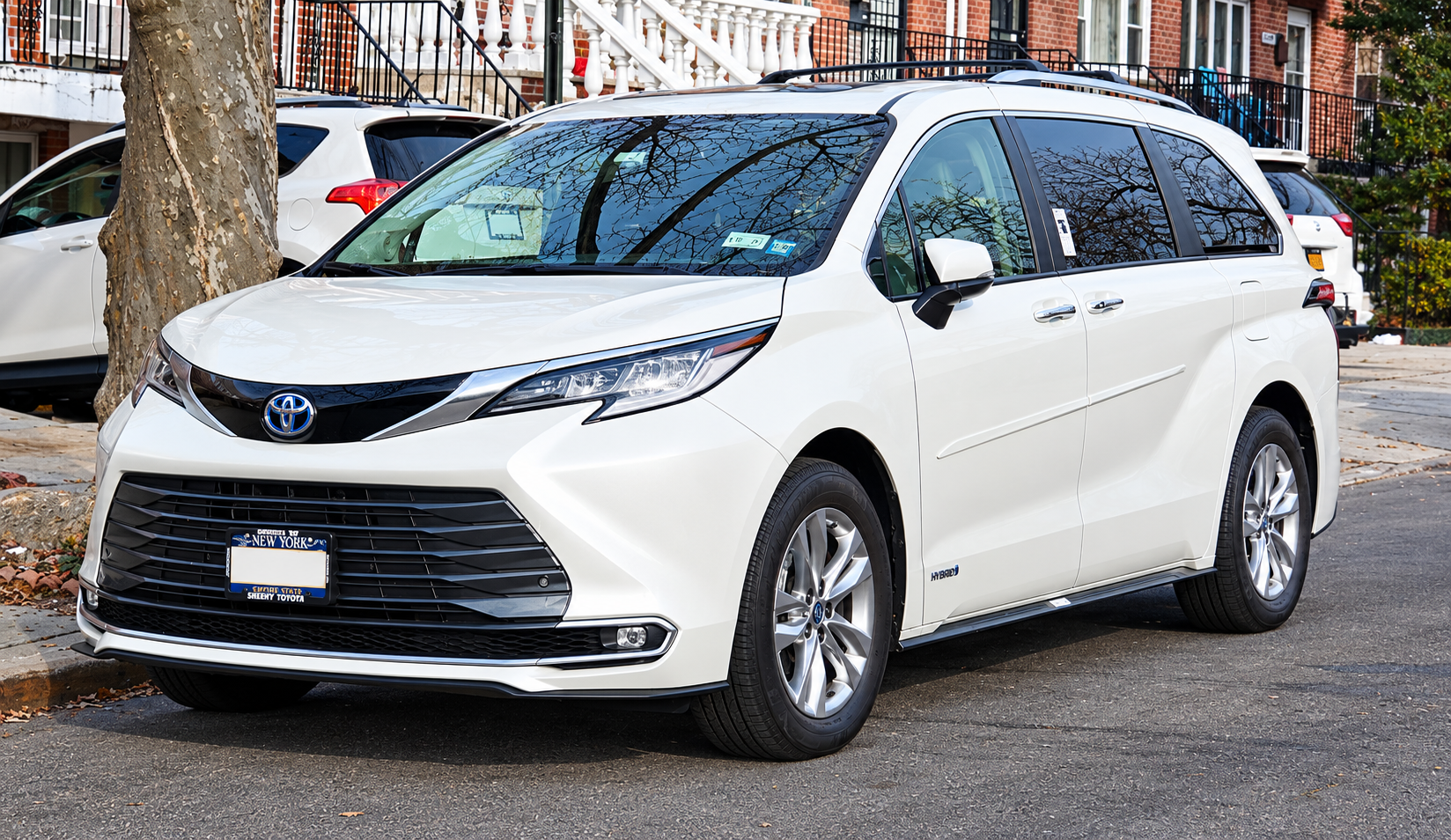
Toyota Recalls 228,367 Sienna Hybrids Over Second-Row Seatbacks That May Unlock in Crashes
Toyota is recalling 228,367 model-year 2022-2026 Sienna Hybrid minivans because their second-row seatbacks may not remain secured during a crash. The defect can reduce the seat’s ability to restrain an occupant and increase injury risk, according to the National Highway Traffic Safety Administration information summarized in an October 27 recall report.

The planned free repair is not identical across all affected vehicles. Dealers will update the software in the supplemental restraint system electronic control unit. Siennas equipped with Toyota’s Mobility as a Service package will also receive replacements for both second-row seatbacks.
That split remedy is the important engineering feature of the campaign. For the broader recall population, Toyota plans to address the condition through restraint-control software. A smaller, specially configured group requires physical seat assemblies with a different recliner mechanism, indicating that software alone is not the specified remedy for every seating configuration. The available information does not identify how many recalled minivans have the Mobility as a Service package.
Why the restraint software is involved
The affected second-row seats integrate seat belts with pretensioners. In a sufficiently severe frontal crash, a pretensioner rapidly removes slack from the belt to help hold the occupant in position. That action makes the seat structure, belt, recliner and restraint controller parts of one safety system rather than independent components.
Recall documents describe an interaction inside the seat’s outboard recliner mechanism. Under certain frontal-impact conditions, pretensioner deployment can produce oscillation between locking components in the recliner. Depending on factors including seatback position and deployment timing, the internal cam can rotate far enough for the recliner to disengage from its locked position.
The software update is intended to change control of the pretensioner. Vehicles with the Mobility as a Service package instead require both second-row seatbacks to be replaced in addition to the electronic remedy. Toyota’s package-specific repair illustrates a recurring systems-integration constraint: a controller update can alter how connected hardware operates, but it cannot make every physical mechanism equivalent across different configurations.
Seatback retention is part of occupant protection
A seatback does more than provide comfort or define seating position. During a crash, it must work with the seat belt, head restraint, mounting points and adjusters to manage occupant movement. If a locked seatback releases when the restraint system is loaded, the intended geometry between the occupant, belt and seat can change at the moment those components are expected to work together.
Federal Motor Vehicle Safety Standard No. 207 covers seats, their attachment assemblies and their installation in passenger vehicles and other covered vehicle classes. NHTSA has separately been considering broader updates to seating-system requirements, noting in a 2024 rulemaking notice that occupant protection requires a balance between seatback integrity and controlled energy absorption. That general regulatory work does not determine whether the recalled Siennas violated a particular federal standard.
What owners should expect
Toyota plans to have dealers perform the required software update and, where applicable, replace the two second-row seatbacks at no charge. A dealer visit will therefore be necessary, but the scope of the work will depend on the vehicle’s configuration.
Owner notification letters are expected to be mailed around December 7. The available recall information does not provide an expected repair duration or geographic distribution. It also does not identify any associated crash or injury count.
For affected families, the immediate action is straightforward: wait for Toyota’s notification and arrange the free dealer remedy. For Toyota and its dealers, the more complex task is ensuring that each of the 228,367 minivans receives the configuration-appropriate repair software broadly, and two replacement second-row seatbacks where the Mobility as a Service package makes hardware replacement necessary.
| More aerospace and engineering stories, right in your MSN feed. Follow AMI on MSN |
By Thomas Caldwell — AMI’s senior editor for mechanical and mobility engineering, covering vehicle electronics, systems integration, electrification, chassis systems, propulsion, and safety policy.




