


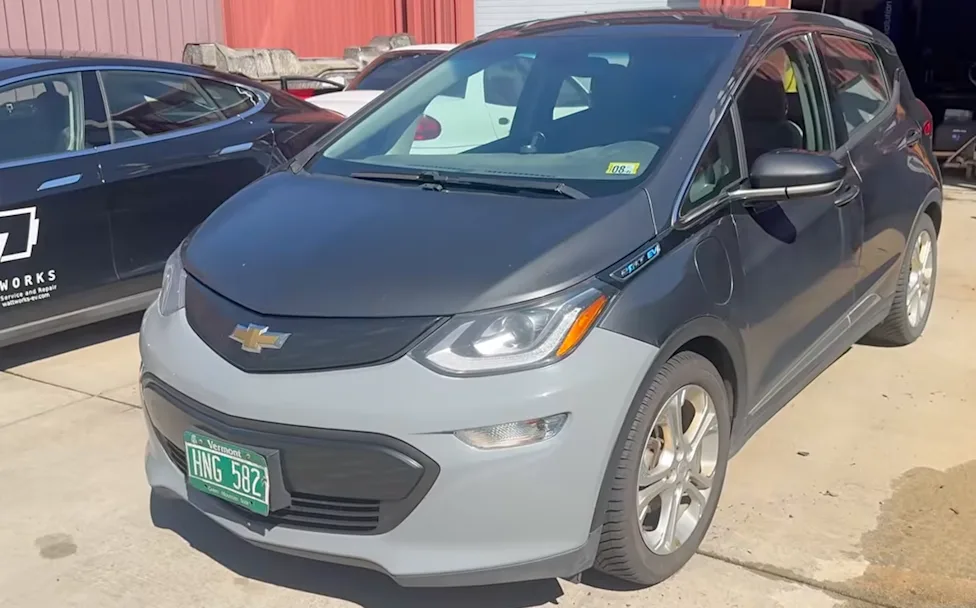
471,616-Mile Chevrolet Bolt Gets Third Battery After 330,000-Plus-Mile Pack Fails
A 2019 Chevrolet Bolt EV with 471,616 miles has returned to service with its third high-voltage battery after arriving at Out of Spec Renew unable to shift into drive. The car displayed a battery-fault warning, and the replacement pack installed under General Motors’ fire-recall program had reportedly covered more than 330,000 miles before failing.
The repair, documented on October 27, 2026, gives the Bolt a used recall-specification pack with approximately 10,000 to 15,000 miles. That battery was previously installed in a 2017 Bolt EV in 2023. It is an unusual example of keeping an electric car operating near the half-million-mile mark, but the account does not identify the precise failure inside the outgoing pack.
One car, three battery packs
The Bolt’s original battery was removed in 2022 as part of GM’s response to manufacturing defects associated with battery-fire risk. The broader campaign covered about 140,000 Bolt EV and Bolt EUV vehicles in North America. In 2021, the National Highway Traffic Safety Administration said GM was expanding the recall to all 2017-2022 Bolt EVs because their high-voltage packs could catch fire.
The recall replacement then accumulated more than 330,000 miles, according to The Drive. That figure is notable because it represents the mileage on one battery, rather than the odometer reading of a car that received several packs at shorter intervals. It also substantially exceeds the 100,000-mile distance associated with the limited parts warranty GM offered on replacement battery modules for earlier Bolt models.
Still, mileage alone cannot describe the pack’s complete aging history. Battery deterioration depends on elapsed time, energy throughput, temperature, charging power, chemistry and battery-management controls. The owner was not identified, and there is no established record here of the car’s driving pattern, climate exposure or charging behavior. The case therefore shows what one recall replacement achieved, not what every Bolt battery should be expected to deliver.
Battery life is only part of vehicle life
The inspection also found suspension, wheel-bearing and steering-rack problems, along with cosmetic bumper damage. Those findings illustrate a basic whole-vehicle constraint at extreme mileage: removing the combustion engine does not remove mechanical wear from the chassis, steering system, bearings, tires, brakes or body.
An electric Bolt avoids several recurring combustion-vehicle service items, including engine oil, spark plugs and a timing belt. Its traction motor also has fewer moving parts than an internal-combustion engine. But high mileage still subjects wheel bearings to repeated rotation and loading, while suspension joints, dampers, bushings and steering components continue to absorb road inputs. Once a vehicle reaches this level of use, continued operation depends on the condition and repairability of the entire platform, not solely the health of its propulsion battery.
The third pack also demonstrates the potential role of used batteries in extending an older EV’s service life. Installing a compatible pack with only 10,000 to 15,000 miles avoids requiring a newly manufactured battery for this particular repair. Compatibility, diagnostic status and pack condition remain central systems-integration concerns; a replacement must communicate correctly with the vehicle and satisfy its electrical, thermal and structural requirements.
An outlier with a useful boundary
Large fleet datasets provide context for why one vehicle cannot establish a general lifespan. Geotab’s 2025 analysis of more than 22,700 electric vehicles found average battery-capacity degradation of 2.3% per year, with meaningful variation tied to vehicle design and operating conditions. Vehicles with frequent, high-power fast charging experienced higher average degradation than those relying more heavily on lower-power charging.
That analysis measures gradual capacity loss across many vehicles, while the Bolt arrived with a fault warning and could not enter drive. The available information does not say whether its problem resulted from ordinary cell aging, an isolated component, pack electronics or another internal condition. Capacity degradation and a fault that disables propulsion are related aspects of battery health, but they are not interchangeable measures.
The used third battery has returned the Bolt to operation, and The Drive projected that it could carry the car beyond 500,000 miles. Reaching that mark would require fewer than 28,400 additional miles far less than the distance reportedly delivered by the outgoing recall pack but the suspension, bearings and steering rack show why the battery will not be the only system determining whether this Chevrolet gets there.
| More aerospace and engineering stories, right in your MSN feed. Follow AMI on MSN |
By Thomas Caldwell — AMI’s senior editor for mechanical and mobility engineering, covering vehicle electronics, systems integration, electrification, chassis systems, propulsion, and safety policy.



