


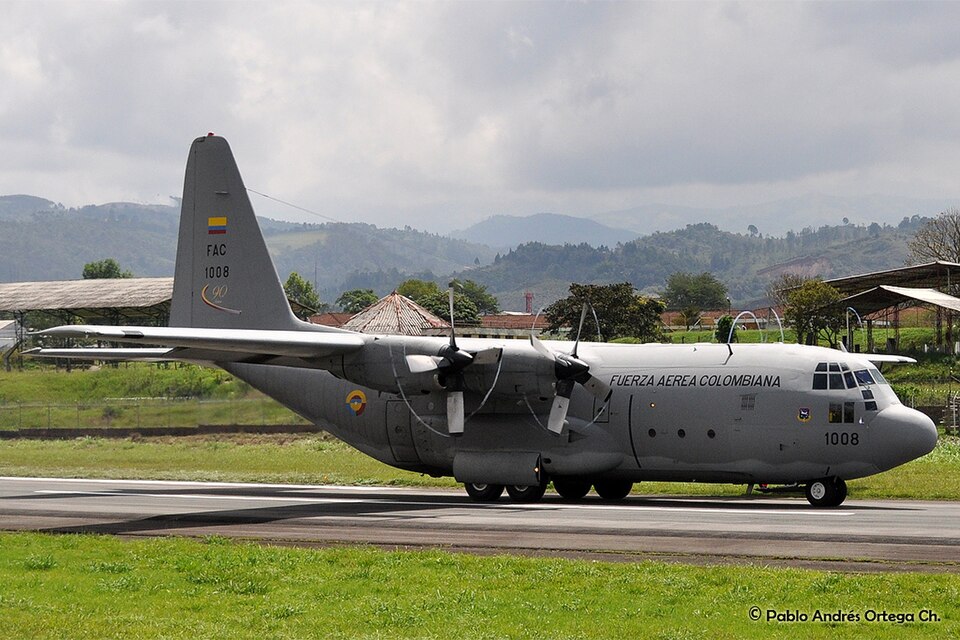
Colombia C-130 Findings Reverse 6,000-Pound Margin in Crash That Killed 69
The closed investigation into the Colombian Air Force C-130 Hercules crash that killed 69 people reportedly identifies excess weight as a contributing factor even though the preliminary calculation placed the aircraft about 6,000 pounds below its applicable takeoff limit. The full final report remains unpublished, leaving no revised weight or explanation for that consequential change.
Colombian and U.S. Air Force specialists formally completed the investigation into the March 23 crash of aircraft FAC 1016. La FM reported on Oct. 26 that the final findings cited human error, excess weight and runway conditions. The report had been delivered to Colombia’s Ministry of Defense about a month earlier.
The transport was carrying 126 people from Puerto Leguizamo to Puerto Asis: 113 Army personnel, 11 Air Force crew members and two National Police officers. Fifty-seven survived. An initial statement had put the number aboard at 125, but the later institutional breakdown totals 126.
The weight conclusion changed, but the calculation is missing
In April, investigators estimated the C-130’s takeoff weight at approximately 133,000 pounds. They calculated that the maximum possible takeoff weight for the conditions at Puerto Leguizamo was 139,000 pounds, producing the roughly 6,000-pound margin that is now central to the unresolved discrepancy.
That preliminary number was itself a reconstruction. Personnel weight records were unavailable after the accident, so investigators used interviews, cockpit recordings and other available information to estimate the load. Such a reconstruction necessarily depends on the completeness and accuracy of passenger, cargo, fuel and configuration inputs. The publicly reported final findings do not identify which input changed, provide a replacement takeoff weight or state whether investigators revised the condition-specific limit.
The distinction between an aircraft’s broad structural capability and the allowable weight for a particular departure is important. A C-130 may have a higher published maximum takeoff weight in general service, but an individual departure can be limited to a lower figure by runway length, environmental conditions, aircraft configuration and the required performance margin. Investigators had already selected 139,000 pounds as the applicable preliminary ceiling at Puerto Leguizamo, rather than relying on a generic C-130 maximum.
Without the final report, “excess weight” remains technically ambiguous. It could refer to a revised aircraft weight, a lower allowable weight for the actual conditions, or another loading-related determination. The available account does not resolve which interpretation the investigators adopted.
Runway and obstacles formed a linked performance problem
Puerto Leguizamo’s runway is approximately 1,200 meters, or 0.745 miles, long. About four seconds after becoming airborne, FAC 1016 struck three trees in its departure path. Investigators found branches as large as 16 centimeters about six inches in diameter inside an affected engine. The impacts disrupted engine operation and reduced power.
The aircraft remained airborne for about 36 seconds and crashed more than two kilometers from the takeoff point. The pilot warned those aboard to prepare for impact before the crash.
These observations establish the tree strikes and subsequent power reduction, but the reported final summary does not explain how investigators apportioned significance among weight, runway conditions and obstacles. It also does not specify whether “runway conditions” meant available length, surface condition, nearby obstructions or a combination of those factors.
Weight is especially consequential during a constrained departure because it affects the performance available before and after liftoff. A heavier aircraft generally requires more runway and has less climb capability under the same conditions. If engine power is then reduced, the remaining performance margin becomes more important. The published information does not quantify those relationships for FAC 1016, so it cannot show how much each cited factor contributed.
The preliminary investigation had already treated the trees as an operational hazard. It recommended restricting departures from the affected runway end until obstacles near the departure path could be cleared. That recommendation directly addressed an identified exposure regardless of the unresolved loading calculation.
The final report must reconcile the two assessments
The reported findings also cite human error without identifying the action involved. No public account specifies whether that category concerned loading, performance calculations, departure planning, aircraft handling or another decision. Assigning it to any person or phase of the operation would go beyond the released findings.
Investigators examined wreckage, terrain, weather and survivor testimony. The Colombian Air Force had described the aircraft as airworthy, reported no active operational restrictions in its records and said it was covered by a maintenance program following manufacturer guidance.
The missing final report now carries the central explanatory burden: it must show what changed between the reconstructed 133,000-pound estimate and the conclusion that excess weight contributed. Until that calculation is public, the investigation is formally closed but its most significant reversal remains unexplained.
| More aerospace and engineering stories, right in your MSN feed. Follow AMI on MSN |
By Thomas Caldwell — AMI’s senior editor for mechanical and mobility engineering, covering vehicle electronics, systems integration, electrification, chassis systems, propulsion, and safety policy.



