


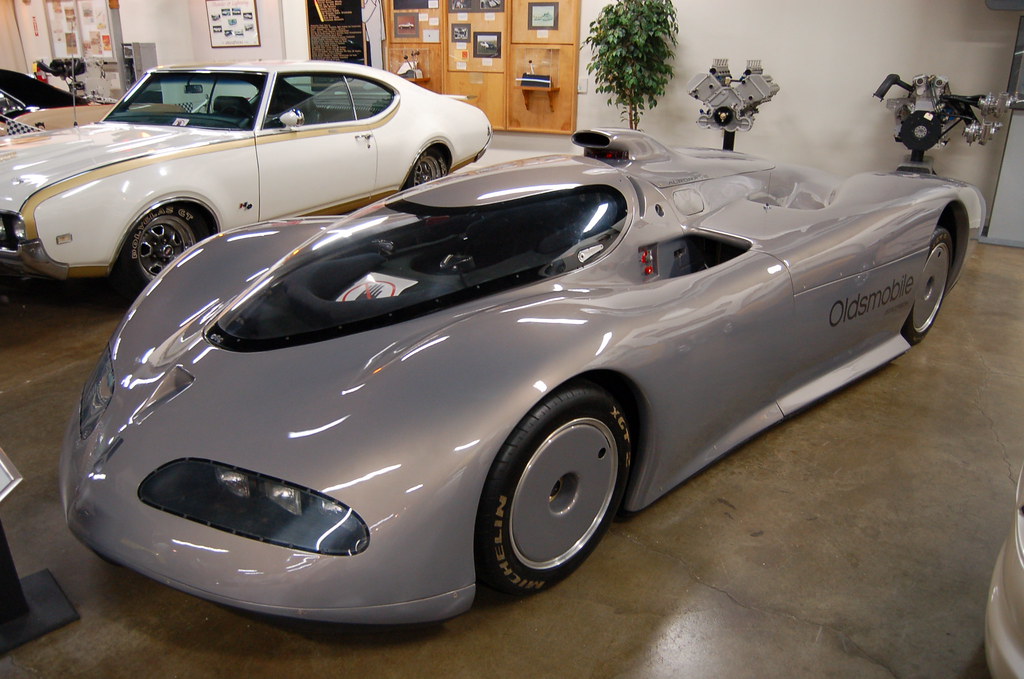
Two Scrapped Oldsmobile Aerotechs Return After Parts Survive in Arizona
Two Oldsmobile Aerotech record cars that General Motors ordered scrapped have returned from an unlikely afterlife. Components from the 1987 streamliners survived for roughly 30 years in an Arizona collection, making it possible to rebuild both cars and place them before the public again.

Collector Matthew Katz acquired the surviving parts and supported the reconstruction with GM and Batten Engineering, working in collaboration with the Petersen Automotive Museum. The completed Aerotechs were unveiled at the 2025 Las Vegas Concours with Ed Welburn, the designer responsible for their original shape, in attendance.
The recovery reverses what had appeared to be a definitive end for the program. GM produced three Aerotech versions between 1987 and 1992, then ordered all three dismantled after their record campaigns. The Arizona components did not preserve the two early cars intact, but they retained enough material to anchor reconstructions of machines whose significance rests on measured performance rather than an unverified top-speed claim.
A racing chassis beneath a wind-tunnel body
The Aerotech was more than a styling exercise with a powerful engine. Welburn developed its initial form with GM aerodynamicist Max Schenkel, refining the body through wind-tunnel work. Underneath were modified components from the March 84C CART racing car, a design associated with the 1984 CART Constructors’ Championship and Rick Mears’s Indianapolis 500 victory that year.
That combination provided a useful systems foundation. Racing-derived underpinnings supplied a platform suited to sustained high speed, while the enclosing body addressed the aerodynamic resistance that rises rapidly as velocity increases. The body and chassis therefore had to function together; adding engine output without controlling drag and stability would not have delivered the documented record results.
The two cars also showed how Oldsmobile adjusted the complete package rather than treating power as the only variable. The first, short-tail Aerotech used a single-turbocharged, Quad 4-derived four-cylinder engine producing 900 horsepower. The second combined a twin-turbo version rated at 1,000 horsepower with a long-tail body optimized for speed.
The long tail reduced the size and severity of the separated wake behind the car, lowering the pressure drag generated at the rear. Modern wind-tunnel research on simplified vehicle shapes supports that underlying principle: tapering the roof and sides of an elongated tail can substantially reduce drag, although tail length, lift and crosswind behavior remain important design constraints. One three-dimensional streamlined-tail study found that side tapering suppressed edge vortices and reduced both drag and lift compared with an upper-surface taper alone.
That research was not a test of the Aerotech, but it helps explain why the long-tail car purchased speed through body length as well as additional boost. An extended tail is impractical for an ordinary passenger vehicle, yet a record car can accept that packaging cost when minimizing aerodynamic loss is the central mission.
Measured records, not the rumored maximum
During trials at the Fort Stockton Test Track in 1987, with FIA officials overseeing the results, A.J. Foyt drove the 900-horsepower short-tail Aerotech to a 257.123-mph closed-course record. He then drove the 1,000-horsepower long-tail car to an average of 267.399 mph over a flying mile. One direction of that run was measured at 278.357 mph.
Contemporary accounts alleged that the long-tail Aerotech reached as much as 290 mph elsewhere on the 7.7-mile oval, but that figure was not established as an official result. The 267.399-mph two-way average is the stronger engineering benchmark because it was produced under observed record conditions and reduced the influence of wind or other directional effects.
A third Aerotech expanded the program from outright speed to endurance in 1992. Powered by a 4-liter Aurora V8, it covered 10,000 kilometers at 170.761 mph and 25,000 kilometers at an average of 158.386 mph. The first two cars were also later fitted with Aurora V8 engines and functional lights before the program ended.
The reconstruction cannot undo the decision to dismantle the original vehicles, and the rebuilt cars necessarily reflect an intervention beyond simple preservation. It does, however, return surviving program hardware to recognizable form. More importantly, it restores the physical link between three elements behind the 1987 results: CART-derived chassis engineering, highly boosted four-cylinder power and bodies developed to make that power effective at speed.
GM ended Oldsmobile as a brand in 2004, but the Aerotech’s disappearance proved less final. Parts stored for decades in Arizona ultimately brought back two cars whose official records include a 267.399-mph flying-mile average a result that survived even when the machines themselves nearly did not.
| More aerospace and engineering stories, right in your MSN feed. Follow AMI on MSN |
By Thomas Caldwell — AMI’s senior editor for mechanical and mobility engineering, covering vehicle electronics, systems integration, electrification, chassis systems, propulsion, and safety policy.



