


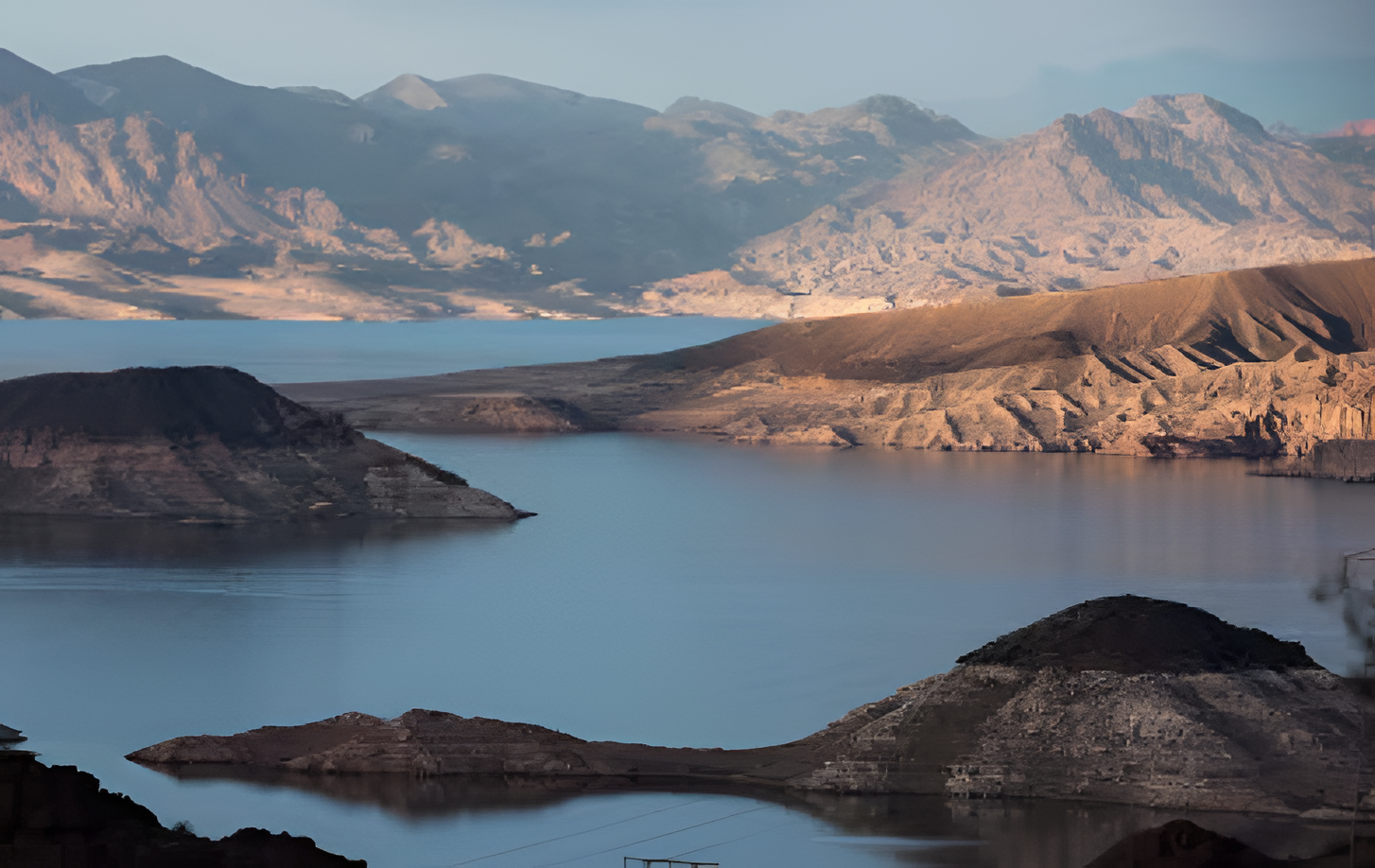
As Lake Mead Falls, Tucson’s Underground Water Offers a Decade’s Buffer
Tucson’s main outside water supply could eventually stop if Lake Mead fell to dead pool, but that would not immediately empty the city’s taps. Decades of storing Colorado River water underground have created a reserve expected to cover at least the first 10 years of a complete canal cutoff.
The tension lies in how the two systems are connected. Tucson receives Colorado River water through the 336-mile Central Arizona Project canal, which draws from Lake Havasu and pumps the water more than 800 feet uphill. Lake Havasu, in turn, depends on water released downstream from Lake Mead through Hoover Dam. At a Lake Mead elevation of roughly 895 feet, reservoir water would sit below Hoover Dam’s lowest intake gates and could no longer flow downstream by gravity. More than 2 million acre-feet would remain trapped behind the dam’s lowest outlets, but Tucson’s incoming supply would ultimately be cut off.
That threshold remains well below current conditions. Lake Mead reached 1,037.16 feet on October 22, 2026 about 142 feet above dead pool. Reclamation’s October probable-minimum forecast projected the reservoir could reach 982.43 feet in July 2028. A separate most-probable projection placed it at 1,009.85 feet that month, illustrating how runoff, conservation and operating assumptions produce materially different short-term outcomes. Neither projection reaches dead pool.
The underground reserve is already Tucson’s main supply
Tucson’s protection comes from treating the aquifer as a large storage component rather than relying solely on water held behind distant dams. Colorado River water is delivered to recharge facilities west of the Tucson Mountains, spread across basins and allowed to percolate underground. Recovery wells later pump it back out for treatment, blending and delivery.
Approximately 78% of Tucson Water’s current deliveries already consist of recovered Colorado River water. The Central Avra Valley facility has 11 recharge basins across 317 acres, while the Southern Avra Valley facility has nine basins across 226 acres. The arrangement developed after water-quality complaints and pipe corrosion led Tucson to stop sending canal water directly into the municipal system.
Since 2000, Tucson has banked approximately 600,000 acre-feet of Central Arizona Project water underground. Tucson Water director John Kmiec has said the city can access at least another 400,000 acre-feet through the Arizona Water Banking Authority. Together, those stored supplies represent at least a decade of water if canal deliveries stop completely.
The wider groundwater position is larger. Including stored canal water, Tucson Water has access to roughly 4.7 million acre-feet, equivalent to about 47 years at the current use rate. Its Central Well Field supplies the other 22% of present deliveries and is maintained for peak demand and backup. A reclaimed-water network also offsets approximately 4.7 billion gallons of drinking-water use each year and could continue operating without the canal.
The buffer will begin doing real work in 2027
Tucson does not need to wait for a physical cutoff before drawing on its bank. The city expects to begin using stored-water credits in 2027 to cover a canal-order shortfall of at least 20,000 acre-feet. Its preliminary order is approximately 71,000 acre-feet, less than half its 144,191 acre-foot allocation. Under a paid conservation agreement, 50,000 acre-feet of the difference is scheduled to remain in Lake Mead.
Those reductions reflect both hydrology and water-right priorities. The 1968 law authorizing the Central Arizona Project made its diversions junior to California’s first 4.4 million acre-feet during shortages. The current federal framework and the underlying allocation structure are detailed in the Congressional Research Service’s Colorado River management report. Canal deliveries therefore would be reduced substantially before Lake Mead approached the physical dead-pool threshold.
Demand reduction extends the life of every stored acre-foot. Tucson’s per-person drinking-water use declined from about 165 gallons per day in 2000 to approximately 110 gallons in 2024. The city is now in Tier 2 of its drought plan. A Tier 3 recommendation is expected if Lake Mead falls below 1,025 feet or canal deliveries drop below one year of drinking-water demand.
The underground reserve nevertheless has a fixed systems limit: it is storage, not a new source. Tucson can add Colorado River water to the Avra Valley aquifer only while releases continue downstream to Lake Havasu and the Central Arizona Project intake remains supplied. The city’s bank can bridge a prolonged interruption, but replenishing that bank still depends on the same dam-and-canal chain whose decline made the reserve necessary.
| More aerospace and engineering stories, right in your MSN feed. Follow AMI on MSN |
By Thomas Caldwell — AMI’s senior editor for mechanical and mobility engineering, covering vehicle electronics, systems integration, electrification, chassis systems, propulsion, and safety policy.



