


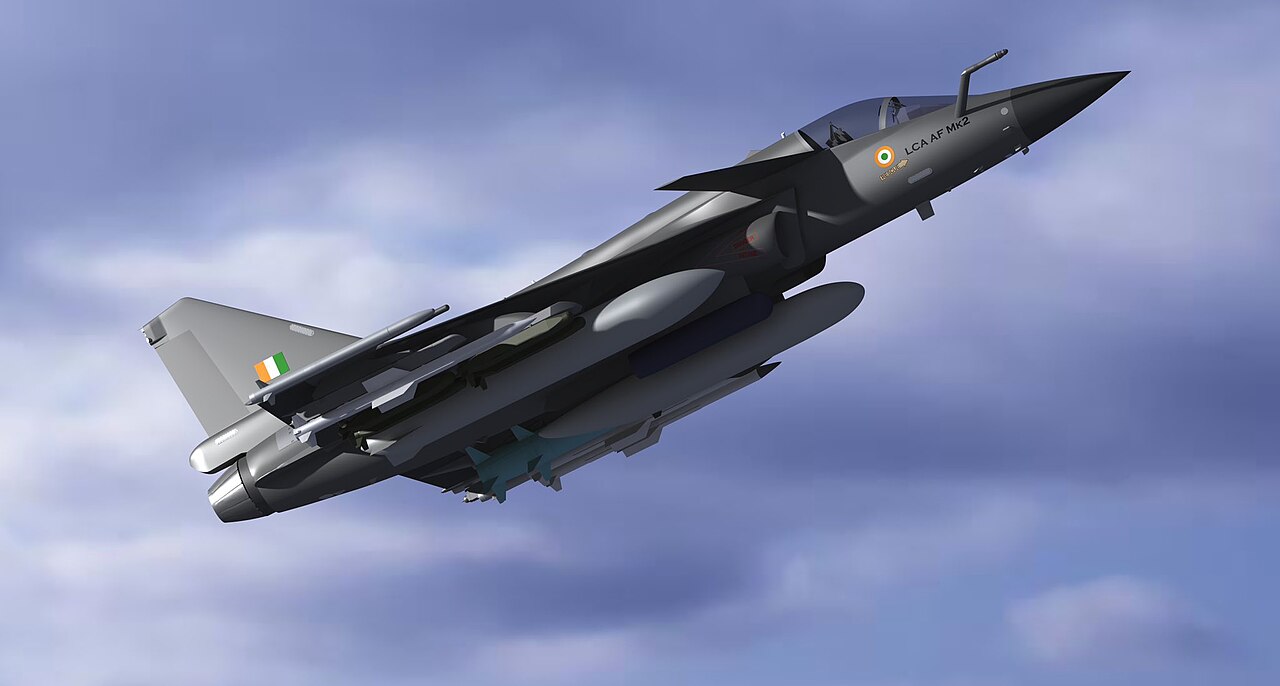
Former Air Force Vice Chief Says Tejas Mk-2 May Miss Frontline Window
India’s Tejas Mk-2 could arrive after its value as a frontline fighter has substantially faded, according to recently retired Indian Air Force Vice Chief Air Marshal Nagesh Kapoor. Asked whether the aircraft would remain operationally relevant if fielded in large numbers during the mid-2030s, Kapoor answered: “No, operationally, definitely no.”
That judgment does not make the Tejas Mk-2 useless. Kapoor argued that India will not have enough fifth and sixth-generation fighters to deploy across the entire country, leaving missions and locations where aircraft in the Mk-2’s class could fill force-structure gaps. The tension is therefore less about whether the fighter can serve and more about whether its development schedule will leave it suited to the missions for which it was originally intended.
A fighter’s schedule is part of its capability
Fighter programs are measured by more than speed, range or onboard systems. Their delivery dates determine the threats, allied systems and competing aircraft they will encounter. A design intended to strengthen the fleet in one decade can occupy a narrower role if large-scale production slips into the next.
Kapoor placed that timing problem against China’s expanding fifth-generation fleet, which is projected to reach 500 J-20 fighters by 2030. He wants both the 4.5-generation Tejas Mk-2 and India’s fifth-generation Advanced Medium Combat Aircraft to enter service, but said they “must come at a much faster speed.” His concern is that the Indian Air Force could remain dependent on older-generation designs while a regional competitor fields newer aircraft in substantial numbers.
The Mk-2 is not the only part of the Tejas family facing schedule pressure. The Indian Air Force has ordered 180 Tejas Mk1A aircraft, but deliveries have encountered multi-year delays associated primarily with late GE Aerospace F404-IN20 engines, mission-software validation and demanding operational requirements.
The engine pipeline has begun moving. GE Aerospace shipped four F404-IN20 engines in September 2026, bringing additional hardware to Hindustan Aeronautics Limited as completed airframes waited for powerplants. At least 25 airframes were ready at that point, according to an October engine-delivery update. HAL hopes to deliver the first 18 to 25 Mk1A aircraft by March 2027.
Engines, however, are only one part of turning completed airframes into accepted military aircraft. By early October, the Indian Air Force and HAL were preparing another induction review while remaining radar-integration issues were being addressed. The aircraft would also require final approval from India’s military airworthiness regulator, and no Mk1A had yet been delivered.
Why the Mk-2 could still matter
Kapoor’s gap-filling argument reflects a basic fleet constraint: the most advanced aircraft are unlikely to be available in unlimited numbers. A mixed fleet can assign newer, scarcer fighters to the most demanding frontline requirements while using less advanced aircraft where their capabilities remain adequate. In that structure, the Tejas Mk-2 could still add aircraft numbers and cover deployments that do not justify assigning the newest platforms.
The cost of delay is a reduced operating envelope for that contribution. The later the Mk-2 arrives in quantity, the more its role may shift from leading modernization to supporting a fleet increasingly organized around fifth-generation aircraft. That is the practical meaning behind Kapoor’s distinction between diminished frontline relevance and continuing utility.
Kapoor also recommended that India explore participation in either Europe’s Future Combat Air System, involving Dassault Aviation, Airbus and Indra Sistemas, or the Global Combat Air Programme led by the United Kingdom, Italy and Japan. That is advocacy from a retired officer, not an announced Indian procurement decision.
Joining a consortium would not erase India’s near-term fighter shortage or accelerate aircraft already moving through domestic development and production. It could instead provide a route into a future sixth-generation program without progressing solely through consecutive domestic fighter generations. Consortium participation would bring its own negotiations over schedules, industrial roles and requirements, none of which are resolved by Kapoor’s proposal.
The immediate test remains closer to the factory floor: whether engine deliveries, systems validation and airworthiness work can translate the waiting Mk1A airframes into operational aircraft. How quickly that happens will shape confidence in the larger promise that the more advanced Tejas Mk-2 can reach squadrons before its intended frontline window closes.
| More aerospace and engineering stories, right in your MSN feed. Follow AMI on MSN |
By David Whitaker — Associate editor for AMI’s aerospace and drone systems desk, translating flight systems, aircraft programs, spaceflight, and UAV developments into accessible technical stories.



