


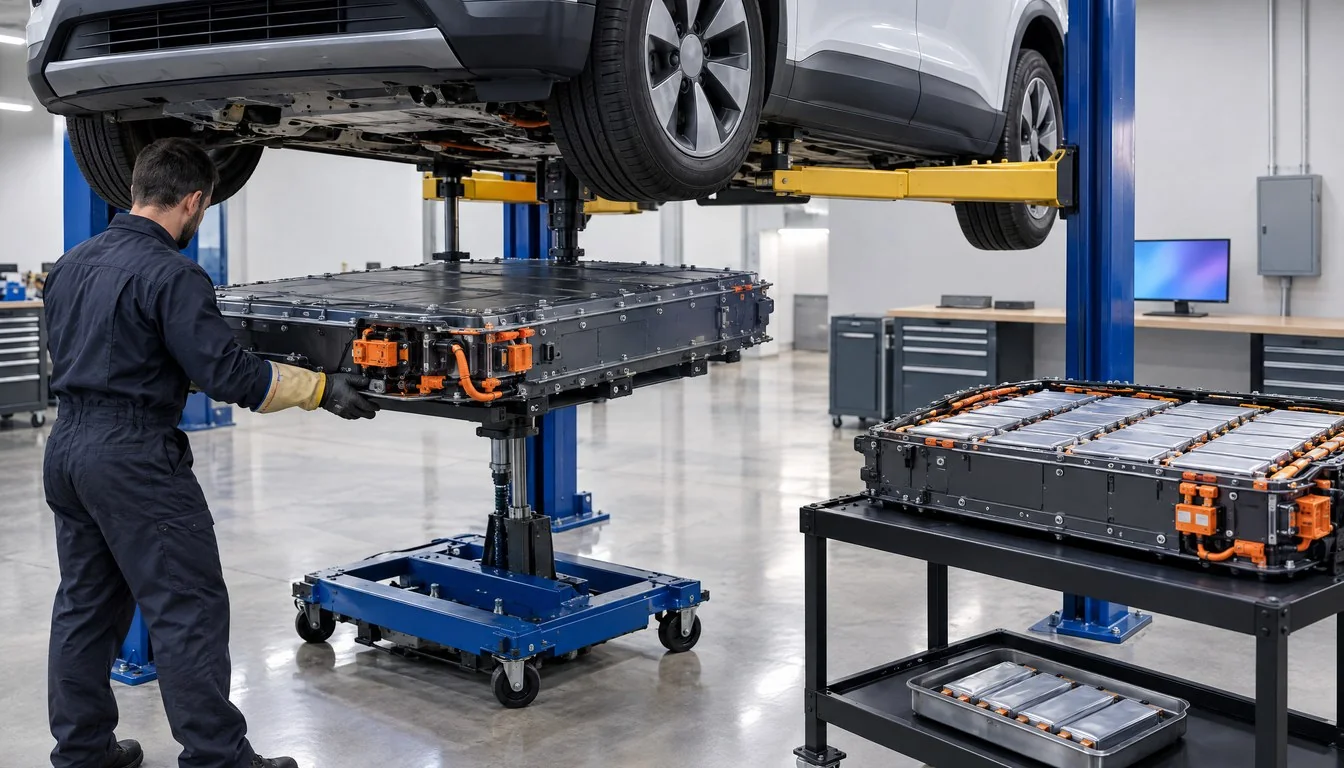
GM Orders Second Battery Replacement for 66 Chevrolet Equinox EVs
A major repair that was supposed to return 66 Chevrolet Equinox EVs to service now has to be done again. General Motors says remanufactured high-voltage battery packs previously installed in certain 2025 models contained modules that were ineligible for reuse, so authorized dealers must replace each complete pack a second time.

The action is GM Customer Satisfaction Program N262565450, not a safety recall. It covers 66 vehicles in the United States and runs through November 30, 2028. GM advises affected owners to contact a dealer promptly to arrange service, which must be completed by a technician with the required EV training.
The limited population is important: GM has not said that every 2025 Equinox EV, or Equinox EVs more broadly, require another battery. Owners who previously received a replacement pack can review their service history and ask an authorized GM EV dealer whether their vehicle identification number is included in this specific program.
Why module eligibility controls the entire repair
An electric-vehicle battery pack is a system assembled from smaller modules, along with electrical connections, thermal-management hardware, sensors and control electronics. Remanufacturing can retain suitable components rather than discarding an entire pack, but that approach depends on reliable screening at the component level. A module must satisfy the remanufacturer’s reuse criteria before it is allowed back into a vehicle battery.
GM has disclosed the result of that screening breakdown modules it classified as ineligible were installed but not the criterion they failed. The program material does not identify their state of health, age, electrical performance, physical condition or service history. It also does not explain how they passed into the remanufactured packs or identify the organization that rebuilt them.
General remanufacturing guidance illustrates why sorting and grading are central controls. The second edition of UL 1974 covers evaluation, sorting and grading for remanufactured, reconditioned and rebuilt batteries, including batteries intended for the same or a similar application. Its requirements include diagnostic and maintenance considerations, as well as controls related to the usable life of components.
A 2024 review of electric-vehicle battery remanufacturing similarly describes inspection, state-of-health screening, module testing and final quality checks as core steps. The thresholds discussed in that literature are not necessarily GM’s thresholds, but the process establishes the broader engineering point: a pack-level repair is only as dependable as the eligibility decision for every reused module entering the assembly.
Traceability is another part of that control chain. Battery history, prior use and retained performance data can inform whether a component remains suitable for vehicle propulsion. SAE J2997 recommends data retention and serviceable pack design to support battery reuse, repair and remanufacturing. Better records do not replace physical testing, but they can make screening more consistent and help keep unsuitable components out of finished packs.
What owners still do not know
GM’s prescribed remedy is another complete high-voltage battery replacement rather than an in-vehicle module repair. That returns the responsibility for module selection, pack assembly and validation to a controlled service chain, but it also requires owners to surrender their vehicles for a second major intervention after the first replacement was completed.
The available program material does not identify an owner-observable symptom, a specific failure mode or a safety consequence associated with the ineligible modules. It also does not say whether the next packs will be new or remanufactured. Those unanswered points limit conclusions about what owners might have experienced and about the configuration of the replacement they will receive.
A separate GM bulletin, PIE0753G, concerns selective battery-pack replacement for analysis and states that it is not a recall. No documented connection places those vehicles among the 66 covered by N262565450, so the two actions should be treated separately.
For the affected owners, the immediate consequence is straightforward: a completed high-voltage battery repair must be repeated in full. For battery remanufacturing, the case exposes the cost of a failed eligibility gate one unsuitable reused component decision can ultimately send an entire assembled pack back through the replacement process.
| More aerospace and engineering stories, right in your MSN feed. Follow AMI on MSN |
By Thomas Caldwell — AMI’s senior editor for mechanical and mobility engineering, covering vehicle electronics, systems integration, electrification, chassis systems, propulsion, and safety policy.



