


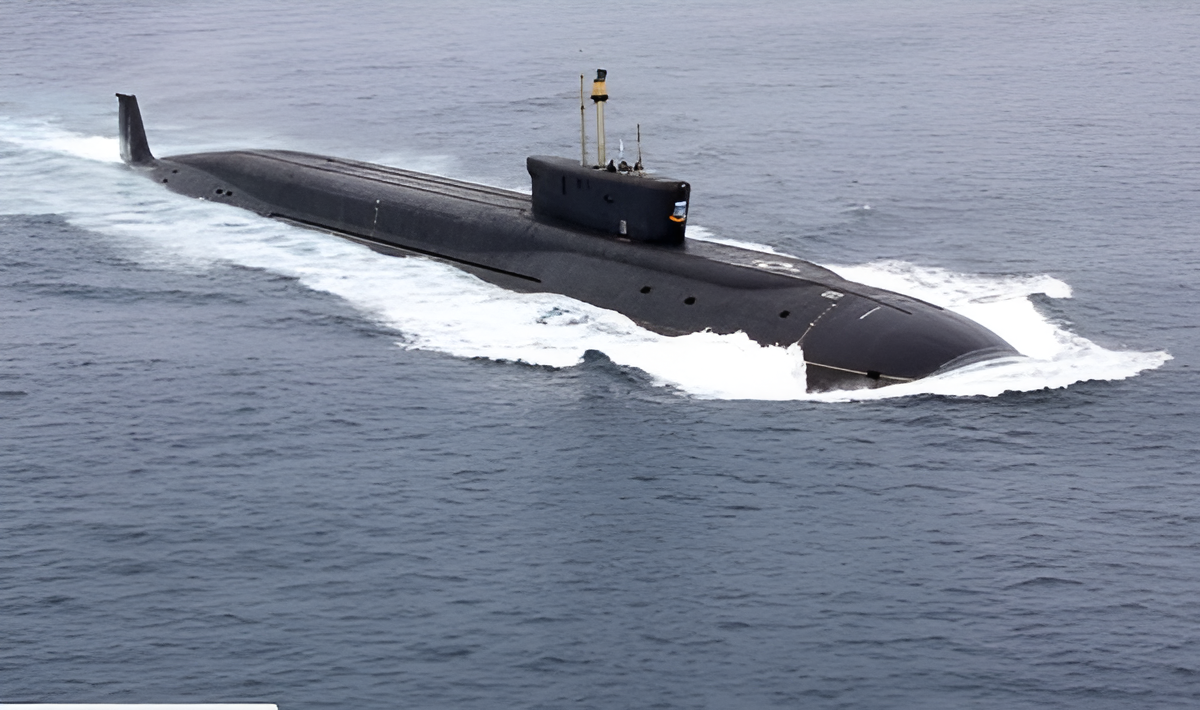
Russia’s 24,000-Ton Generalissimo Suvorov Submarine Fires 5,160-Mile Missile Underwater
Twenty-four thousand metric tons is the submerged displacement behind Russia’s latest long-range missile exercise. The nuclear-powered Generalissimo Suvorov submarine fired a Bulava intercontinental ballistic missile while underwater in the Sea of Okhotsk on October 28, according to the Russian Defense Ministry. The missile was directed toward the Chizha test range in Russia’s Arkhangelsk region during what Moscow described as scheduled combat training.
The ministry said monitoring data showed the missile’s warheads reached the designated test area at the scheduled time, according to an account of its announcement. It did not release the flight time or detailed performance data, and there is no independent confirmation of the result. The publicly confirmed event is therefore a submerged launch during a scheduled exercise, accompanied by Russia’s stated outcome rather than a complete test report.
The scale is what makes the launch immediately striking. Generalissimo Suvorov is approximately 558 feet long and displaces about 14,720 metric tons on the surface. Fully submerged, that figure rises to roughly 24,000 metric tons. The vessel reportedly can travel at around 15 knots on the surface and as fast as 29 knots underwater.
Its Bulava missile is a similarly large system. The weapon has a reported launch weight of 36.8 metric tons and an estimated range of 5,160 miles, or 8,300 kilometers. The Center for Strategic and International Studies describes the Bulava as a solid-propellant, submarine-launched ballistic missile developed for Russia’s Borei-class strategic submarines.
A submarine and missile designed as one strategic system
The launch illustrates the defining capability of a ballistic-missile submarine: releasing a long-range weapon without first surfacing. That allows the vessel to remain below the waterline through the launch phase, preserving the mobility and concealment that give sea-based nuclear forces their strategic value.
Generalissimo Suvorov can carry 16 Bulava missiles. Its significance therefore comes from more than the performance of one weapon. Nuclear propulsion gives the submarine the endurance associated with extended underwater operations, while its missile capacity creates a mobile sea-based component of Russia’s nuclear deterrent. The available information does not describe the underwater launch sequence or provide subsystem-level test measurements, but the exercise demonstrated that the submarine and missile were operated together in their intended submerged configuration.
The vessel, also designated K-553, belongs to the Project 955A Borei-A class. Rubin Central Design Bureau for Marine Engineering designed it, and construction began at the Sevmash shipyard on December 26, 2014. The Russian Navy commissioned the submarine in 2022. It initially served with the Northern Fleet before transferring to the Pacific Fleet in October 2023 and reaching its permanent base in Kamchatka.
The Borei-A design incorporates updated systems intended to reduce detectable physical signatures and improve protection during operations. Those features support the submarine’s broader purpose: remaining difficult to locate while carrying weapons with intercontinental reach. The October exercise publicly displayed the launch side of that mission, but it offered no data by which outside observers could assess accuracy, reliability or the submarine’s detectability.
Scheduled training with an unavoidable strategic audience
Russia officially characterized the launch as scheduled combat training. Its timing nevertheless gives the exercise a wider audience. Supporters of Ukraine are likely to read a submerged intercontinental-missile launch as Russia displaying its nuclear force during the ongoing war, particularly amid heightened concern about nuclear signaling in Europe.
That interpretation is context, not a confirmed purpose assigned to this specific exercise. The International Crisis Group has warned that demonstrations of nuclear resolve can increase escalation risks when opposing governments interpret the same activity differently. Moscow’s stated explanation remains scheduled training, while the visible result was a 24,000-metric-ton submarine launching a nuclear-capable missile with an estimated 5,160-mile range from beneath the Sea of Okhotsk.
The unresolved engineering question is how completely the system met its test objectives. Russia reported that the designated area was reached, but without flight time, telemetry or detailed results, the public record shows a successful launch claim not a full performance assessment.
| More aerospace and engineering stories, right in your MSN feed. Follow AMI on MSN |
By David Whitaker — Associate editor for AMI’s aerospace and drone systems desk, translating flight systems, aircraft programs, spaceflight, and UAV developments into accessible technical stories.



