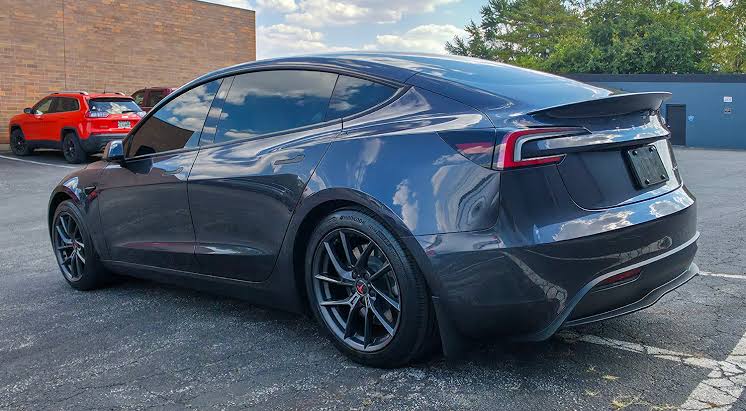
Bridgestone Says Tesla Model 3 Testing Shows EV Tires Can Last 50% Less
A tire does not distinguish between acceleration and regenerative braking. In both cases, the contact patch must transmit a longitudinal force between the vehicle and the road. On an electric vehicle such as the Tesla Model 3, that repeated loading combines with substantial mass, immediate motor torque and handling-oriented suspension geometry all of which can accelerate tread wear.
Bridgestone estimates that electric-vehicle tires generally last about 50% less than tires on comparable combustion vehicles. The company bases its explanation partly on testing involving a Tesla Model 3, but the figure is an attributed industry estimate rather than a universal result. Bridgestone also acknowledged that its broader comparison used the Model 3 and the Toyota Camry it normally tests, two vehicles that are not directly equivalent in mass or performance.
Why regenerative braking still loads the tires
Battery weight and instant torque are the most familiar explanations for electric-vehicle tire wear. A heavier vehicle places greater vertical load on each tire, while a motor capable of delivering torque immediately can impose strong acceleration forces without waiting for an engine or transmission to build speed.
Regenerative braking adds another part of the load cycle. When a driver lifts the accelerator, the motor can operate as a generator and slow the car while returning energy to the battery. That process reduces reliance on the friction brakes, but the deceleration force still travels through the tires. An unidentified Bridgestone representative summarized the pattern by saying, On an EV, the tire is either always under torque or always under regen.
The statement is a useful description of frequent loading, not a claim that every electric car applies maximum force continuously. Regeneration intensity varies with vehicle settings, speed, battery condition and driver input. Aggressive one-pedal driving can nevertheless produce repeated acceleration-to-deceleration transitions during ordinary urban use. Those reversals make tire wear a systems issue rather than a consequence of mass alone.
Regeneration also creates a tradeoff between two sources of non-exhaust emissions. It can substantially reduce wear at the brake pads and rotors, yet the tires must still supply the friction needed to slow the vehicle. A 2025 Virginia Tech study of airborne tire particles modeled electric vehicles as averaging 43% more mass than similarly sized combustion vehicles, with considerable variation among models. The researchers noted that their weight-based calculation did not account for additional low-speed torque, illustrating why real-world tire wear cannot be inferred from vehicle mass alone.
The Model 3’s handling geometry adds another variable
Suspension alignment determines how tread pressure is distributed as a car moves. Camber describes the tire’s inward or outward inclination relative to vertical, while toe describes whether the tires point slightly toward or away from one another. Both values can change dynamically as the suspension moves and the body loads during cornering.
The Model 3 Performance was cited as an example of the tension. It is a relatively heavy car with a low center of gravity and suspension tuning intended to produce athletic handling. Under acceleration and cornering, dynamic camber, toe and weight transfer can concentrate work on particular parts of the tread. Bridgestone highlighted rear-tire wear as a particular concern on electric vehicles configured this way.
This means two versions of an electric vehicle can produce different wear outcomes even when they use the same underlying battery technology. Tire construction, alignment, driven axle, suspension tuning, road surface, climate and driving style all influence service life. A high-performance Model 3 and a Camry therefore cannot support a clean powertrain-only comparison.
What Bridgestone’s mileage figures actually show
Bridgestone says it completed a 20,000-mile wear test and winter testing of its Turanza EV tire on a Tesla Model 3. The company targeted 50,000 miles of service on that platform, compared with an estimated 32,000 to 35,000 miles for what its representative described as a previous-generation standard tire.
Those numbers describe Bridgestone’s development target and internal comparison. They do not establish that every Turanza EV will reach 50,000 miles, or that every conventional tire on a Model 3 will stop at 35,000 miles. The company developed a material called PeakLife polymer for the EV tire and later extended the technology to other products, while also obtaining an original-equipment fitment on the Tesla Model Y.
Longer tread life is only one tire-design objective. Compound, tread and structural choices can also affect driving range, cabin noise, wet and winter performance, and ride comfort. An original-equipment tire may emphasize efficiency because lower rolling resistance helps an electric vehicle travel farther per charge, while a replacement design may assign greater priority to durability.
Bridgestone’s 50% estimate is therefore best understood as a warning about combined vehicle loads, not a fixed replacement schedule. The Model 3 places battery mass, rapid torque response, regenerative deceleration and athletic chassis tuning into one system, leaving the tire to absorb the consequences every time the car accelerates, slows or turns.
| More aerospace and engineering stories, right in your MSN feed. Follow AMI on MSN |
By Thomas Caldwell — AMI’s senior editor for mechanical and mobility engineering, covering vehicle electronics, systems integration, electrification, chassis systems, propulsion, and safety policy.