Carbon Black Turned Tyres Black and Made Them Last Longer
Early tyres could be white. Modern tyres are overwhelmingly black. The difference is not primarily a styling decision: it reflects a change in the materials mixed into the rubber to improve wear resistance, heat resistance, toughness and durability.

Rubber itself is described as colourless, and zinc oxide one of the additives commonly used in early tyre production is pure white. The resulting tyres therefore had a white appearance. Zinc oxide provided some wear resistance, but the rubber formulation remained relatively soft compared with the compounds that followed.
White rubber versus black reinforcement
The important change came in the early 20th century, when tyre manufacturers discovered that adding carbon black could greatly improve wear resistance. The material also gave the compound useful heat resistance, abrasion resistance, toughness and resilience. Longer tyre life, rather than a preference for a darker colour, drove the transition.
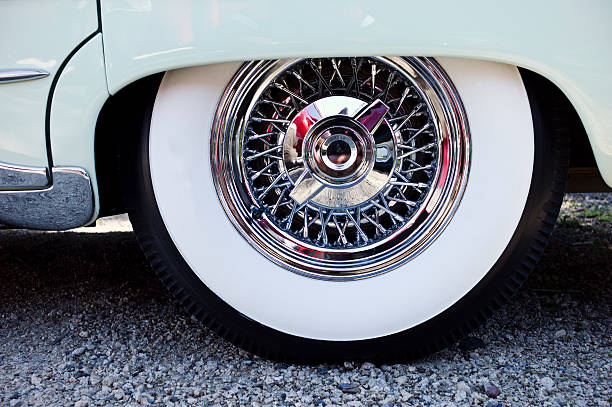
The contrast is visible in the history of white-sidewall tyres. Carbon black was initially available in limited quantities, making it difficult for manufacturers to use enough of it throughout the entire tyre. Some therefore concentrated the material in the tread, where road contact made wear resistance especially valuable, while retaining white sidewalls. This produced a black tread around a white sidewall.
As carbon black became established in compounds for both the tread and sidewall, the whole tyre became black. White sidewalls persisted in some products into the early 1970s, while tyres have been entirely black as the industry standard since that period.
The colour follows the compound
Carbon black is a black carbon material made through the incomplete combustion of heavy petroleum products. When it is incorporated into the rubber compounds used for the tread and sidewall, its pigment changes the appearance of the finished tyre. The same basic material is also used for colour in products such as printing ink, toner and mascara, although those applications have different performance requirements.
In a tyre, however, the visible colour is secondary to the material properties carbon black contributes. The formulation must withstand repeated deformation as the tyre rotates, abrasion where the tread meets the road and heat generated during operation. Carbon black’s contribution to wear and heat resistance helps explain why the additive became standard across tyres with widely different purposes.
This also explains why black should not be treated as a quality rating. Two tyres can have the same all-black appearance while differing in their compound formulations, construction and resulting performance. Colour confirms the presence of black material in the compound; it does not reveal the tyre’s complete design or durability by itself.
Recycled carbon black presents a separate challenge
Recovering carbon-rich material from discarded tyres does not automatically produce a direct replacement for the carbon black used to manufacture new ones. A 2024 study of recycled carbon black from tyre pyrolysis found that organic residues and inorganic impurities can promote particle agglomeration and reduce active surface area. Those limitations can prevent low-quality recovered material from being reused directly in demanding rubber applications.
That recycling problem underlines the importance of formulation rather than colour. Virgin and recovered carbon black may look similar, yet contamination, particle structure and processing history can make them behave differently. Reusing recovered material in new tyres can therefore require additional treatment and quality control rather than simple collection and grinding.
The familiar black tyre is ultimately a record of an engineering choice made more than a century ago. White rubber and zinc oxide gave way to carbon-black reinforcement because tyres needed to resist wear and heat more effectively. The colour remained visible, but durability was the reason for the change.
| More aerospace and engineering stories, right in your MSN feed. Follow AMI on MSN |
By Robert McKinney — Editor-in-Chief for AMI’s automotive and mobility coverage, with a mechanical engineering background and a decade reporting on powertrain systems, EV innovation, and global vehicle manufacturing.