Safety Board Says Piper Cub Hit Car, Killing 88-Year-Old Passenger
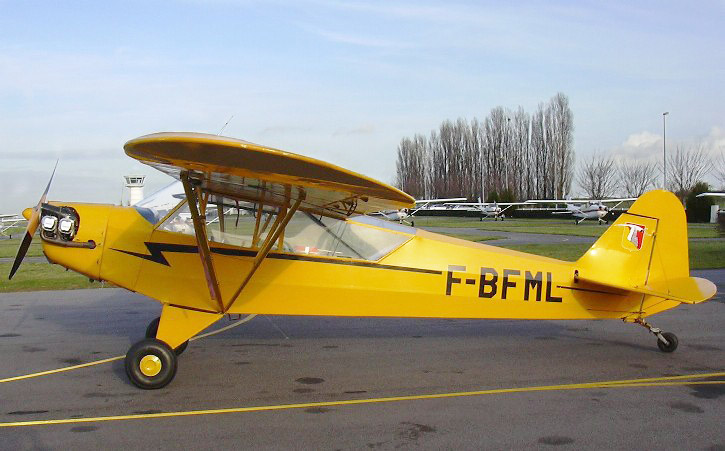
A low-flying 1946 Piper J-3 Cub struck a car on a public road beside Indiana’s Boonville Airport on Oct. 18, fatally injuring 88-year-old passenger Leon Hatchett and tearing the airplane’s left main landing gear away. The airplane remained airborne for about two hours before landing safely, according to the National Transportation Safety Board’s preliminary account.

The account changes the basic understanding of an accident initially described as a possible mechanical failure or an aircraft part falling onto the vehicle. Investigators now say the Cub itself hit the northbound car on South Baker Road at the western edge of the airport, with the landing gear separating during the collision rather than before it.
Hatchett suffered serious injuries and later died. The car’s driver and the pilot were not injured. Hatchett was a longtime Warrick County pastor who served at Wayside Chapel Church.
The pilot described a low pass, not a mechanical emergency
The personal flight began with a departure from runway 9. The pilot told investigators that he then returned for a low pass in the opposite direction over runway 27, a turf strip measuring 2,300 feet long and 100 feet wide.
Near the runway’s west end, the pilot climbed and performed what the preliminary report calls an “impossible turn.” He made additional turns, lined up with runway 27 again and flew low with little power. About two-thirds of the way along the runway, he applied full throttle.
The term “impossible turn” is commonly associated with an attempted low-altitude return toward a runway after an engine failure. In this case, however, the report does not describe the maneuver as a response to an engine failure. The pilot reported “no preimpact mechanical anomalies that would have precluded normal operation.” The phrase therefore records the report’s description of the maneuver, not a finding that the Cub had suffered a power loss.
The pilot estimated that the airplane was traveling about 70 mph when it struck the car at the end of the runway. He told investigators that tall weeds, tree shadows and the vehicle’s dark color concealed it until it was directly ahead. That visibility account comes from the pilot and remains one part of an investigation that has not reached a probable-cause finding.
A collision followed by an unusual two-hour flight
The impact removed the Cub’s left main landing gear, but the airplane stayed in the air. The pilot circled the airport for approximately two hours and landed safely shortly after 5 p.m., roughly two hours after the collision at about 3 p.m.
That sequence explains why early emergency information was confused. Warrick County Sheriff Michael Wilder said dispatch initially received a report of a potential aircraft mechanical failure that had struck a vehicle. Boonville Fire Department Chief Steven Byers also said responders did not initially know whether the airplane had clipped the car or whether a detached component had hit it.
Later accounts from police, the Federal Aviation Administration and the NTSB aligned around a different sequence: the low-flying airplane struck the car, the impact tore away the left landing gear, and the damaged Cub then continued flying.
The preliminary report resolves that central sequence but not why the collision occurred. It relies largely on the pilot’s account and does not determine fault or probable cause. Investigators still must evaluate the available physical, operational and environmental information before issuing final findings.
For now, the most consequential correction is also the clearest: no reported preimpact mechanical problem sent a part into the car. The preliminary record instead places the airplane itself over the road at the runway’s end, where aviation activity crossed into ordinary traffic with fatal consequences.
| More aerospace and engineering stories, right in your MSN feed. Follow AMI on MSN |
By David Whitaker — Associate editor for AMI’s aerospace and drone systems desk, translating flight systems, aircraft programs, spaceflight, and UAV developments into accessible technical stories.