


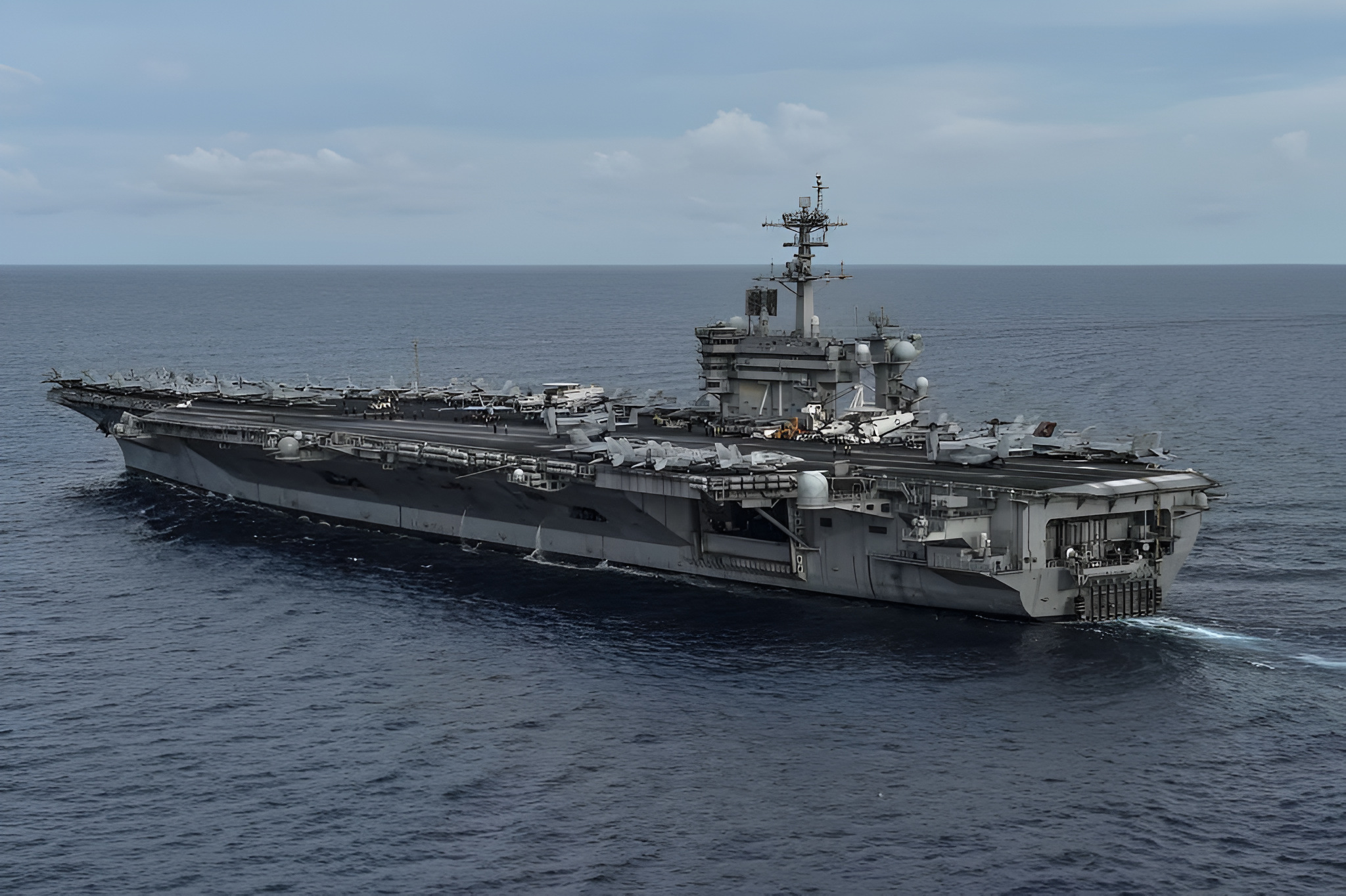
USS Theodore Roosevelt Leads 9,000-Person Buildup, Gulf Force Could Top 20,000
The U.S. military is assembling an unusually large force in the Persian Gulf without a publicly announced decision to resume strikes against Iran. The Pentagon deployed the USS Theodore Roosevelt and several amphibious landing ships from San Diego in late October, sending roughly 9,000 sailors and Marines toward the region.

One U.S. official said the deployment could push the regional naval presence above 20,000 sailors and Marines, with hundreds of aircraft supporting the wider force. The aircraft total applies to the overall U.S. presence rather than the Theodore Roosevelt alone. Even with that boundary, officials described the concentration as one reached only a handful of times over the past two decades.
The buildup creates a sharp readiness-policy divide. Forces, aircraft and support ships are moving into place, but two diplomats briefed on U.S. warnings stressed that, as of Oct. 28, no final decision had been made on renewed American strikes. The White House and other U.S. officials declined to comment on the reported warnings.
One deployment combines two different aviation systems
Theodore Roosevelt is the aviation hub of the package. The Navy’s Carrier Air Wing 11, assigned to the carrier and Carrier Strike Group 9, has nine squadrons operating Super Hornet fighters, Growler electronic-warfare aircraft, Hawkeye airborne command-and-control aircraft, Osprey tiltrotors and Sea Hawk helicopters.
That composition gives the carrier a broad aviation and support organization rather than one type of aircraft performing one mission. Its squadrons bring different functions under a common embarked air wing, backed by the carrier’s maintenance spaces, flight deck, fuel system and command structure. The practical effect is a large increase in available aviation capacity, although keeping it available requires a continuous flow of maintenance, parts, fuel and personnel.
The amphibious force contributes a separate Marine and aviation component. According to the Navy’s amphibious assault ship fact file, these ships form the core of amphibious ready or expeditionary strike groups and move Marine units using aircraft and landing craft. Large amphibious assault ships resemble smaller aircraft carriers, but their design centers on carrying Marines and supporting ship-to-shore movement.
Putting carrier and amphibious formations in the same region therefore adds more than personnel. It combines a carrier air wing with Marine aviation, transportation and landing capacity, while adding the ships and staffs needed to coordinate those forces. At the same time, each additional ship and squadron expands the sustainment burden and places more pressure on deployment schedules, crews and maintenance pipelines.
The scale is exceptional, but it has a recent precedent
The Navy had three carrier strike groups in the Middle East in April, its first concentration of that size there since 2003. The Theodore Roosevelt movement follows that exceptional surge rather than a routine one-for-one rotation. A potential regional total exceeding 20,000 sailors and Marines would again put substantial naval and aviation capacity in a confined operating area.
The deployment also adds to an already expensive commitment. The Pentagon’s latest estimate to Congress put the cost of the Iran conflict at $47.1 billion through the accounting period covered by that estimate. Carrier and amphibious operations provide policymakers with additional options, but their ships, aircraft and personnel continue consuming resources whether or not a new operation is ordered.
Before the Nov. 3 elections, two diplomats said U.S. officials had warned several Middle Eastern countries to prepare for possible renewed military action and potential Iranian retaliation. Allies were reportedly urged to take precautions around energy facilities and other crucial infrastructure. Those preparations reflect the risk that disruption could spread beyond military forces into systems supporting civilian life and the regional economy.
The diplomats said a new U.S. operation could last several days, while retaliation by Iran or aligned groups could prolong the conflict. They did not provide a firm timeline for when American forces might be ready to resume strikes.
Diplomatic efforts were continuing alongside the deployment. Iranian Foreign Minister Abbas Araghchi said Tehran continues to give diplomacy a chance to succeed, while the United Arab Emirates urged the sides to exercise wisdom and pursue political solutions to help contain tensions. Against those appeals, the measurable development is the force itself: roughly 9,000 additional personnel moving toward a region that could soon hold more than 20,000 U.S. sailors and Marines, even as the decision governing their ultimate mission remained unresolved in the latest reporting.
| More aerospace and engineering stories, right in your MSN feed. Follow AMI on MSN |
By David Whitaker — Associate editor for AMI’s aerospace and drone systems desk, translating flight systems, aircraft programs, spaceflight, and UAV developments into accessible technical stories.


