Russia’s Giant Kaliningrad Radar Nears Completion With 3,000-Kilometre Reach Estimated
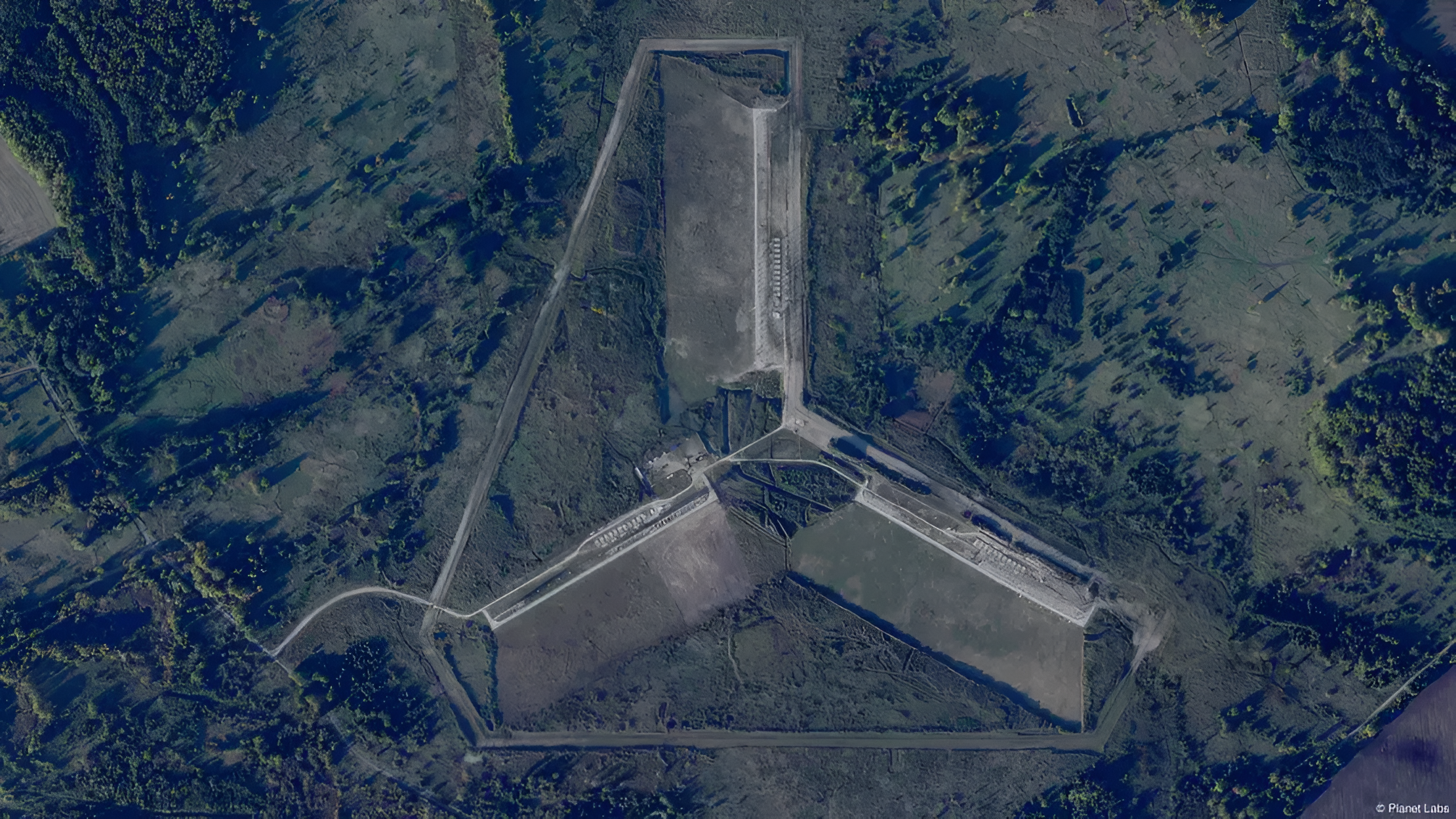
Three antenna arrays longer than 500 metres are reportedly nearing completion near Gvardeysk in Russia’s Kaliningrad exclave. Analysts estimate that the giant installation could eventually survey activity at distances approaching 3,000 kilometres, potentially extending Russian early-warning coverage across Ukraine and much of Europe. What the visible construction cannot establish is whether the radar works at that range or is operational at all.
Commercial satellite imagery reported by Deutsche Welle provides the firmest evidence: three beam-shaped arrays at a large fixed installation between Poland and Lithuania. The site’s geometry has led experts to identify it as a probable over-the-horizon radar, a system intended to detect objects beyond the line-of-sight limit imposed on conventional radar by Earth’s curvature.
Former Lithuanian military commander and security expert Vaidotas Malinionis said the apparent objective is long-distance observation and early warning. Possible functions include tracking aircraft, detecting ballistic missiles and monitoring NATO military activity. He also set the central boundary on those assessments: The goal and the purpose of this radar is observation of long-distance targets and early warning capabilities. We still don’t know if it is operationally capable of doing that, but it is definitely being constructed right now.
Why an array can be enormous without proving its performance
Skywave over-the-horizon radar commonly operates in the high-frequency radio band. Instead of relying on a straight signal path, it uses the ionosphere to bend radio energy back toward Earth. Energy reflected from a sufficiently large object can then return to the receiver for signal processing. An IEEE overview places typical skywave detection ranges between 1,000 and 3,000 kilometres and describes the technology as a broad-area early-warning tool that can cue line-of-sight sensors.
That benchmark makes the estimate for Gvardeysk technically credible as a system-class comparison, but it does not verify this particular installation. Antenna length and orientation help define where a fixed radar can transmit and receive. Useful performance also depends on transmitters, receivers, processing hardware, software, calibration, communications and trained operators elements that ordinary satellite imagery cannot validate.
Australia’s established Jindalee Operational Radar Network offers a practical comparison. According to an official U.S. Space Force description, its radars have operating ranges of 1,000 to 3,000 kilometres, but their performance varies with the ionosphere, environmental clutter, and the size, reflectivity and motion of a target. Jindalee also does not operate continuously in peacetime, illustrating that maximum reach and constant surveillance are separate measures.
The ionosphere changes with solar activity, geomagnetic conditions and the day-night cycle. Thunderstorms can create localized disturbances, while rough seas and wind can increase clutter for maritime surveillance. Detection probability also depends on whether an object provides a sufficiently strong radar return and moves in a way that the system can distinguish from its surroundings.
These constraints mean a nominal 3,000-kilometre radius is not a uniform bubble in which every aircraft or missile is continuously tracked. Over-the-horizon radar is valuable primarily for wide-area awareness and additional warning time. More precise tracking can then be assigned to other sensors. An IEEE historical review likewise describes high-frequency over-the-horizon radar as a specialized method that uses ionospheric refraction to reach far beyond conventional microwave radar.
Construction, commissioning and capability are different milestones
Reports that similar installations may detect or disrupt electronic signals do not confirm those functions at Gvardeysk. Baltic satellite-navigation interference has also been reported, but the available information does not attribute it to this site. A separate large circular antenna installation has been identified near Chernyakhovsk, roughly 50 kilometres west of Gvardeysk, although no operational relationship between the facilities has been established.
If commissioned successfully, the Gvardeysk installation could give Russia earlier notice of military movements and more time to cue other surveillance systems. Its position inside Kaliningrad would place that broad monitoring capability between two NATO countries, making the site consequential even before its precise performance is known.
The next decisive evidence would be documented commissioning, sustained operation or validated detection results not another measurement of the arrays. For now, Gvardeysk presents a stark mismatch: more than 1.5 kilometres of visible antenna structures and an estimated Europe-spanning reach, but no publicly demonstrated operational capability.
| More aerospace and engineering stories, right in your MSN feed. Follow AMI on MSN |
By David Whitaker — Associate editor for AMI’s aerospace and drone systems desk, translating flight systems, aircraft programs, spaceflight, and UAV developments into accessible technical stories.