SpaceX Closes 2020 With Classified NRO Launch
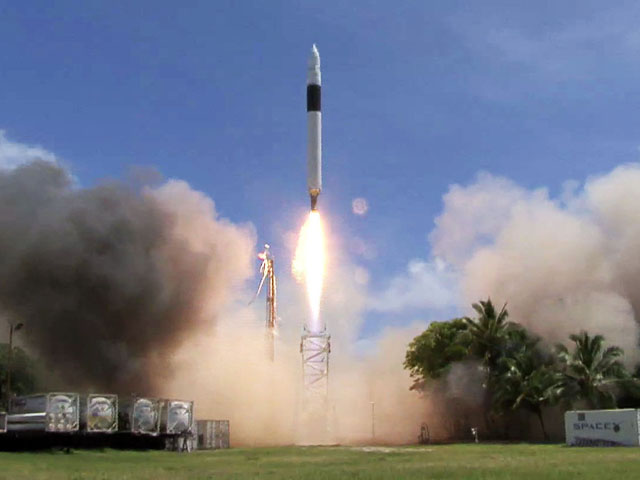
SpaceX concluded a year of intensive launch activity with the successful deployment of a classified payload for the National Reconnaissance Office (NRO) on December 19, 2020. The mission, designated NROL-108, lifted off at 9:00 a.m. Eastern from Space Launch Complex 39A at Kennedy Space Center, Florida, marking the company’s 26th and final launch of the year.

The Falcon 9’s first stage executed a precise return to Cape Canaveral’s Landing Zone 1 approximately eight minutes after liftoff. This landing represented SpaceX’s 70th successful recovery of a first-stage booster, underscoring the company’s growing mastery of reusable launch vehicle technology. The booster used for NROL-108 had already completed four previous flights, most recently on August 30 when it launched Argentina’s Saocom radar satellite.
Originally scheduled for December 17, the launch was postponed when engineers halted the countdown less than two minutes before ignition. The delay was prompted by a high-pressure sensor reading in the upper stage liquid oxygen tank, which required further evaluation. Such holds reflect the stringent safety and performance checks integral to orbital launch operations, especially when handling sensitive national security payloads.
This mission marked SpaceX’s second collaboration with the NRO. The first, NROL-76, flew in May 2017 from the same pad. The NRO is responsible for building and operating the United States government’s fleet of reconnaissance satellites, which provide intelligence capabilities critical to national defense. Details of NROL-108’s payload and orbital parameters remain classified, and SpaceX’s webcast concluded roughly eight minutes after liftoff, omitting coverage of the second stage.
Although NROL-108 was a U.S. government mission, it was procured commercially rather than through the U.S. Space Force’s National Security Space Launch program. This approach mirrors the procurement model used for NROL-76 in 2017. Under “delivery in orbit” contracts, agencies such as the NRO bundle satellite acquisition with launch services, allowing them to leverage commercial providers for missions outside the traditional military launch framework.
Wayne Monteith, associate administrator for commercial space transportation at the Federal Aviation Administration, highlighted the significance of this model during a Space Foundation virtual event on December 15. “It’s a way to reduce costs,” Monteith said, noting that the NROL-108 mission exemplifies how the NRO can take advantage of the commercial licensing process. By contracting with commercial launch providers, government agencies can tap into market efficiencies while maintaining mission-specific requirements.
The NRO has also contracted launches from Rocket Lab, another commercial provider whose missions are licensed by the FAA. This trend reflects a broader shift in the U.S. government’s space procurement strategy, where commercial partnerships play an increasingly important role in delivering capabilities quickly and cost-effectively.
For SpaceX, the NROL-108 launch capped a year of rapid operational tempo, with missions ranging from crewed flights to the International Space Station to deployments of its Starlink broadband constellation. The company’s ability to maintain a high cadence while recovering and reusing boosters has drawn attention across the aerospace sector. Reusability not only reduces hardware costs but also shortens turnaround times between launches, enabling more flexible scheduling for both commercial and government customers.
From an engineering perspective, the successful recovery of a flight-proven booster after its fifth mission demonstrates the robustness of SpaceX’s refurbishment processes and the resilience of its hardware under repeated stress. The precision landing at Landing Zone 1 required coordinated control of grid fins, engine burns, and autonomous guidance systems, all operating within tight tolerances.
The NROL-108 mission, while shrouded in secrecy, stands as a clear example of how commercial launch providers are becoming integral to national security space operations. It also underscores the growing interplay between government agencies and private aerospace firms, a relationship that is reshaping the economics and cadence of space access.