Drone Swarms Take 3D Printing to New Heights
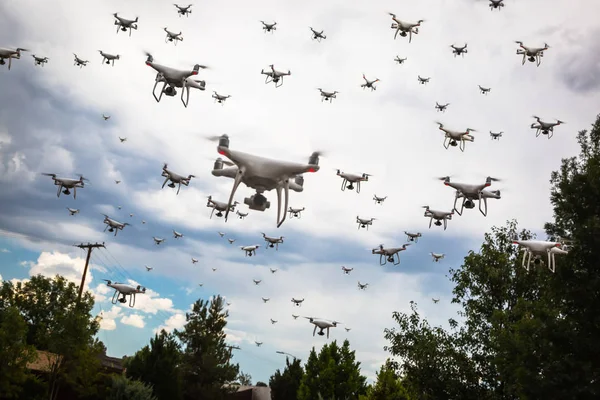
A team of researchers has demonstrated a proof-of-concept system in which coordinated swarms of drones act as airborne 3D printers, depositing construction materials layer by layer to build or repair structures. Drawing inspiration from the nest-building behavior of bees and wasps, the approach offers mobility and adaptability beyond what fixed-location 3D printing systems can achieve in the construction sector.

The initiative, termed Aerial Additive Manufacturing, is led by Imperial College London and the Swiss Federal Laboratories of Materials Science and Technology, with contributions from engineering, architecture, and technology experts at several international universities. The concept was recently detailed in the journal *Nature*, underscoring its potential to reshape construction practices for tall buildings, bridges, and other challenging sites.
In operation, the drones follow pre-programmed work schedules, flying autonomously to deposit material as the structure takes shape. Each unit is equipped with onboard sensing and control systems that allow it to adjust its work in response to evolving geometries during construction. This adaptability is crucial for maintaining precision when working in dynamic environments. Human supervisors can intervene when necessary, modifying the planned build sequence based on real-time data streamed from the swarm.
Two specialized drone types were developed for the trials. “BuilDrones” handle the deposition of materials, while “ScanDrones” perform quality assurance, monitor progress, and relay instructions to the building drones. This division of labor ensures that construction proceeds efficiently and with high accuracy.
The team formulated four distinct material compounds with properties akin to cement, tailored for aerial deposition. In one test, the drones constructed a 2.05-meter-high cylinder from a polyurethane-based foam, layering 72 passes to achieve the final form. Another test produced an 18-centimeter cylinder composed of 28 layers of a custom structural cement-like material. Self-adjusting printing heads compensated for minor positional drift between drones, maintaining a tolerance within 5 millimeters.
While these prototypes are modest in scale, they serve as a critical step toward larger applications. “We’ve proved the concept that drones can work autonomously and in tandem to construct and repair buildings, at least in the lab,” said project lead Mirko Kovac. “This scalable solution could help construction and repair in difficult-to-reach areas, like tall buildings.”
The potential impact extends beyond efficiency gains. Traditional construction in hazardous or inaccessible locations often requires scaffolding, cranes, or human workers operating at significant risk. Aerial additive manufacturing could reduce such dangers by shifting much of the work to autonomous aerial systems. In addition, the ability to deploy drones rapidly to remote or disaster-stricken areas could enable timely repairs or temporary structures without the logistical complexity of moving heavy equipment.
From an engineering standpoint, the project integrates several advanced technologies. Autonomous navigation relies on precise localization and mapping, while the deposition process demands consistent material flow and environmental compensation for wind or vibration. The quality control role of ScanDrones hinges on real-time imaging and data fusion, feeding adjustments back into the swarm’s collective behavior.
The research also touches on sustainability. By tailoring materials for aerial delivery, waste can be minimized, and structures can be built with less disruption to surrounding environments. The polyurethane foam used in trials, for example, offers lightweight thermal insulation properties, while the cement-like compound provides structural integrity suitable for load-bearing elements.
Though the system remains in laboratory stages, the proof-of-concept marks a significant milestone. Scaling up will require addressing challenges such as increased payload capacity, extended flight endurance, and robust coordination across larger swarms. Nevertheless, the demonstrated precision and adaptability suggest a promising trajectory for aerial 3D printing in construction.