SpaceX Completes Third Starlink Launch in Five Days
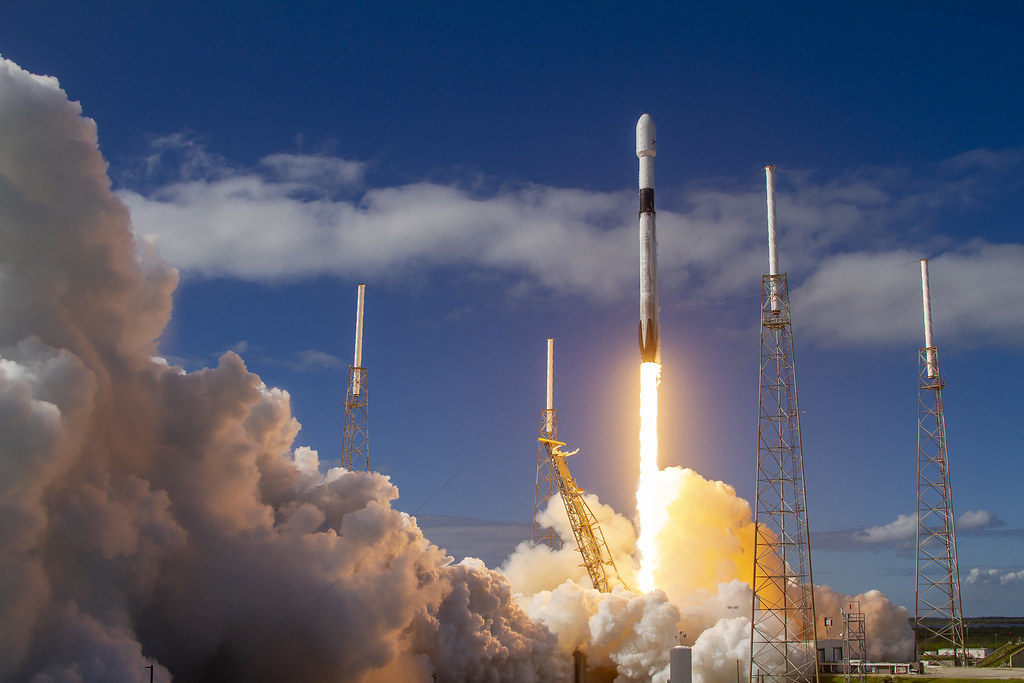
Just after sunrise on Florida’s Space Coast, SpaceX’s Falcon 9 rocket roared off pad 39A at Kennedy Space Center at 6:59:40 a.m. EDT, marking the company’s third Starlink deployment in less than a week. The mission added 53 more satellites to the privately-developed broadband network, continuing a rapid cadence that has become a hallmark of SpaceX operations in 2022.

The historic launch site, once the departure point for Apollo moon missions, now serves as a hub for crewed flights and satellite deployments under SpaceX’s lease. Nine Merlin 1D engines powered the 229-foot-tall vehicle through a golden morning sky, producing 1.7 million pounds of thrust as it climbed northeast. After two-and-a-half minutes, the first stage separated, beginning its controlled descent toward the drone ship “A Shortfall of Gravitas” stationed in the Atlantic.
Guided by titanium grid fins, the booster executed a series of burns to slow its velocity before touching down vertically about 400 miles from the launch site. This marked the fifth flight for the reusable stage, which will be returned to Cape Canaveral for refurbishment. Meanwhile, the second stage pressed on, achieving orbital velocity near 5 miles per second.
Two burns from the upper stage’s single Merlin Vacuum engine placed the payload into a near-circular orbit approximately 200 miles above Earth, inclined 53.2 degrees to the equator. About an hour after liftoff, retention mechanisms released the flat-packed satellites as the vehicle passed south of Australia. The upper stage was programmed for a final deorbit burn to ensure it would not contribute to the growing problem of orbital debris.
Each Starlink satellite, weighing over a quarter ton, is equipped with solar arrays for power generation and ion thrusters for precise orbital maneuvering. Following automated health checks, the spacecraft will gradually raise their altitude to 335 miles over the coming weeks or months. According to astrophysicist Jonathan McDowell, who maintains detailed records of spaceflight activity, SpaceX has now launched 2,653 Starlink satellites, with more than 2,300 currently operational.
The mission, designated Starlink 4-18, capped a remarkable five-day stretch in which Falcon 9 rockets flew from all three of SpaceX’s active pads—Vandenberg Space Force Base in California, Cape Canaveral Space Force Station, and Kennedy Space Center. Each carried 53 Starlink satellites, underscoring the efficiency of the company’s production and launch infrastructure.
This flight was the 47th dedicated Starlink launch. SpaceX’s aggressive schedule shows no signs of slowing, with the Transporter 5 rideshare mission slated for May 25 from pad 40 at Cape Canaveral. That launch will carry dozens of small satellites from government and commercial customers, and the booster is planned to return to Landing Zone 1 for an onshore recovery.
Early June will see the start of another busy campaign, beginning with a Dragon cargo mission to the International Space Station on June 7. Subsequent launches will include the Nilesat 301 geostationary communications satellite for Egypt’s Nilesat, the SARah 1 radar observation spacecraft for the German military, SES 22 for television broadcasting, and additional Starlink batches.
The pace of operations highlights the maturity of SpaceX’s reusable launch system. Turnaround times for boosters have been compressed through streamlined refurbishment processes, while the company’s ability to cycle between launch pads maximizes throughput. For engineers and enthusiasts alike, the precision landings and rapid redeployment of hardware offer a compelling demonstration of modern aerospace manufacturing and operational discipline.
Beyond the technical achievements, the Starlink network represents a large-scale application of satellite constellations for global connectivity. The deployment of thousands of low Earth orbit spacecraft requires meticulous coordination of orbital slots, collision avoidance protocols, and deorbit planning to mitigate space debris. SpaceX’s adherence to post-mission disposal procedures, such as controlled reentry of upper stages, reflects growing industry awareness of the need for sustainable space operations.