Thermally Drawn Multi‑Material Fibers Advance Soft Robotics
Soft robotic systems offer unique advantages in environments that demand gentle, adaptive interaction, particularly in biomedical contexts. Traditional actuation methods—whether tendon-driven, pneumatic, hydraulic, shape-memory, electrical, or magnetic—each bring distinct trade-offs. Integrating actuation with sensing, imaging, optical or electrical transmission, and fluid delivery can transform these devices into multifunctional tools. Achieving such integration at sub‑3 mm diameters and lengths exceeding 300 mm has proven difficult with conventional molding, extrusion, or additive manufacturing techniques.

The research presented applies the thermal drawing process, long used in optical fiber production, to fabricate high‑aspect‑ratio soft robotic fibers. This method scales down a preform’s cross‑section by factors of 10–30 while preserving intricate internal architectures. Preforms are built with compression molding or 3D printing, incorporating channels, holes, and multiple materials. During drawing, functional elements such as optical guides, metallic wires, or tendons can be fed into designated positions, becoming embedded within the elastomeric cladding.
Actuation is achieved via three tendons positioned at 120° intervals within the fiber. Pulling on these tendons from the proximal end bends the fiber with two degrees of freedom. Material selection balanced rheological compatibility with thermal drawing and mechanical performance. Polycarbonate (PC), SEBS, and Geniomer all showed the necessary viscosity and modulus behavior at processing temperatures, preserving microchannel geometry by resisting thermal reflow. Mechanical testing revealed PC’s high stiffness and force output, SEBS’s intermediate modulus and high elongation, and Geniomer’s extreme compliance. Blocking force measurements showed PC fibers generating 66.3 mN, SEBS 2.7 mN, and Geniomer 1.3 mN under comparable conditions. SEBS was chosen for its favorable combination of drawability, softness, and sufficient actuation force.
The team demonstrated fibers as thin as 700 µm, with internal features on the order of tens of micrometers. Integrated tendons, lubricated with ethanol to reduce friction, allowed controlled bending up to 540°. A peripheral control unit with servo motors, microcontroller, and custom software enabled manual, scripted, or autonomous operation. A constant‑curvature kinematic model mapped tendon displacements to 3D tip positions, validated through camera‑tracked bending experiments.
Beyond basic motion, fibers were outfitted with optical guides for targeted light delivery. Using inverse kinematics, the distal tip traced predefined shapes projected onto a screen. Increasing degrees of freedom was achieved either by segmenting the fiber with two independent tendon sets or by nesting a smaller actuated fiber inside a larger one, adding translational capability.
Perception was integrated via embedded optical displacement sensors. Paired light‑emitting and receiving guides measured reflected intensity from nearby surfaces, resolving distances with sub‑millimeter accuracy up to 18 mm. Operating in a darkroom with diffuse white targets minimized environmental light and orientation effects. Algorithms using this feedback enabled obstacle avoidance in one and two dimensions, adjusting bending direction and angle in real time. A radial scanning protocol combined proximity data with known configurations to reconstruct 3D object geometries, identifying features such as openings and guiding tools—like a 150 µm guidewire—through them.
Electrical functionality was added by embedding metallic wires connected to an electrometer. Contact with conductive hydrogels of known admittivity produced measurable currents corresponding to material conductivity. Fluidic capability came from integrating multiple microchannels, enabling suction and delivery of dyed liquids between targeted vials under precise tip positioning.
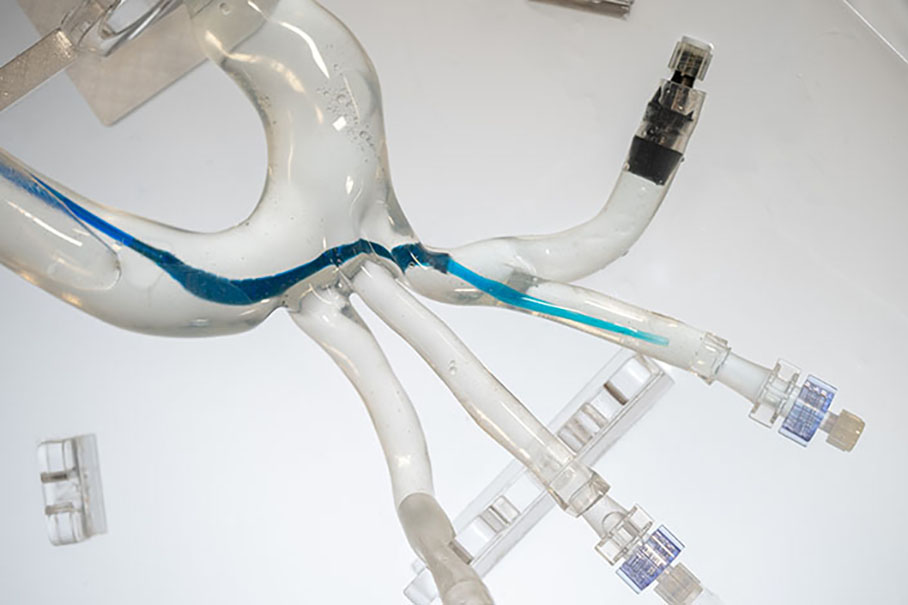
For a minimally invasive navigation demonstration, fibers incorporated PTFE liners for stiffness along most of their length, with a soft steerable tip. In a silicone aortic arch model, the device was advanced manually, then steered via tendon actuation to follow vessel curvature, deploy a guidewire, and inject fluid through the central lumen. Aspect ratios up to 1150 were achieved, with outer diameters as small as 2.25 mm for the navigable catheter‑like configuration.
These thermally drawn, multi‑material fibers combine extreme aspect ratios, fine structural detail, and multifunctionality. Embedded optical, electrical, and fluidic elements operate alongside tendon‑driven actuation, enabling soft robots that can sense, image, adapt, and manipulate within constrained, delicate environments.