Soft Robotics Sculpture Mimics the Rhythm of Breath
In a fusion of art, engineering, and speculative design, MIT student Mateo Fernandez has developed an inflatable anthropomorphic sculpture that uses soft robotics to replicate the cadence of human breathing. Titled “Searching for a Pulse,” the machine is conceived as both a kinetic organism and a pulsating organ, engineered to convey the mechanical essence of respiration.

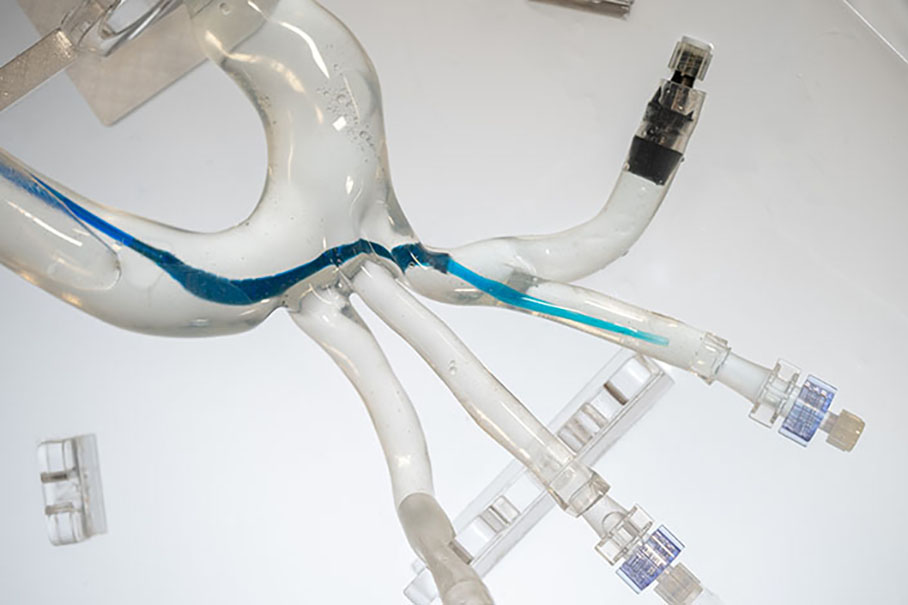
The structure’s core is a 3D-printed ribcage composed of polygonal frames rigidly conjoined to form a skeletal boundary. Within this frame, inflatable soft materials expand and contract, driven by an air supply routed through a network of tubes. The motion is deliberate and rhythmic, producing dynamic pulsations that mirror the slow, organic cycle of inhalation and exhalation.
Fernandez describes the cadence of the airflow as evocative of medical scenarios. “The slow cadence of air fluctuating through the machine mimics that of a patient on a hospital gasping for air, every time less and less and less,” he explains. The sculpture’s design positions it as both the organ under strain and the ventilator sustaining it, a duality that underscores its conceptual depth.
Soft robotics, central to the sculpture’s operation, offer unique mechanical advantages for biomimetic applications. Unlike rigid-link mechanisms, soft actuators can deform continuously, enabling lifelike motion without complex joints. In aerospace and robotics engineering, similar principles have been explored for adaptive grippers, morphing surfaces, and compliant structures that interact safely with humans. Here, those principles are adapted to an artistic context, using pneumatic actuation to create an intimate portrayal of breath.
The work is informed by recent history and technological trajectory. Fernandez notes the rapid development of artificial intelligence alongside the lingering memory of the Covid-19 pandemic. By integrating these themes, the sculpture becomes a speculative artifact—projecting a future in which “breathing machines” are pervasive. “Air is the substrate that ties everything together,” Fernandez adds, framing the element not only as a mechanical medium but as a metaphorical connector between past events and imagined futures.
From a mechanical design perspective, the sculpture’s ribcage functions as a load-bearing structure that constrains and shapes the expansion of the inflatable components. The polygonal geometry offers both rigidity and aesthetic complexity, while the pneumatic system must be tuned to achieve the desired breathing rhythm. Engineers working with similar systems often face challenges in balancing air pressure, flow rate, and material elasticity to produce controlled, repeatable motion.
The use of 3D printing for the skeletal frame allows precise control over dimensions and joint tolerances, ensuring that the inflatable elements interact predictably with their constraints. In robotics research, such integration of additive manufacturing with soft actuators has enabled rapid prototyping of bio-inspired machines, from artificial muscles to flexible wings.
The sculpture’s tubes and valves form a closed-loop pneumatic circuit, with air supplied and exhausted in a timed sequence. This approach parallels the operation of certain aerospace environmental control systems, where airflow must be modulated to maintain pressure and temperature in sensitive compartments. Here, however, the modulation serves an expressive purpose—rendering visible the invisible process of breathing.
By embedding mechanical realism into an artistic framework, “Searching for a Pulse” invites reflection on the convergence of human physiology and machine design. For engineers and technologists, it demonstrates how soft robotics can be harnessed not only for functional tasks but also for conveying complex narratives. The sculpture’s slow, deliberate pulsations resonate as both a technical achievement and a meditation on the role of machines in shaping human experience.