Stork STM Parafoil UAV Advances in Royal Navy Trials
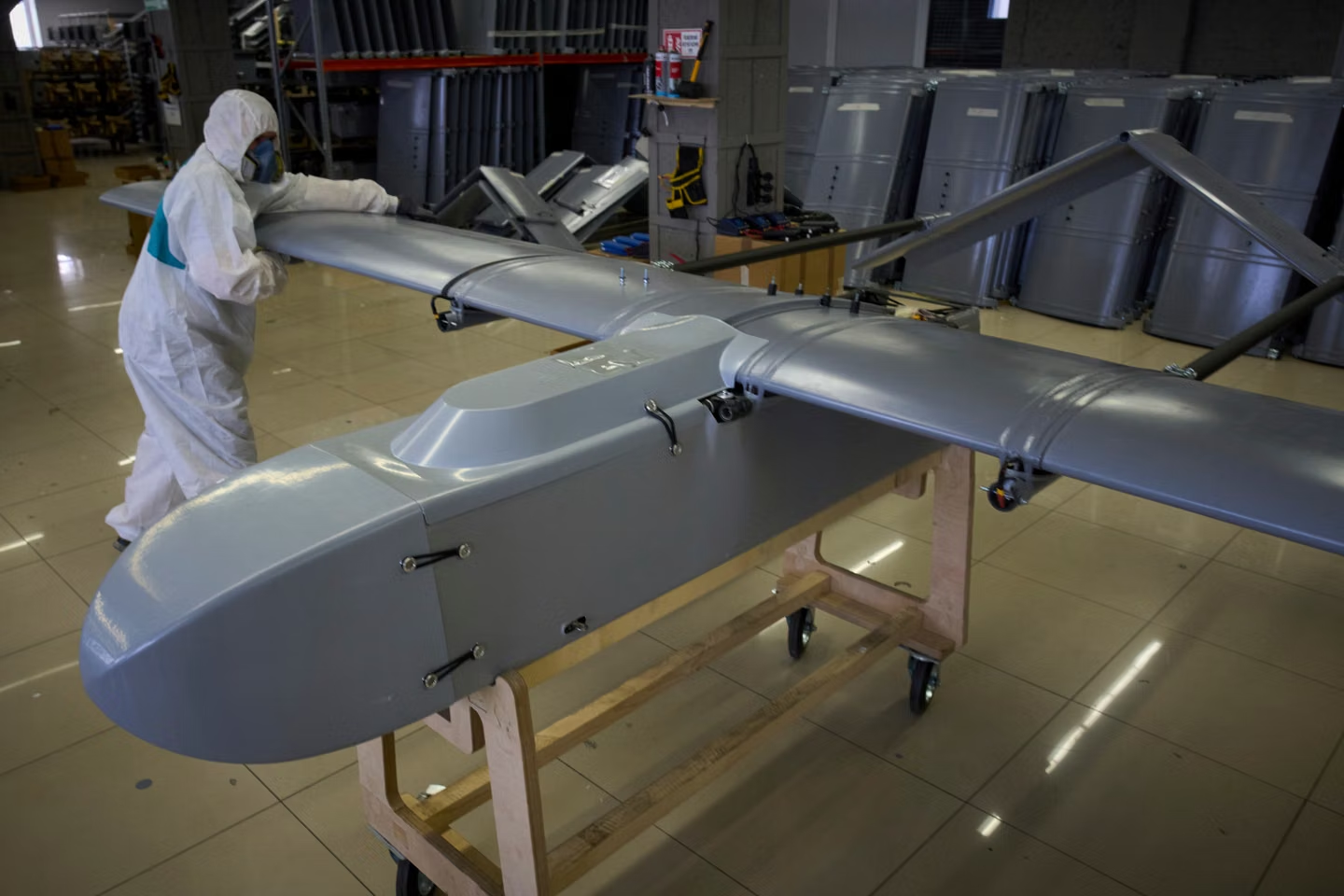
Animal Dynamics’ Stork STM parafoil UAV has secured a place in the next phase of the Royal Navy’s Uncrewed Aerial Systems Heavy Lift Challenge (UASHLC), marking a significant step for the UK-based developer of autonomous heavy-lift aerial vehicles. The selection follows a competitive pre-selection flying event in which the Stork STM demonstrated its ability to transport substantial payloads over long distances, outperforming several established UAV and aerospace contenders.

The Stork STM is engineered for beyond visual line of sight (BVLOS) operations, carrying payloads of up to 135 kg across distances reaching 400 km—roughly equivalent to the span from Oxford to Paris. This payload specification aligns with a practical operational benchmark: resupplying an eight-person section for two days. The combination of range and capacity positions the UAV to meet both intra-theatre (ship-to-ship) and inter-theatre (ship-to-shore) logistics demands, a capability that could release manned helicopters for more specialized missions.
UASHLC Phase 2 is jointly managed by Defence Equipment & Support’s Future Capability Group, the Royal Navy’s Office of the Chief Technology Officer, and 700X Naval Air Squadron. The program seeks to evaluate uncrewed systems for naval logistics, focusing on operational flexibility and the ability to sustain forces in dispersed maritime environments. For the Royal Navy, adopting UAVs for heavy-lift tasks could reduce risk to personnel and improve efficiency in contested or remote areas.
Flight trials for this phase are scheduled to take place in Cornwall. During these, Animal Dynamics will adapt the Stork STM for maritime use, a process that includes integrating secure satellite communications (SATCOM) to enable global operational control. The aircraft will also be equipped with a sonobuoy dispenser, illustrating the versatility of its payload bay for missions beyond cargo transport, such as anti-submarine warfare support. Additional wing development will incorporate a retraction mechanism, enhancing safety and practicality for deck operations aboard naval vessels.
The Stork STM’s parafoil wing design is a defining feature. Parafoils generate lift efficiently at low speeds and require less power for sustained flight compared to multirotor or hybrid VTOL platforms, which often face endurance limitations due to the high energy demands of vertical lift. Unlike conventional fixed-wing aircraft, the Stork STM can operate from short, unprepared surfaces, expanding its deployment options in austere environments. This adaptability is particularly valuable for naval operations where deck space is constrained and landing zones may be improvised.
The engineering approach addresses a common trade-off in UAV design: balancing payload, range, and operational flexibility. Heavy-lift multirotors excel in vertical take-off and landing but are constrained by battery endurance, while fixed-wing UAVs offer range but require runways. The parafoil configuration offers a middle ground, combining efficient cruise performance with short take-off and landing capability.
Adrian Thomas, CEO of Animal Dynamics, stated, “We are very excited to have won a place in the UASHLC through our performance in the fly-offs against strong competition from established UAV and aerospace companies. Selection by the UK Ministry of Defence (MoD) and the Royal Navy reflects the fantastic capabilities the Stork STM has to offer, and the strength and experience of the team in terms of engineering, flight ops and certification. We look forward to the next stage of flight trials when we can demonstrate the continuing performance and capability enhancements of the Stork STM and the clear path to commercialisation.”
The upcoming trials will be a proving ground for the Stork STM’s marinised configuration and its ability to integrate into naval logistics chains. Success in these evaluations could position the platform as a viable alternative to crewed aircraft for certain supply missions, offering operational resilience and cost efficiency while leveraging autonomous flight technologies.