

No air-breathing aircraft has beaten NASA’s 2004 X-43A speed record. That detail remains notable in light of the small size, lack of the crew, and designed-for-purpose and single-use nature of this craft. At merely twelve feet long, the X-43A aircraft was launched from the wing of a B-52 bomber, after being boosted in midair over the Pacific Ocean to test the concept and finally released to prove the feasibility of controlled scramjet-powered hypersonic flight.

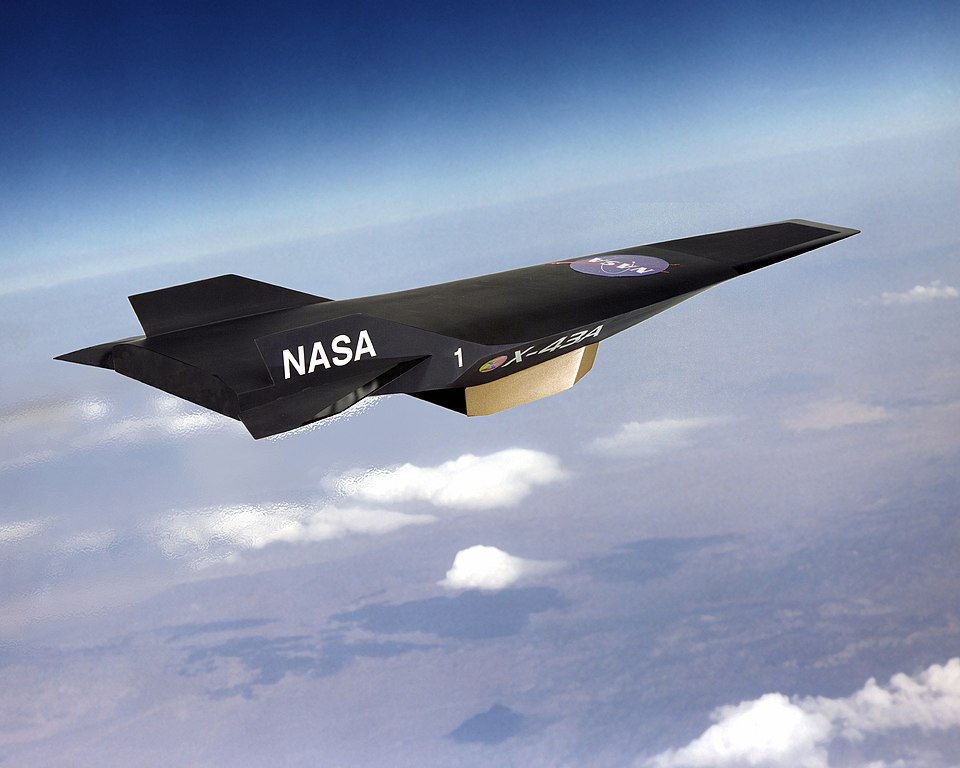
Indeed, the result was unprecedentedly successful. On the final mission, the X-43A was able to fly at Mach 9.6 at 110,000 feet, marking the fastest flight of all air-breathing planes. In another attempt, the record-setting flight of 2004 allowed reaching Mach 6.8, but the final flight marked the culmination of both development and proved the potential of hypersonic flight as such.
And the reason was in the engine itself. According to NASA, A scramjet (supersonic-combustion ramjet) is a ramjet engine in which the airflow through the engine remains supersonic. That was essential because a conventional jet engine decelerates the airstream to ignite it, while scramjets do not. At the speeds above Mach 5, it became the most feasible option to produce enough thrust for sustained flight. And as such, scramjet engine explains the need to boost the craft to hypersonic speeds before releasing it into unpowered flight since scramjets do not work from rest. Also, from the design, one could see that the engine was the core part of the airframe. It posed unique material and control problems.
At nearly Mach 10 velocities, heat loads were enormous, and, according to NASA, the Mach 10 version of the X-43A required extra thermal protection compared to Mach 7 variant. The former would withstand temperatures of up to 2,000 degrees Fahrenheit, and guidance would ensure its stability in hypersonic flight, where powered part takes seconds, yet lasts minutes. Also, the failure of 2001 flight contributed to the design improvement – NASA established that the failure was the fault of the booster’s flight control system and redesigned it to reach the records on the following test.
However, the question emerges why NASA chose not to launch the follow-up craft after this breakthrough, yet built many others. After all, the Hyper-X program of NASA was intended for the purpose of proving scramjet flight technology. Indeed, it succeeded in achieving that goal: it took eight years and nearly $230 million to accomplish. By that time, it had completed the goal set. NASA switched its focus to manned space flights in that period, and the hypersonic research took the route to military applications. It happened with the case of the X-51A Waverider.
According to reports, in 2013 the Air Force announced that the plane flew over 230 nautical miles for about six minutes and reached Mach 5.1, setting a new record for the longest air-breathing hypersonic flight (even if the record of the X-43A was not approached). The Waverider also set the mark with the use of hydrocarbon fuel, rather than hydrogen. The result was unusual – the craft was built, yet did not pave the way further and served the purpose of proving the concept of scramjet flight instead. Nevertheless, it set records to endure for decades and prove the possibility of air-breathing hypersonic flight. But it established the limit of its own success and gave legacy to match with the future craft.