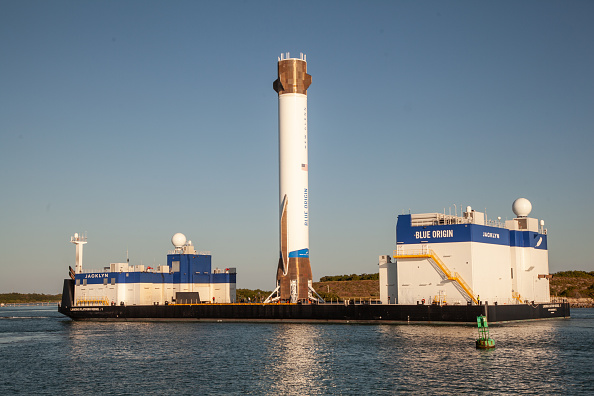
Blue Origin Puts Reused New Glenn Booster Through Key Trial
Can a heavy lift rocket become routine without learning how to fly the same hardware again? Blue Origin has gotten one step closer to answering that question, as the company performed a ground test of one of its previously flown New Glenn boosters. Although lasting for just 19 seconds, the test did not include anything as spectacular as actual launch, but was more of a milestone, indicating Blue Origin’s intentions to re-fly a refurbished booster, making New Glenn not just another large rocket, but also a reusable one.

It is important to highlight how serious of an attempt this is. New Glenn is not a small scale experimental vehicle at more than 320 feet in height, it represents an entirely different class of rockets that could carry significant payloads both commercially and nationally. The core of Blue Origin’s design relies on a reusable first stage equipped with seven BE-4 engines using methane fuel, with the entire stage planned to land at a remote landing platform located far off the coast.
In that sense, the reusable New Glenn cannot just be treated as another piece of paper, but affects everything related to its launch cadence, production, and performance for potential clients. Speaking of which, this is already the second time Blue Origin CEO Dave Limp mentions their intentions to re-fly a booster: “With our first refurbished booster, we elected to replace all seven engines and test out a few upgrades including a thermal protection system on one of the engine nozzles. We plan to use the engines we flew for NG-2 on future flights.”
There are some good reasons why Blue Origin chose not to use old hardware and decided to swap engines instead. Any reusable rocket becomes efficient depending on how successfully the company managed to address such concerns as thermal loading on the engine section, landing procedures, recovery process, etc. In other words, reusability is achieved only with attention to details. And since Blue Origin claims that every New Glenn stage could be used up to 25 times, the test with a reused vehicle proves that this is already a step towards real operations.
But what about the recovery segment? Blue Origin has developed the whole process of New Glenn’s recovery by relying not on ships, but on a dedicated platform called Jacklyn. The company decided to move away from ship conversions after the early failure of the concept. But Jacklyn also corresponds with Blue Origin’s goals the platform provides for easier booster recovery, as well as a better chance for New Glenn to be used for launching heavy payloads, with the upper stage taking care of orbit insertion.
And there will be yet another heavy payload launched soon: the next flight of New Glenn will include AST SpaceMobile BlueBird, which has gained popularity due to the size of its antenna. Thus, the combination of Blue Origin’s largest booster with its most capable client shows how the company intends to make use of the new platform. Should Blue Origin succeed in implementing regular launches using reusable boosters, New Glenn will stop being famous for its size alone and its efficiency will also come to play.