NASA’s Mars Helicopter Blades Crossed Mach 1 for a Reason
For a mission to Mars, the point of transition to supersonic velocity makes aerial transportation a matter of utility rather than demonstration. This is what distinguishes the most recent round of testing by NASA: the space agency has ceased demonstrating that aircraft can stay aloft in such a harsh environment and is now moving towards actually making use of that ability. By developing helicopters capable of delivering science payloads, large energy sources, and sophisticated sensors, NASA wants to exploit the atmosphere with density comparable to 1% of Earth’s in an efficient manner.

In Jet Propulsion Laboratory’s 25-foot space simulator, rotor experiments in carbon-dioxide environment representing Martian atmosphere were conducted. Three-bladed helicopter blade system reached the tip speed of Mach 1.08 under increased pressure generated by headwind. This particular value has to be highlighted due to a peculiar position of Mars rotors in regard to shock waves and transsonic flow phenomena. On account of the low density of the atmosphere, a high tip speed is necessary for lifting the aircraft; yet, such an approach implies numerous difficulties connected with the proximity to the speed of sound namely, shock waves, drag, aerodynamic instability, and loads.
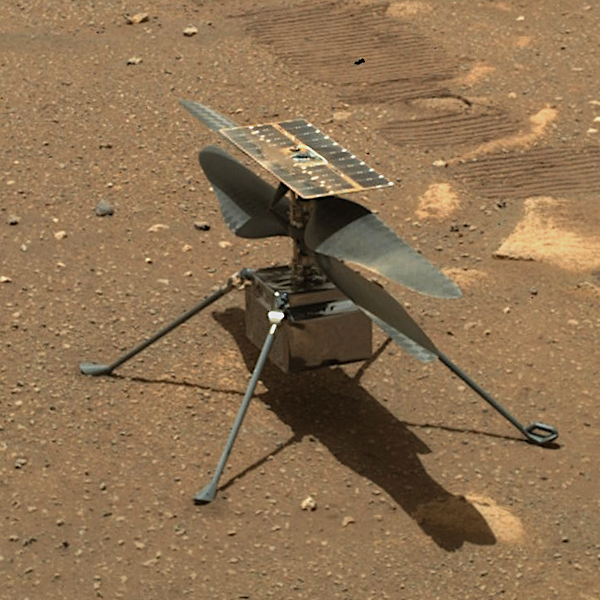
Ingenuity intentionally left that border untouched. The rotor speed of Ingenuity was set to be not higher than Mach 0.7 since NASA wanted to ensure the safety of that particular flight, considering unpredictable gusts and behavior of the blades close to Mach 1 zone. This decision can hardly be criticized, but now, after almost 72 flights, Ingenuity managed to shift the focus to the utility of aerial transport rather than the feasibility of such flights. It follows that new rotor testing campaign goes beyond mere demonstration of flight at Mars.
As NASA says, the obtained data confirm an increase of 30% in lift force, meaning that the design of new rotor-powered vehicles will become lighter and capable of lifting more instruments. New science packages will be mounted in addition to bigger energy supply units. Rotorcraft will become able to conduct flights further away from the landing site or rover as well as explore those regions of the surface which are unreachable by means of wheels or orbiting spacecrafts. From the perspective of scientific exploration, more lift means more opportunities for mounting instruments on rotorcraft.
Ingenuity had its day in the sun, and “NASA had a great run with the Ingenuity Mars Helicopter, but we are asking these next-generation aircraft to do even more at the Red Planet,” JPL Mars Exploration Program manager Al Chen stated. Rotors testing project manager Jaakko Karras put things in a very clear way: “If Chuck Yeager were here, he’d tell you things can get squirrely around Mach 1.”
Additionally, NASA tested a rotor with the two blades of increased size in connection with Skyfall Mars helicopter project aimed to launch three next-generation rotor-powered craft to Mars. Similar tip speed values were obtained in regard to that rotor at lower rotational speed, indicating the new rotor characteristics that engineers have to take into account in developing new aircraft types. NASA research in relation to optimization of airfoils and rotors for Mars demonstrates the difficulty in increasing the rotational speed of the blades.
“The successful testing of these rotors was a major step toward proving the feasibility of flight in more demanding environments, which is key for next-gen vehicles,” NASA Ames’ Shannah Withrow-Maser noted. For the purposes of Mars exploration, this may be seen as a line drawn between Ingenuity and future rotorcraft: the former proved the possibility of such flights, whereas the latter would prove their usefulness.