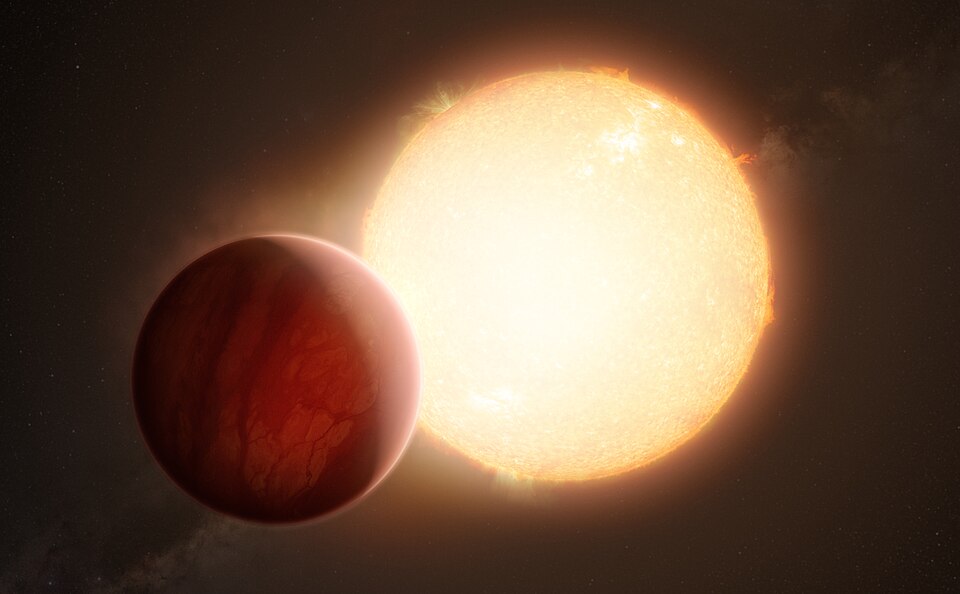
Webb Found Sand Clouds and Clear Skies on a Distant Giant
But could there be something resembling a weather system on a planet 690 light-years away? For the first time in the history of exoplanet research, the James Webb Space Telescope (JWST) provided astronomers with a relatively detailed answer to this question. As shown by the data collected, the gas giant WASP-94Ab goes through a daily weather cycle with sand-filled morning clouds and afternoon-to-evening clearness. This opens up unprecedented opportunities for analyzing the chemical composition of the planet’s atmosphere since hot Jupiters usually have thick layers of clouds formed by vaporized rocks and metals.

And the problem lies in clouds. As noted by David Sing of Johns Hopkins University, “we’ve known for quite a while that clouds are pervasive on hot Jupiter planets, which is annoying because it’s like trying to look at the planet through a foggy window.” Therefore, scientists’ efforts to explore these planets were focused mainly on overcoming the problem of dense atmospheric clouds. However, thanks to a unique feature of JWST, today they have succeeded.
By using transmission spectroscopy, i.e., observing starlight as it passes through the planet’s atmosphere, astronomers managed to detect sand clouds in the morning hemisphere and a completely clear evening side. It turned out that due to the strong temperature difference between night and day, WASP-94Ab is tidally locked it always shows the same side to its star and thus has significant differences in cloud coverage on the two sides. As the atmosphere rotates, a high-pressure front moves towards evening with visible clouds, and they disappear on the other side of the planet due to warming.
Thanks to the unusual transparency of the planet’s evening hemisphere, researchers were able to obtain new information about the composition of its atmosphere. Unlike previous studies conducted using Hubble, in which the planet appeared almost entirely shrouded in clouds, JWST was able to determine that the main components are hydrogen, helium, carbon, and oxygen. Moreover, in terms of elemental abundance, WASP-94Ab turned out to be similar to Jupiter.
In addition, the results obtained confirm once again that JWST has changed the rules of the game in terms of atmospheric research. Thanks to the instrument’s unique capabilities, Webb’s observations show the importance of resolving cloud structures on the surface of exoplanets in order to correctly interpret the measurements and determine their chemical composition.
More broadly, the significance of the discovery can be understood based on NASA’s summary of JWST’s contributions to the study of extrasolar planets. In particular, by combining infrared radiation sensitivity and extremely high accuracy, the telescope is used to obtain inventories of atmospheres, thermal maps, and even images of other planets. For example, Webb has found silicate sand clouds in WASP-107b and sulfur dioxide due to photochemistry and determined the thermal radiation signature for rocky exoplanets with an insignificant atmosphere.
Therefore, it is worth noting that today astronomers are gradually moving from the detection of exoplanets themselves to their comparative meteorology and geology a study of phenomena and processes occurring in their atmospheres and interiors. The weather on WASP-94Ab can be explained in two ways: either wind picks up silicate particles, carries them high in the atmosphere over the nightside, and they sink, or clouds simply disperse in the heat of the day like morning mist. According to Sing, “not only have we been able to clear the view, but we can finally pin down what the clouds are made out of and how they’re condensing and evaporating as they move around the planet.”