Webb Found a Giant Black Hole Where a Young Galaxy Should Be
Around 50 million suns, as its name suggests, equals the mass of a blackhole that emerged before the galaxy, in which it hung, was completed. The result, based on observations of a small early-universe object called Abell2744-QSO1, is contrary to the typical stories observed in the universe. Within the nearby universe, the galaxies and central black holes grow together, and black holes constitute a small fraction of the galaxy’s mass. In contrast, QSO1 has no such structure. Some of the extreme lopsidedness suggests the central black hole did not slowly increase in mass over a long period of time in an already old galaxy.

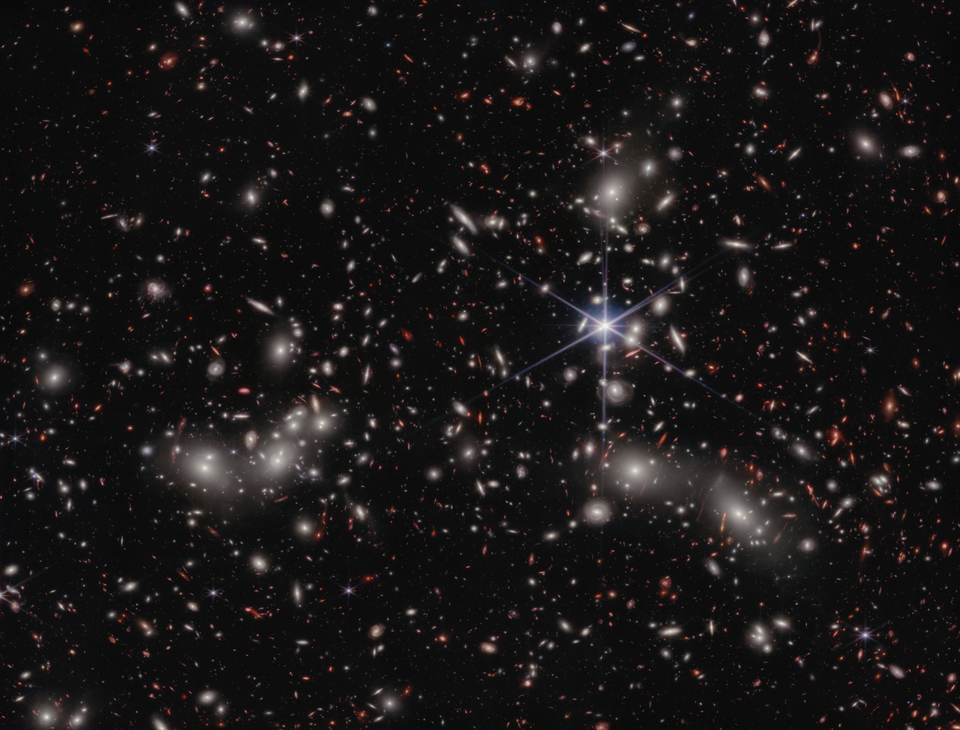
The object with its compact, extremely red appearance is part of a crowd of Little Red Dots, a class Webb discovered in great numbers in its initial observations. Then they are everywhere in the young Universe and only rarely seen in later stages, which is why they offer a great deal of value when it comes to the study of the formation of the first large structures in the Universe. In QSO1, looking at a distant source was assisted by gravitational lensing from Abell 2744, which acts as a kind of telescope that gravitational field magnifies the source to be viewed as a spectrum by Webb’s NIRSpec instrument, allowing the researchers to see how the gas was moving around the centre.
That was the turning point of that motion. There are all sorts of similarities between the way the surrounding gas rotates and how planets rotate around a dominant central mass, which is what Keplerian means. That meant astronomers would have a direct method to measure the mass of the black hole, a method which would agree with estimates they could make by comparing the black hole with another, more familiar system of stars in the immediate vicinity. Roberto Maiolino said, “a paradigm shift, a total revisiting of the classical scenarios of how black holes form and grow”. Mass is just one of the surprises.
The maps of the composition have shown that QSO 1 is composed of a very primitive material, with an extremely high percentage of hydrogen and helium, and comparatively little oxygen or other heavy elements. That’s important because over time heavy elements are created by the stars. Such a chemically pristine setting, coupled with the very massive black hole, suggests an object that is caught very early on before it underwent the normal course of stellar processing to create a large galaxy. Especially, we didn’t think there could coexist such a clean environment with such an over-massive black hole as Saiyang Zhang said.
This does not leave us with a single explanation! Heavy seeds, about created from direct gas collapse, would result in black holes which are already significantly larger than usual. Yet another asset is other Webb findings that prove that some newborn black holes have been growing in rapid malnourishment as part of brief feeding frenzies when material was infalling in unprecedented high rates, above the Eddington rate. In a second Little Red Dot, CANUCS-LRD-z8.6, Webb discovered a black hole gobbling matter at a high rate in a compact, young galaxy within a mere 600 million years after the Big Bang!
All in all, the systems are changing the question. What about the old question about how galaxies have been able to form black holes so rapidly? In at least some of the first structures, it appears that black holes grew more rapidly, and galaxies slowly condensed around them, Webb’s data is revealing.