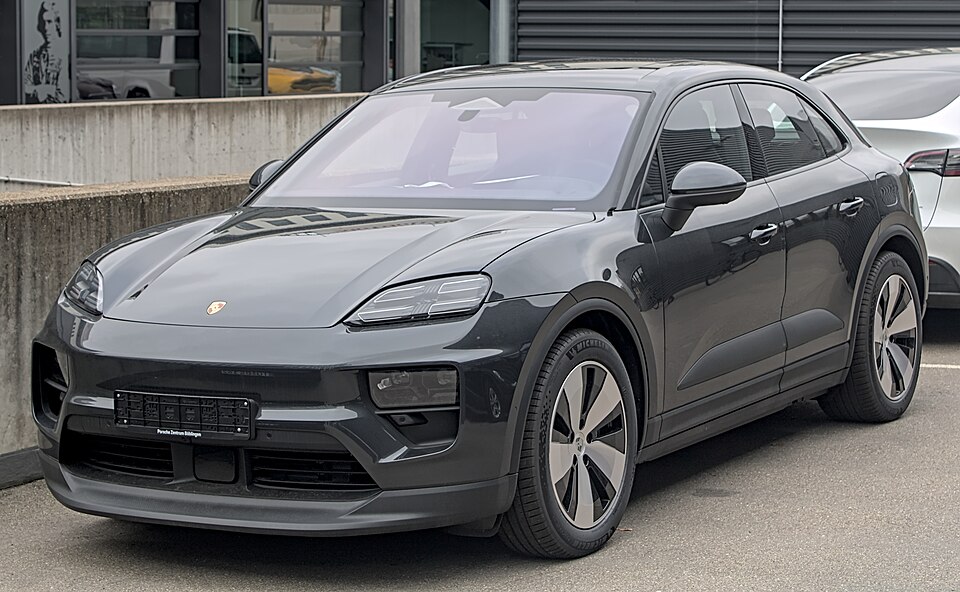
Porsche Macan EV’s Price vs. Experience Gap
Over six months and more than 8,000 miles of use have revealed a persistent disconnect between the Porsche Macan EV’s nearly $100,000 price tag and the day-to-day experience it delivers. The test vehicle, a Macan 4, began at $80,795 including destination charges, but Porsche’s extensive options list quickly pushed the total to $99,020. The additions included Papaya Metallic paint ($1,240), 21-inch wheels ($2,310), 14-way comfort seats ($1,350), rear-axle steering ($2,030), an augmented reality head-up display ($2,530), and the Comfort package with ventilated front seats, a Bose audio system, and LED matrix headlights ($3,910).

Director of editorial content Steven Ewing noted, “Every time I get in the Macan, it feels less and less like a vehicle worthy of a nearly $100,000 price tag. There are so many great Porsche qualities — the steering, the ride and handling — but the interior? No way.” While the cabin features leather surfaces and carpeted door pockets, the illusion of luxury fades with cheap-feeling plastic along the center console rails, basic speaker grilles, and extensive piano black trim that quickly shows fingerprints and dust.
Script writer Duncan Brady focused on the center stack controls: “These center stack buttons feel so cheap. The whole panel moves when you press down, and although I’m glad there’s some auditory and tactile feedback, I’d much prefer physical controls.” The downsized gear selector feels insubstantial, and the Bose audio system delivers a flat sound lacking bass depth. The overall interior ambiance is described as uninspiring, with richer colors and materials available only through further spending.
Comparisons to other electric vehicles in the same price range underscore the Macan’s shortcomings. The BMW iX tested in the same program cost $102,070 but impressed with bold interior design and varied textures, even in a black-on-black configuration. Manager of written content Cameron Rogers recalled, “My first thought when stepping into the iX’s cabin for the first time: ‘Oh wow, BMW is really going for it these days, aren’t they?’” The Rivian R1T, purchased in 2022 for $76,250, showcased open-pore wood across the dash and doors, multi-material seats, abundant natural light, and distinctive floor mats — all at a significantly lower price.
Beyond aesthetics, the Macan’s equipment list leaves gaps that are unusual for a vehicle in this segment. Features such as a 360-degree camera system and a rear windshield wiper, standard on the iX, were absent from the Porsche because they were optional extras not specified. Their omission has been a point of frustration, highlighting Porsche’s tendency to charge separately for items many competitors include by default.
From an engineering perspective, the Macan EV’s chassis tuning and steering precision remain high points, consistent with Porsche’s reputation for dynamic excellence. However, the tactile and sensory aspects of the cabin — critical for perceived quality — lag behind. In automotive design, material choice and interface feel are as vital to user satisfaction as performance metrics. The reliance on piano black surfaces, for example, may be visually sleek under showroom lighting but can degrade the daily experience through smudging and glare. Similarly, cost-effective plastic components in high-touch areas undermine the premium narrative.
The contrast with rivals illustrates a broader trend in EV design: as electric platforms free up interior packaging and allow for new material strategies, manufacturers are experimenting with cabin layouts and finishes to differentiate their offerings. BMW’s iX and Rivian’s R1T demonstrate how integrating varied textures, natural materials, and distinctive forms can elevate perceived value, even without increasing mechanical complexity.
In the Macan EV’s case, the absence of such design ambition leaves the impression of a conventional luxury crossover retrofitted with electric propulsion, rather than a ground-up rethink of what a $100,000 EV should feel like inside. For buyers in this segment, especially those attuned to engineering detail and material execution, that gap between price and experience is difficult to overlook.