Curiosity’s Accidental Sulfur Find Shows the Scientific Value of Rover Mobility
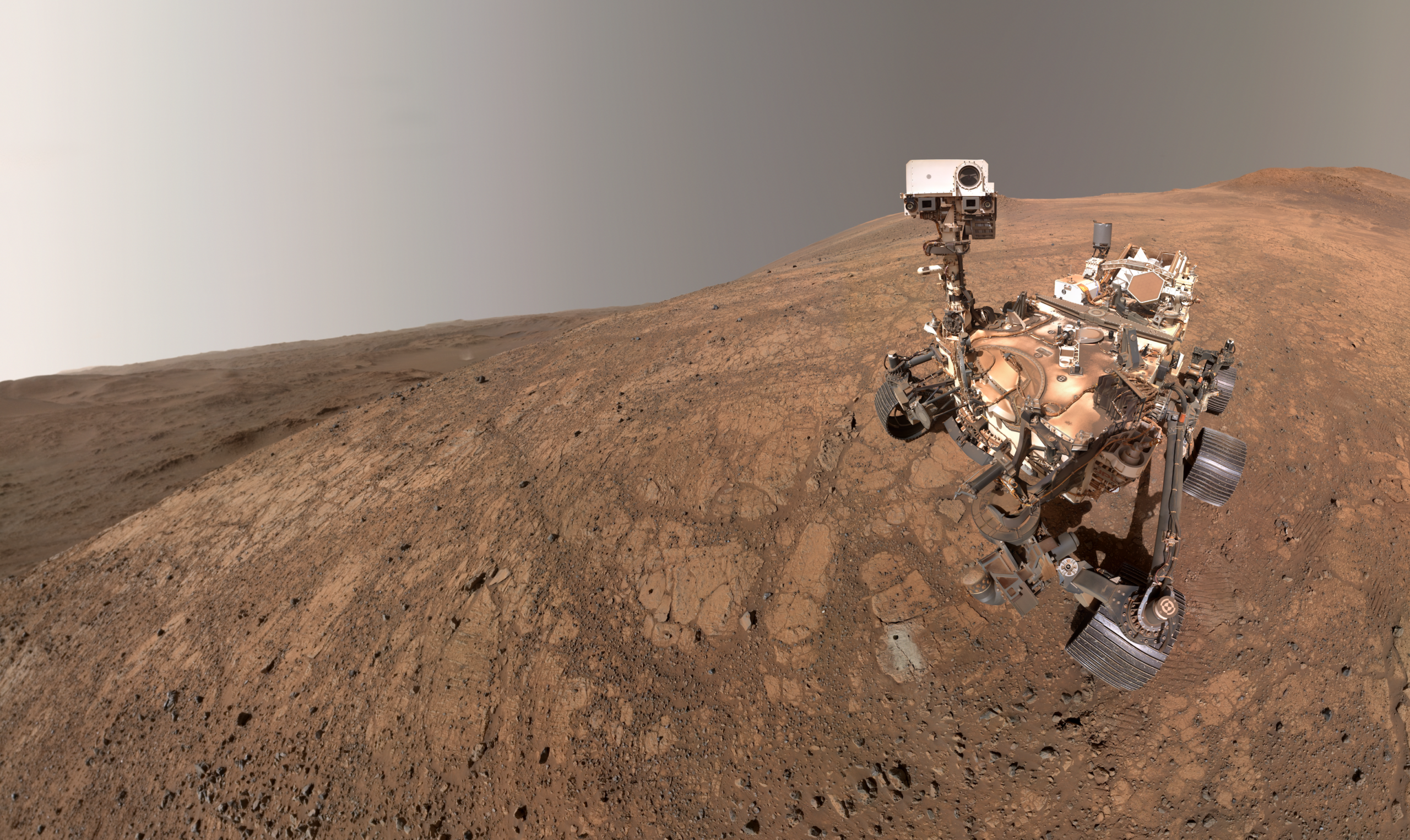
NASA’s Curiosity rover accidentally crushed a rock while driving through Gediz Vallis on Mars on May 30, 2024, exposing yellow crystals later identified as elemental sulfur—the first pure sulfur found on the planet. According to NASA’s mission account, Curiosity photographed the material with its Mast Camera on June 7 and used the Alpha Particle X-ray Spectrometer on its robotic arm to determine its composition. The find demonstrates a basic advantage of surface robotics: mobility can expose previously hidden material, while contact instruments can establish chemistry that imagery alone cannot confirm.
The discovery occurred on the lower slopes of Mount Sharp, the layered mountain inside Gale Crater that Curiosity has explored since landing in 2012. It was not the product of a planned drilling campaign. One of the rover’s wheels rolled over the rock and cracked it, revealing a fresh interior that would otherwise have remained concealed.
That accident matters because planetary fieldwork depends partly on access. Orbiters can survey enormous areas, map terrain and identify broad spectral signatures, but their observations do not guarantee that every small or buried mineral deposit will be recognized. A rover operates at a radically smaller geographic scale, yet it can approach individual rocks, expose new surfaces and place instruments close enough to test their elemental composition.
Elemental sulfur is not another Martian sulfate
Curiosity was already traveling through terrain rich in sulfates, salts that contain sulfur chemically bound with other elements. Such minerals can be left behind when water evaporates, making them useful records of ancient environmental change.
Elemental sulfur is chemically different. It consists of sulfur atoms rather than sulfur bound to oxygen in a sulfate mineral. NASA describes the material as odorless; the familiar rotten-egg smell associated with sulfur comes from hydrogen sulfide gas, not elemental sulfur itself.
This distinction turns the crushed rock from a colorful curiosity into a geological problem. Scientists had found multiple forms of sulfur-bearing material on Mars, but pure elemental sulfur had not previously been confirmed there. NASA also said the conditions needed to produce it had not been associated with this location.
The rover encountered numerous bright rocks resembling the crushed specimen, so the find does not appear limited to one anomalous fragment. That visual resemblance supports further investigation, but it does not by itself prove that every nearby stone has the same composition or establish the deposit’s full extent. Each inference still depends on additional imaging and chemical measurements.
The formation mechanism remains open
NASA has not established how the sulfur formed. On Earth, elemental sulfur can be produced through several geological pathways, including volcanic and hydrothermal processes. Groundwater interactions, chemical reactions and long-term temperature changes are also among the possibilities raised for the Martian material. None is a confirmed explanation for the Gediz Vallis rocks, and the relationship between the elemental sulfur and surrounding sulfate-rich terrain remains unclear.
That uncertainty is important. The presence of elemental sulfur does not establish biological activity, nor does it independently prove that this particular site once hosted hot springs or volcanic conditions. The responsible process must be reconstructed from the sulfur’s physical setting, neighboring minerals and the sequence of geological events recorded in the channel.
Gediz Vallis itself preserves a complicated history. Curiosity’s observations indicate that water-related flows, wet debris movement and dry avalanches all contributed to features in the channel. The mission team is using those observations to build a timeline for a period when the Martian environment was changing and surface water was disappearing.
A mobility event became an instrument result
The sequence illustrates how a rover’s subsystems work together scientifically. The mobility system created the exposure, Mastcam documented its color and texture, and the arm-mounted spectrometer supplied the compositional identification. No single step would have delivered the complete result: a yellow patch in an image is suggestive, while a chemical measurement without geological context is harder to interpret.
Curiosity’s accidental sulfur exposure is therefore less a story about luck alone than about platform capability. A mobile laboratory can exploit an unplanned contact, reposition its sensors and convert an unexpected broken rock into a defensible measurement. The origin of the sulfur remains unresolved, but the rover has given researchers a new constraint that models of Gale Crater’s chemical history now have to accommodate.
By David Whitaker — Associate editor for AMI’s aerospace and drone systems desk, translating flight systems, aircraft programs, spaceflight, and UAV developments into accessible technical stories.