Chandra Finds Neighboring Jet May Suppress Ancient Galaxy’s Star Formation
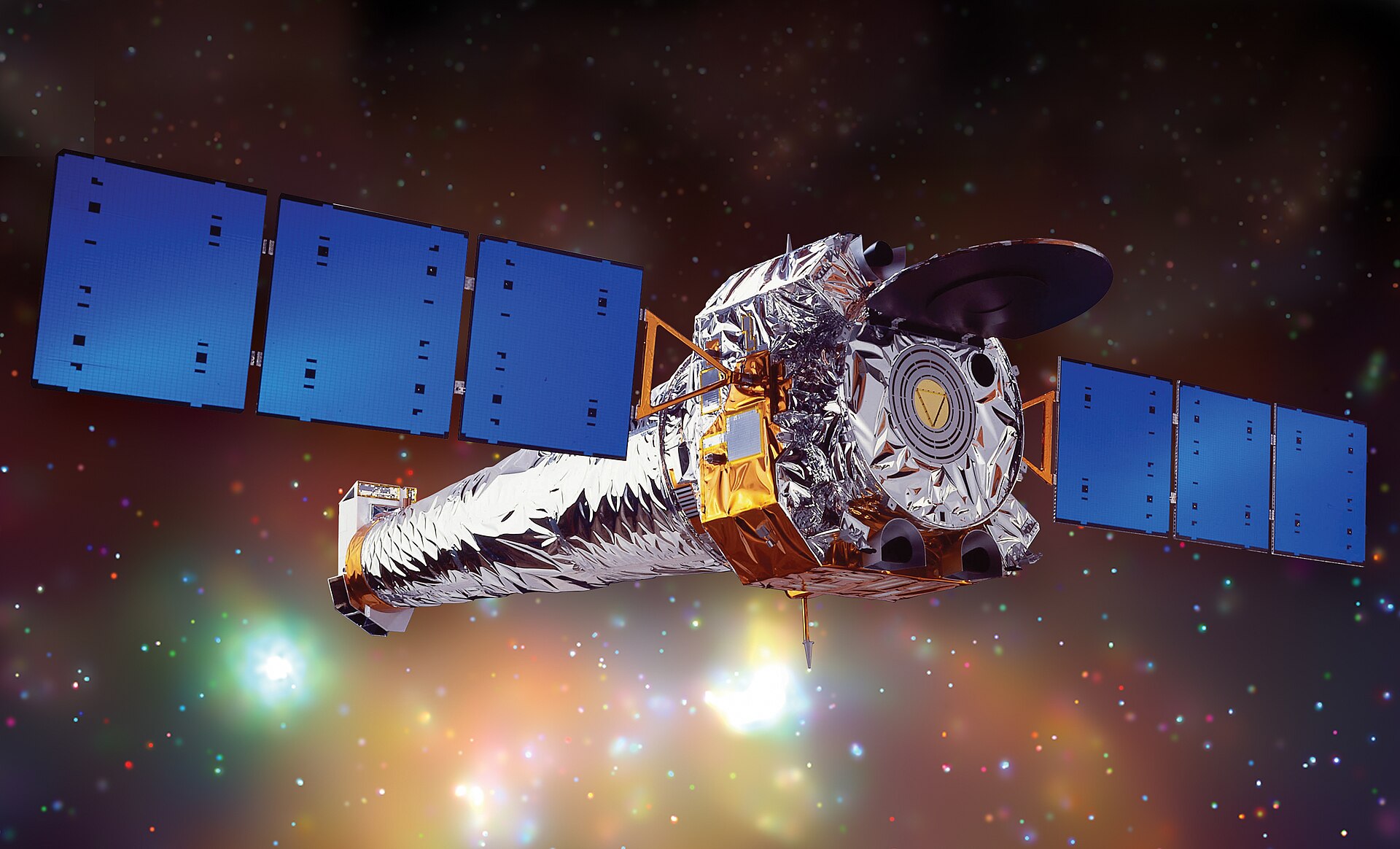
Astronomers using NASA’s Chandra X-ray Observatory have found evidence that a jet from a neighboring supermassive black hole may be disrupting the gas supply of MQN01 J004131.9-493704, an early-universe galaxy nicknamed the “red potato.” Announced in a Chandra release on July 21, 2026, the result connects the jet’s direction with unusually turbulent gas surrounding a galaxy that is forming fewer stars than expected. That alignment supports a jet-driven explanation, but it does not yet prove that the jet caused the turbulence or reduced star formation.

MQN01 J004131.9-493704 is about 11.7 billion light-years from Earth, so astronomers observe it as it appeared when the universe was roughly 2 billion years old. It sits at an intersection of the cosmic web, where large structures of galaxies and gas meet. Images from the James Webb Space Telescope revealed the galaxy’s blob-like appearance and led to its informal nickname.
The important feature is not its shape but its environment. Data from the European Southern Observatory’s Very Large Telescope show that the galaxy is surrounded by an enormous cloud of relatively cold, dense gas. Under more familiar conditions, some of that material would be expected to fall toward the galaxy, cool further and collapse into regions where new stars can form. Instead, the galaxy contains mostly older, cooler stars and has a comparatively low star-formation rate.
Why turbulent gas changes the calculation
Gas temperature alone does not determine whether a galaxy can build stars. The material also has to lose enough energy and settle into dense structures. Strong turbulence works against that process by keeping gas in irregular motion and supplying pressure that can resist collapse.
The team, led by Weichen Wang of the University of Milan-Bicocca, found that the cloud around the red potato is more turbulent than large gas clouds surrounding comparable galaxies. Chandra then identified X-ray evidence for a particle jet from a growing supermassive black hole in another galaxy about 200,000 light-years away. The jet points toward the red potato’s gas cloud and may be striking it.
If that interpretation is correct, the jet is not simply heating its host galaxy. It is transferring energy across intergalactic distance into another galaxy’s surrounding material. The resulting agitation could slow the rate at which the red potato acquires fresh gas, leaving it with the raw ingredients for stars nearby but without an efficient way to bring those ingredients together.
That distinction matters. The proposed mechanism is closer to interrupting a supply chain than removing the inventory. Cold gas remains present, but turbulence may prevent enough of it from settling and collapsing. In galaxy-evolution terms, this would be an example of black-hole feedback operating beyond the galaxy that contains the black hole.
Chandra supplies one part of a multiwavelength case
No single observatory provides the full diagnosis. Webb supplies infrared information about the galaxies and their stellar populations. Hubble data supported measurements showing the red potato’s red color and low star-formation rate. Radio observations from the Atacama Large Millimeter/submillimeter Array trace relatively cool gas, while Chandra’s X-ray measurements identify the growing black hole and its jet.
This division of labor is essential in the distant universe. Researchers must separate stellar light, cool gas and energetic black-hole activity before testing whether those components are physically interacting. Chandra’s contribution is therefore not the original discovery of the red potato, but the identification of a plausible external energy source for its disturbed environment.
The causal link remains conditional
Three observations make the neighboring jet a credible explanation: the red potato forms fewer stars than its gas-rich surroundings would suggest, its surrounding cloud is unusually turbulent, and the nearby jet is directed toward that cloud. The researchers also considered activity from a black hole inside the red potato and energy from a burst of star formation, but judged those alternatives less likely.
Even so, geometry and correlation do not by themselves establish energy transfer. The available material does not provide a quantitative turbulence measurement, the jet’s power or a direct measurement showing how much the galaxy’s gas-acquisition rate has changed. Those missing constraints are important because they would help determine whether the jet carries enough energy to produce the inferred effect over the relevant distance.
The result is consequently best read as a strong candidate mechanism rather than a completed causal chain. Its broader value lies in showing where Chandra’s X-ray capability fits into early-galaxy research: it can expose energetic black-hole activity that infrared and radio observations alone cannot fully characterize. If subsequent measurements confirm that the neighboring jet is driving the turbulence, the red potato would provide a rare example of one galaxy’s black hole regulating star formation in another. For now, Chandra has narrowed the engineering-style diagnosis from an unexplained shortage of stars to a specific, testable energy source.
By David Whitaker — Associate editor for AMI’s aerospace and drone systems desk, translating flight systems, aircraft programs, spaceflight, and UAV developments into accessible technical stories.