Gande Constellation Launch Starts Network With 14-Satellite Monitoring Phase
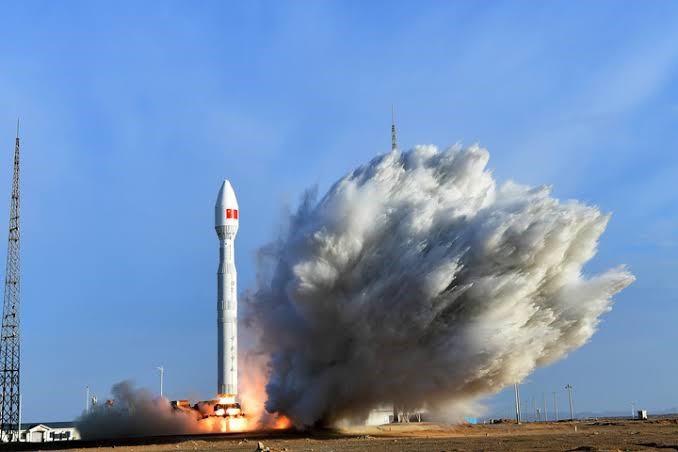
China began deploying the commercial Gande Constellation on July 26, 2026, starting a three-phase orbital-monitoring network scheduled for completion before 2030. The first spacecraft launched aboard a Lijian-1 commercial rocket from northwest China, according to a Chinese government information-office account. The immediate engineering significance is limited but concrete: deployment has started, while the initial LX630 phase is planned to grow to 14 satellites that monitor and catalog objects in orbit.
Gande is being developed by Beijing-based private aerospace company ATmoto Technology. The complete architecture calls for 120 satellites deployed in three phases: 14 in LX630, another 36 in the second phase and 70 in the third. That scale matters because a distributed constellation can provide more observation opportunities than a single spacecraft, but the launch of one satellite does not yet establish constellation-level coverage or operational performance.
Fan Wei, identified as Gande’s chief engineer, said the first launch fills a gap in China’s commercial space-based debris-monitoring capability and represents a key step in space traffic management. That description reflects the program’s intended role, not a demonstrated service level. No tracking-accuracy results, catalog size, revisit-rate figures or independently evaluated performance data have been disclosed.
What the first spacecraft adds
The first satellite reportedly carries an artificial-intelligence-aided onboard computer. Its developers say that processor can support routine surveillance, emergency response and rapid tracking without frequent ground intervention. Moving some processing aboard the spacecraft can reduce dependence on continuous ground commands and potentially shorten the time between collecting observations and assigning follow-up work.
That is an architectural advantage rather than proof of useful tracking performance. A debris-monitoring system still depends on sensor capability, calibration, orbit determination, processing quality and the ability to correlate repeated observations of the same object. The available information does not identify the sensor type, detectable-object threshold, field of view, measurement precision or latency between observation and catalog update.
The spacecraft also has orbital-transfer capability, according to its developer. In broad terms, maneuverability can give an observation satellite more flexibility in how it conducts its mission. It also introduces familiar spacecraft constraints: propulsion reserves are finite, maneuvers consume mission life, and changing orbit affects where and when the satellite can make later observations. No propulsion specifications, maneuver budget or expected service life have been released.
A phased network with different technical roles
The first 14 LX630 satellites are intended to establish the initial monitoring and cataloging segment. Liangxi Aerospace Technology Group in Wuxi and ATmoto Technology jointly built these spacecraft. Available descriptions differ on whether the first phase’s stated coverage is confined to low Earth orbit or extends across low, medium and high orbital regimes, leaving its precise operational boundary unresolved.
The second phase is planned to add 36 satellites carrying high-resolution imaging and electromagnetic-environment sensors. The third would add 70 artificial-intelligence-enabled satellites intended for object recognition, behavioral analysis and autonomous decision-making. Those descriptions outline a progressively more capable network, but they remain planned functions until the later spacecraft are built, launched and tested.
The deployment schedule also deserves scrutiny. Completing 120 spacecraft before 2030 will require sustained satellite production, launch availability, ground-segment expansion and integration across three generations of payloads. A constellation is not simply the sum of its spacecraft: its practical value depends on coordinated tasking, reliable communications, consistent data processing and maintenance of a usable object catalog.
Collision benefits remain prospective
Better observations can support space-traffic management by improving knowledge of where active satellites and debris are located. That does not mean Gande has already improved collision avoidance. Turning measurements into useful warnings requires validated orbital data, timely conjunction screening and a service model that delivers information to operators who can act on it.
For U.S. satellite operators, the consequential unanswered issue is data access. The developers have not disclosed whether Gande observations or catalog products will be sold internationally, exchanged with other tracking organizations or retained within a domestic commercial service. Without that information, no specific benefit to U.S. spacecraft operators can be assumed.
Gande’s first launch therefore marks the start of new commercial observation capacity, not the arrival of a complete traffic-management solution. The program’s technical credibility will rest on what follows: documented sensor performance, repeatable catalog updates, clearly defined coverage and a deployment cadence capable of turning one spacecraft into the planned 14-satellite first phase and, eventually, a 120-satellite network.
By David Whitaker — Associate editor for AMI’s aerospace and drone systems desk, translating flight systems, aircraft programs, spaceflight, and UAV developments into accessible technical stories.