FCC Restricts Some New Foreign-Made Robots, Spares Previously Approved Vacuums
The U.S. Federal Communications Commission announced on July 28, 2026, that certain foreign-produced mobile robots would be added to its Covered List, restricting new equipment authorizations that are generally required before electronic products can be imported, marketed or sold in the United States. The FCC action could keep some future robot vacuums and other connected robots off the U.S. market without a conditional approval. Previously authorized models remain eligible for import and sale, and consumers may continue using robots they already purchased.

This is therefore not a confiscation order or a shutdown of robot vacuums already operating in American homes. The immediate consequence falls on manufacturers planning new models, major product revisions or U.S. launches involving qualifying foreign-produced hardware.
Why a robot vacuum can fall within the definition
The FCC’s definition is based on a combination of mobility, sensing, control, connectivity and weight rather than on a product label. An “advanced robotic device” must be a mechanical mobile device capable of locomotion, obstacle avoidance, navigation or ground movement. It must operate at a distance from a human supervisor, either through commands or responses to sensor data.
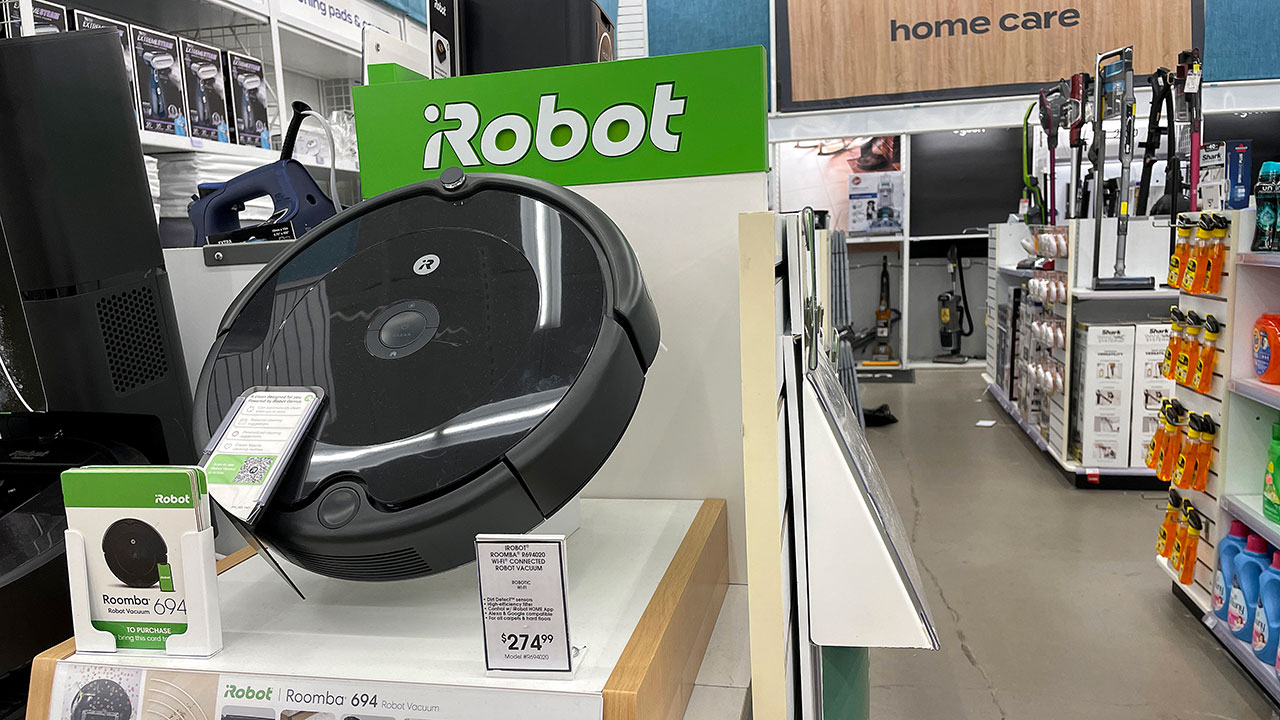
The device must also weigh more than 4.4 pounds when combined with its ground station or dock. That combined-weight provision matters for household cleaning robots because a relatively compact mobile unit may be paired with a substantial charging, debris-emptying or cleaning station.
Qualifying machines must contain an environmental sensor, network connectivity and software that controls functions such as autonomous navigation, movement perception, data collection or remote command and control. Connectivity can be wired or wireless, including Bluetooth, Wi-Fi, cellular or satellite links, and the FCC definition specifies a connection speed of at least 200 kilobits per second in either direction.
Those elements describe the architecture of many contemporary service robots: sensors build a representation of the surroundings, control software converts that information into motion commands, motors provide actuation, and a network connection supports applications, updates or remote functions. Robot lawnmowers and ground-based delivery robots could consequently meet the test as well. Coverage still depends on the complete definition and the device’s production status; it should not be assumed that every imported robot is prohibited.
The restriction applies to authorization, not ownership
Equipment on the Covered List cannot receive a new FCC equipment authorization. Because that authorization is normally a gate to importation, marketing and sale, the decision creates a certification barrier before a covered new model can reach U.S. buyers.
Existing authorizations remain important. The FCC says models that already received authorization may continue to be imported, marketed and sold, while consumers face no restriction on continued use. Basic software and firmware updates may also continue under a waiver intended to preserve usability. Hardware changes or more extensive revisions can raise a different authorization question, making product configuration control more consequential for manufacturers.
The FCC defines “foreign-produced” by whether an article qualifies as a domestic end product under the applicable federal standard. The nationality of the company is not itself decisive, and the action is described as country-neutral. For robotics companies, that distinction shifts attention from branding or headquarters to production content, assembly and supply-chain documentation.
Conditional approvals are the unresolved route to market
A covered robot can receive a conditional approval if the responsible national-security authority determines that the particular device or class does not present the stated risk. Any entity involved in producing the device may apply, and one application can cover multiple models or a class of products. The FCC’s robotics guidance and frequently asked questions explain the scope, exclusions and application channel.
No approval timetable or decision for a specific upcoming consumer robot has been announced. Until individual determinations are published, it would be premature to say that a named manufacturer’s next vacuum has been cleared or blocked. The practical uncertainty is whether conditional reviews can be completed on a schedule compatible with annual product development and retail launch cycles.
Several categories are expressly outside the robotics definition, including connected vehicles, rail-only vehicles, uncrewed aircraft, unmanned underwater vehicles, specified medical devices and fixed industrial or medical robots. Small batches of unauthorized products may also be imported solely for development or testing under existing FCC conditions, provided they are not marketed or sold.
From a systems perspective, the notable change is that radio authorization now reaches beyond a robot’s communications module and into its overall production origin and autonomous architecture. For U.S. robotics programs, market access will increasingly depend on treating sensing, software, connectivity, docking hardware and manufacturing provenance as one certifiable system. Existing owners are insulated, but future product availability will turn on documentation, domestic-production status and the still-developing conditional-approval process.
By Jonathan Barrett — Editor for AMI’s future mobility and autonomous systems section, with two decades covering robotics, e-mobility, drone-vehicle convergence, and transport mechanical systems.