Stoke Space Adds Five Metal Printers After Reporting Above 90% Utilization
Stoke Space became the first beta user of Additive Industries’ MetalFab 420K in May 2025 and subsequently ordered five additional production systems, according to a VoxelMatters account first published in its Aerospace AM Focus 2026 eBook. The expansion at Stoke’s 168,000-square-foot facility in Kent, Washington, follows reported equipment utilization well above 90%. That figure is not independently verified, but Stoke attributes it to automated operation, reduced changeover demands and the ability to continue builds overnight and through weekends without dedicated off-shift crews.
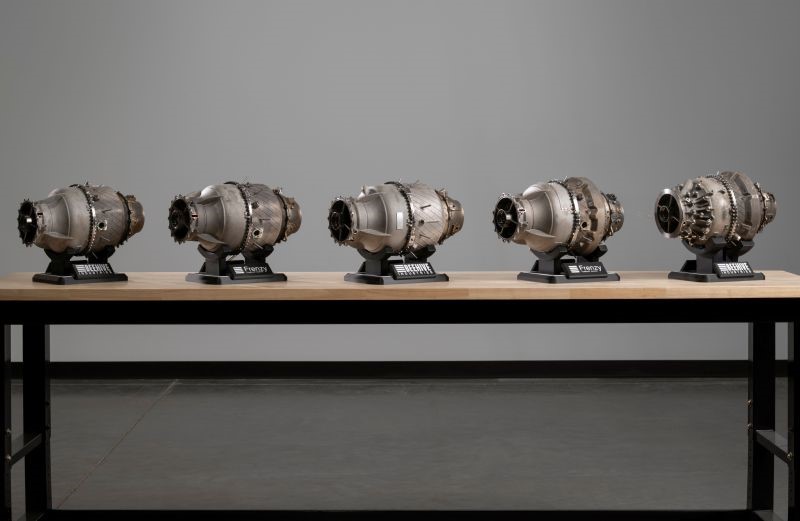
The order confirms a substantial increase in metal powder-bed-fusion capacity for Nova, Stoke’s fully reusable, two-stage launch-vehicle program. It does not establish that any printed component is qualified for flight, nor does it demonstrate Nova’s performance or readiness. Neither company has identified the specific components being produced, released defect-rate data or detailed the applicable inspection and qualification regime.
Four lasers increase throughput and process-control demands
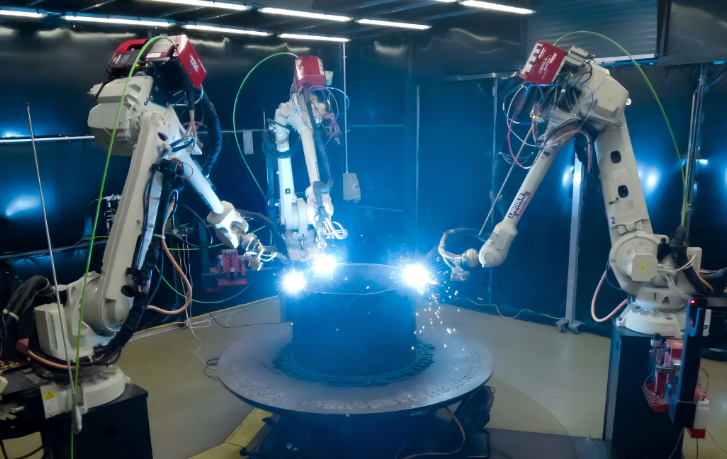
The MetalFab 420K uses four full-field, 1-kilowatt lasers. Additive Industries says their calibrated beam diameter can be adjusted from 100 to 500 micrometers, giving process engineers another variable for balancing energy density, scan speed, feature resolution and build rate. Stoke has used the supplier’s modular MetalFab G2 systems for years, but the 420K adds higher laser power, automated calibration and expanded process-control functions.
Multiple lasers can divide work across the powder bed and increase productive scan time, but parallel melting is not simply a matter of multiplying output. Adjacent scan regions can experience different thermal histories, particularly where laser fields meet. Research on multi-beam processing has associated scan order and path overlap with residual stress, surface condition and the risk of defects at junction regions. A study of dual- and four-laser scanning strategies, conducted on different equipment and aluminum alloy specimens, found that scanning strategy materially affected thermal behavior, stress and surface quality. It should not be read as a test of Stoke’s system, but it illustrates why laser alignment and tightly controlled process parameters matter.
Additive Industries says the 420K can perform laser-to-laser alignment during a build. The supplier presents that capability as a means of maintaining part quality across the machine’s four optical paths. Its gas-flow system has also been revised: claimed capacity increased by more than 2.5 times while velocity variation remains below 10% across the powder bed.
That gas management is mechanically important at higher laser powers and scan speeds. The circulating atmosphere must remove process byproducts while preserving stable conditions over the build area. The machine also incorporates a redesigned filter and controls for oxygen and humidity. These are supplier performance claims; no comparative build results or independent validation data were disclosed.
Automation extends beyond the build chamber
Stoke’s reported utilization depends on more than laser exposure time. Additive Industries integrates powder management with the production system, including a Powder Load Tool that transports feedstock under inert conditions and loads it automatically. The architecture is intended to reduce operator contact with metal particles while limiting the powder’s exposure to oxygen and moisture.
For a U.S. launch manufacturer, this addresses three practical production constraints at once: labor demand, powder condition and machine idle time. Automated handling can reduce manual interventions between jobs, while unattended operation allows a long build to consume nights and weekends that would otherwise require additional staffing. Stoke additive-manufacturing engineer Parker Reynolds said the equipment requires substantially fewer operational labor hours and allows the department to obtain more output with fewer people.
However, high machine utilization is not equivalent to high accepted-part yield. A printer can operate continuously while production hardware still requires post-processing, dimensional inspection, material-property verification and qualification against its intended service environment. Those downstream steps and their capacity are not described in the disclosed figures.
The order establishes scale, not flight status
The companies say additive manufacturing supports multiple critical structures, rapid design iteration and work with alloys intended for high-temperature service. Without component identities, build parameters, inspection results or qualification records, the responsible conclusion is narrower: Stoke is scaling an automated, four-laser manufacturing architecture that it says has already delivered unusually high equipment use.
The five-machine order matters because it moves the MetalFab 420K relationship beyond a single beta installation and toward a larger production fleet. Its engineering value will ultimately depend not only on laser power and uptime, but on repeatable material properties, controlled powder history, stable multi-laser overlap and an inspection chain capable of converting machine hours into accepted hardware. For now, the expansion confirms manufacturing commitment and capacity not Nova flight readiness.
By Edward Collins — Senior editor for AMI’s performance systems and mechanical design coverage, focused on powertrains, drivetrain systems, manufacturing precision, materials, and high-performance engineering.