Destinus Builds Nearly 300 Ruta Missiles Monthly, but Logistics May Lag
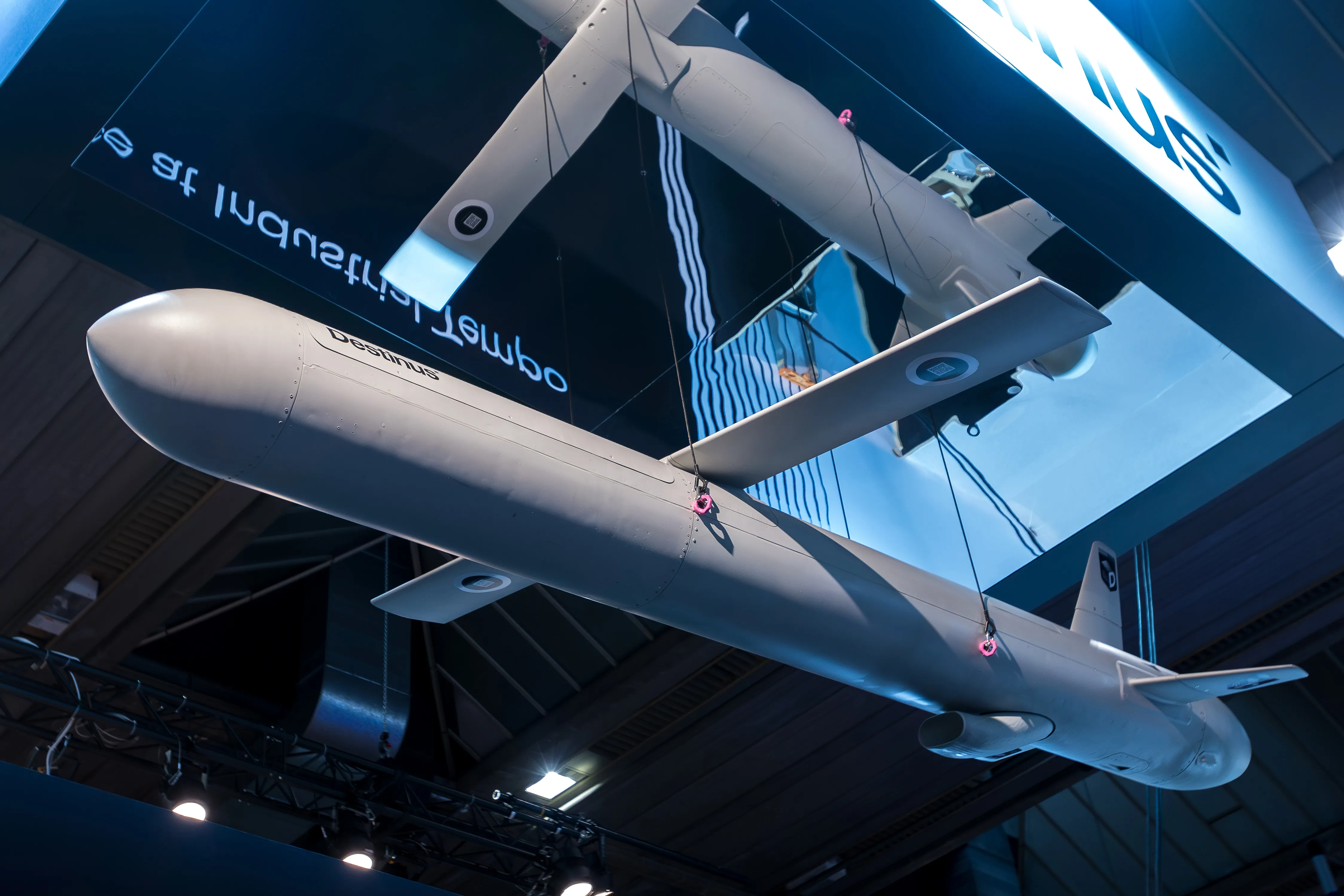
Nearly 300 Ruta cruise missiles a month is the production rate Dutch-headquartered startup Destinus says it has reached in Europe. The company has built more than 1,750 so far and says its current monthly output exceeds the number of cruise missiles all European manufacturers produced in an entire year before Russia’s full-scale invasion of Ukraine.

For supporters of Ukraine, that comparison indicates that European production is beginning to catch up with demand. Destinus Chief Executive Mikhail Kokorich, however, argues that the next constraint may sit beyond the factory: European armed forces still need enough trained units and supporting logistics to receive, store, transport and maintain inventories growing at this rate.
Propulsion moves from bottleneck to series production
Destinus’ scale-up rests partly on bringing a critical propulsion system into repeat production. The company already manufactures turbojet engines producing roughly 1.5 kilonewtons of thrust for its own missiles and other manufacturers. Kokorich expects Destinus to be capable of meeting European demand, including Ukrainian demand, for engines in that thrust class from next year.
That is consequential because access to propulsion has constrained the expansion of jet-powered weapon production in Ukraine. An airframe can draw on established fabrication methods, but a compact turbojet requires tightly controlled rotating components, combustion hardware, fuel delivery and high-temperature assemblies. Producing one functional engine is different from holding dimensions, balance and performance within acceptable limits across hundreds of units.
Series production therefore changes more than the output of one missile model. If Destinus can supply engines to outside manufacturers at the stated volume, propulsion becomes less of a single-program restriction and more of a shared industrial input. The company also says it uses no Chinese components, removing access to suppliers that Kokorich acknowledged could make production “cheaper, faster, easier.” That sourcing choice places greater pressure on European supply consistency and manufacturing cost.
A container designed around inventory handling
Destinus has also started producing the larger Ruta Block 2. The company says it is designed to carry a 250-kilogram payload for more than 700 kilometers. Unlike Block 1, the new version is intended to remain in the same container during storage, transport and launch.
For a growing inventory, that container arrangement is a significant mechanical and logistical design decision. Keeping a missile within one enclosure can reduce handling steps and the need to transfer it between separate storage, transport and launch equipment. It also puts greater responsibility on the container to support environmental protection, secure retention and long-duration storage while remaining compatible with deployment equipment.
The design addresses one part of the logistics burden, but it cannot provide the personnel, depots, vehicles and maintenance organization required to manage large fleets. Kokorich said Europe would need military units alongside expanded storage, transport, maintenance and targeting infrastructure. His stated ambition “tens of thousands of missiles” would make inventory management a system-level undertaking rather than an extension of existing stockrooms.
More factory output exposes the next constraint
The wider European defense sector still faces delivery and conversion problems. An October 2026 Allianz Trade assessment found that industrial investment and delivery have not kept pace with financial commitments. It also estimated that missile import prices were 116% above their 2019-2021 average, meaning larger budgets do not translate directly into proportional increases in inventory.
Destinus presents a narrower but striking counterpoint: one startup now claims a monthly Ruta rate greater than Europe’s entire pre-invasion annual cruise-missile output. Ruta was publicly acknowledged as having been used in combat in October 2025, but the production figure alone does not establish how many systems customers can absorb or keep operational.
Kokorich expects lower-cost missiles with ranges below 1,000 kilometers to represent most future demand, while longer-range systems remain a smaller segment. If that forecast is correct, industrial planning will increasingly favor repeatable engine manufacture, controlled assembly and designs suited to storage in volume. The limiting hardware may no longer be the missile leaving the factory; it may be the depot space, maintenance capacity and trained organization waiting to receive it.
| More aerospace and engineering stories, right in your MSN feed. Follow AMI on MSN |
By Edward Collins — Senior editor for AMI’s performance systems and mechanical design coverage, focused on powertrains, drivetrain systems, manufacturing precision, materials, and high-performance engineering.