


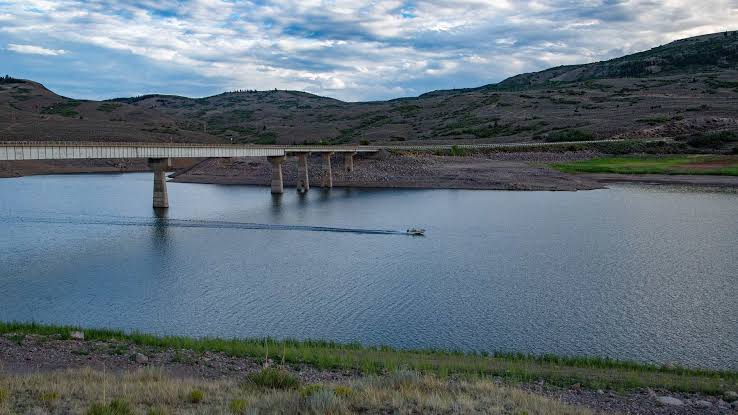
Blue Mesa at 17% Capacity, 19 Feet Above Power Generation Cutoff
Nineteen vertical feet now separate Blue Mesa Reservoir from the point where its hydroelectric plant can no longer generate electricity. On October 22, the Colorado reservoir stood at 7,412.06 feet above sea level 17% of capacity and 19.06 feet above the plant’s minimum power pool.
That margin is narrow, but a shutdown is not forecast as the most likely outcome. Bart Deming of the Bureau of Reclamation estimated a 90% probability that generation will continue, while acknowledging that a worst-case scenario could produce a brief halt by April. The agency projects 600,000 acre-feet of inflow during the next April-through-July period, equal to 94% of average.
Why 19 feet determines whether the turbines can run
The Blue Mesa Powerplant has two 43.2-megawatt generators, providing a combined rated capacity of 86.4 megawatts. It is a peaking plant, meaning operators can increase generation when electricity demand rises rather than running continuously at full output.
Reservoir elevation affects hydropower in two connected ways. Water must remain high enough to reach the turbine intake, and the elevation difference across the dam provides the hydraulic head that drives water through the machinery. At Blue Mesa, water used for generation enters a 16-foot-diameter steel penstock that divides to feed the two turbines.
The minimum power pool is 7,393 feet above sea level. Once the reservoir reaches that elevation, water can no longer reach the turbines under the plant’s operating arrangement. The generators then lose their energy source even though the reservoir still contains water.
This creates the system’s central tension: electricity production would stop before downstream releases do. Blue Mesa Dam has separate outlet works that can continue passing water after the turbines become unavailable. Those releases produce no electricity, but they allow operators to meet downstream requirements.
Another threshold lies 35 feet lower. Dead storage begins at an elevation of 7,358 feet, where remaining water is below the dam’s lowest outlet. Minimum power pool therefore marks the loss of one function generation rather than the end of all controlled releases.
Record-low inflow constrains the operating choices
The reservoir’s decline followed an April-through-July inflow of 151,000 acre-feet, reported as the lowest snowmelt-season total on record. Blue Mesa reached its highest elevation of the year on January 19, when it was 51% full at 7,468.60 feet. By October, most of that stored-water margin had disappeared.
Managers cannot conserve the remaining supply simply by closing the outlets. Federal requirements call for releases benefiting endangered fish, including the razorback sucker and humpback chub. Water also moves through the Gunnison Tunnel to approximately 80,000 acres in the Uncompahgre Valley under a senior water right that predates Blue Mesa Dam.
Reclamation, the U.S. Fish and Wildlife Service and Colorado have reduced the lower Gunnison River flow target at the Whitewater gauge to 500 cubic feet per second, down from roughly 1,050 cubic feet per second typical of June and July. That reduction is reported to retain about 500 acre-feet per day in Blue Mesa. It slows depletion but does not remove the underlying obligations.
The reservoir itself is large when full, holding 940,700 acre-feet and covering 9,180 acres. Its dam is a 390-foot-tall zoned earthfill embankment built from 3.08 million cubic yards of material. Yet those overall dimensions do not determine current power availability as directly as the shrinking elevation margin above the turbine intake.
Effects have already reached recreation
Low water has restricted the Elk Creek, Lake Fork and Iola boat ramps to craft that can be carried by hand since August 24. The operator of Elk Creek Marina said its season effectively ended July 5 and that her family lost about half its income. Warning signs have also been posted for toxic blue-green algae.
For the power system, the next decisive variables are winter accumulation, the timing of runoff and the releases required before spring inflow arrives. Blue Mesa can lose hydropower while still sending obligated water downstream a design boundary that turns the remaining 19 feet into an energy margin, not merely another reservoir-level statistic.
| More aerospace and engineering stories, right in your MSN feed. Follow AMI on MSN |
By Thomas Caldwell — AMI’s senior editor for mechanical and mobility engineering, covering vehicle electronics, systems integration, electrification, chassis systems, propulsion, and safety policy.



